FCPS MCPS IMM MD Paediatrics TOACS
Observed Station | CPSP Format | 8 minutes
⏱️ TIME REMAINING
08:00
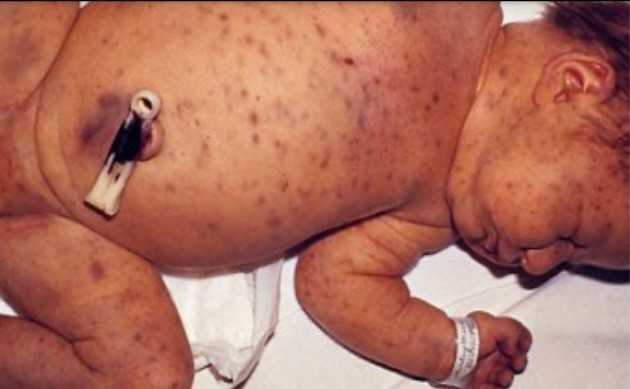
A newborn is evaluated for petechiae, jaundice, and hepatosplenomegaly.
❓ Q1. Identify the condition shown in the image. Describe the characteristic clinical features.
✅ Model Answer: • Condition: Congenital rubella syndrome (CRS).blueberry muffin' rash (extramedullary hematopoiesis)
• Clinical features: blueberry muffin' rash (extramedullary hematopoiesis), Classic triad – sensorineural hearing loss, congenital heart disease (PDA, pulmonary artery stenosis), and cataracts. Other features: ', microcephaly, hepatosplenomegaly, thrombocytopenia, jaundice, glaucoma, retinopathy, radiolucent bone lesions.
• Clinical features: blueberry muffin' rash (extramedullary hematopoiesis), Classic triad – sensorineural hearing loss, congenital heart disease (PDA, pulmonary artery stenosis), and cataracts. Other features: ', microcephaly, hepatosplenomegaly, thrombocytopenia, jaundice, glaucoma, retinopathy, radiolucent bone lesions.
❓ Q2. What is the etiologic agent of congenital rubella syndrome?
✅ Model Answer: • Etiologic agent: Rubella virus – an RNA virus from the family Togaviridae (genus Rubivirus).
• It is transmitted transplacentally from an infected mother to the fetus, particularly during the first trimester.
• The virus causes chronic infection in the fetus, leading to tissue damage and congenital anomalies.
• It is transmitted transplacentally from an infected mother to the fetus, particularly during the first trimester.
• The virus causes chronic infection in the fetus, leading to tissue damage and congenital anomalies.
❓ Q3. What is the risk of congenital rubella syndrome based on the timing of maternal infection?
✅ Model Answer: • Risk of CRS:
- 0-12 weeks (first trimester): ~90% risk of CRS (highest risk).
- 13-16 weeks: ~20-50% risk (hearing loss most common).
- 16-20 weeks: ~10-20% risk (mainly hearing loss).
- After 20 weeks: Very low risk of congenital anomalies.
• Fetal infection: Can occur at any gestation, but anomalies are most severe in early pregnancy.
- 0-12 weeks (first trimester): ~90% risk of CRS (highest risk).
- 13-16 weeks: ~20-50% risk (hearing loss most common).
- 16-20 weeks: ~10-20% risk (mainly hearing loss).
- After 20 weeks: Very low risk of congenital anomalies.
• Fetal infection: Can occur at any gestation, but anomalies are most severe in early pregnancy.
❓ Q4. What is the classic triad of congenital rubella syndrome?
✅ Model Answer: • Classic triad (CRS):
1. Sensorineural hearing loss – most common single manifestation.
2. Congenital heart disease – PDA (most common), pulmonary artery stenosis, VSD.
3. Cataracts – bilateral or unilateral, often present at birth.
• Note: Other features include microcephaly, glaucoma, retinopathy, hepatosplenomegaly, thrombocytopenia, 'blueberry muffin' rash, and radiolucent bone lesions.
1. Sensorineural hearing loss – most common single manifestation.
2. Congenital heart disease – PDA (most common), pulmonary artery stenosis, VSD.
3. Cataracts – bilateral or unilateral, often present at birth.
• Note: Other features include microcephaly, glaucoma, retinopathy, hepatosplenomegaly, thrombocytopenia, 'blueberry muffin' rash, and radiolucent bone lesions.
❓ Q5. What is the 'blueberry muffin' rash in CRS? What is its pathophysiology?
✅ Model Answer: • 'Blueberry muffin' rash: Bluish-red or purpuric papules/nodules scattered over the skin.
• Pathophysiology: Due to extramedullary hematopoiesis in the dermis – the fetus is unable to compensate for the destruction of red blood cells and attempts to produce blood cells in the skin.
• Also seen in other congenital infections (CMV, toxoplasmosis) and hematologic disorders.
• It is a key feature of CRS and often accompanies hepatosplenomegaly.
• Pathophysiology: Due to extramedullary hematopoiesis in the dermis – the fetus is unable to compensate for the destruction of red blood cells and attempts to produce blood cells in the skin.
• Also seen in other congenital infections (CMV, toxoplasmosis) and hematologic disorders.
• It is a key feature of CRS and often accompanies hepatosplenomegaly.
❓ Q6. What are the late manifestations of congenital rubella syndrome?
✅ Model Answer: • Late manifestations (appear in adolescence/adulthood):
- Diabetes mellitus (type 1) – develops in ~20-40% of CRS patients.
- Thyroid disorders – hypothyroidism or thyroiditis.
- Growth hormone deficiency – leading to short stature.
- Progressive rubella panencephalitis (PRP) – a rare, progressive neurological deterioration with ataxia, seizures, and cognitive decline.
- Ocular – glaucoma, retinopathy, cataracts.
- Diabetes mellitus (type 1) – develops in ~20-40% of CRS patients.
- Thyroid disorders – hypothyroidism or thyroiditis.
- Growth hormone deficiency – leading to short stature.
- Progressive rubella panencephalitis (PRP) – a rare, progressive neurological deterioration with ataxia, seizures, and cognitive decline.
- Ocular – glaucoma, retinopathy, cataracts.
❓ Q7. How is congenital rubella syndrome diagnosed?
✅ Model Answer: • Diagnosis:
- Serology: Rubella-specific IgM in the newborn (indicative of congenital infection; maternal IgM does not cross the placenta).
- PCR: Detection of rubella RNA in nasopharynx, urine, CSF, or blood (can be positive for up to 1 year).
- Viral culture: From nasopharynx, urine, or CSF.
- Maternal history: History of rubella infection or exposure during pregnancy.
- Radiologic: Radiolucent bone lesions on X-ray (seen in CRS).
- Serology: Rubella-specific IgM in the newborn (indicative of congenital infection; maternal IgM does not cross the placenta).
- PCR: Detection of rubella RNA in nasopharynx, urine, CSF, or blood (can be positive for up to 1 year).
- Viral culture: From nasopharynx, urine, or CSF.
- Maternal history: History of rubella infection or exposure during pregnancy.
- Radiologic: Radiolucent bone lesions on X-ray (seen in CRS).
❓ Q8. What is the management of a newborn with congenital rubella syndrome?
✅ Model Answer: • Supportive care: No specific antiviral treatment is available.
- Hearing: Audiologic evaluation and hearing aids.
- Vision: Ophthalmology evaluation for cataracts, glaucoma, retinopathy; early surgery for cataracts.
- Cardiac: Cardiologic evaluation, possible surgical repair of PDA or other defects.
- Hematologic: Monitor for thrombocytopenia; transfusions or IVIG if needed.
- Infection control: Contact precautions (infants can shed virus for up to 1 year).
- Multidisciplinary follow-up: Long-term monitoring for hearing, vision, cognitive development, and endocrine complications.
- Hearing: Audiologic evaluation and hearing aids.
- Vision: Ophthalmology evaluation for cataracts, glaucoma, retinopathy; early surgery for cataracts.
- Cardiac: Cardiologic evaluation, possible surgical repair of PDA or other defects.
- Hematologic: Monitor for thrombocytopenia; transfusions or IVIG if needed.
- Infection control: Contact precautions (infants can shed virus for up to 1 year).
- Multidisciplinary follow-up: Long-term monitoring for hearing, vision, cognitive development, and endocrine complications.
❓ Q9. How is congenital rubella syndrome prevented?
✅ Model Answer: • Prevention:
- MMR vaccine: Two doses of rubella-containing vaccine (MMR) – first dose at 12-15 months, second at 4-6 years.
- Preconception screening: Screen all women of childbearing age for rubella immunity (IgG). Vaccinate non-immune women at least 1 month before pregnancy.
- Avoid pregnancy for 1 month after MMR vaccination (live-attenuated vaccine).
- Pregnant women: Rubella serology in early pregnancy; avoid contact with infected individuals.
- Post-exposure: Immunoglobulin (Ig) is NOT effective for preventing rubella after exposure; MMR vaccine within 72 hours of exposure may offer protection in non-pregnant individuals.
- MMR vaccine: Two doses of rubella-containing vaccine (MMR) – first dose at 12-15 months, second at 4-6 years.
- Preconception screening: Screen all women of childbearing age for rubella immunity (IgG). Vaccinate non-immune women at least 1 month before pregnancy.
- Avoid pregnancy for 1 month after MMR vaccination (live-attenuated vaccine).
- Pregnant women: Rubella serology in early pregnancy; avoid contact with infected individuals.
- Post-exposure: Immunoglobulin (Ig) is NOT effective for preventing rubella after exposure; MMR vaccine within 72 hours of exposure may offer protection in non-pregnant individuals.
❓ Q10. What are the contraindications to MMR vaccination?
✅ Model Answer: • Contraindications to MMR:
- Pregnancy (avoid pregnancy for 1 month after vaccination).
- Severe allergic reaction to a previous dose or vaccine component (neomycin, gelatin).
- Severe immunosuppression (HIV with CD4 <200, chemotherapy, radiation, long-term corticosteroids).
- Recent administration of blood products (wait 3-11 months depending on product).
- Moderate to severe illness (defer until recovery).
- Pregnancy (avoid pregnancy for 1 month after vaccination).
- Severe allergic reaction to a previous dose or vaccine component (neomycin, gelatin).
- Severe immunosuppression (HIV with CD4 <200, chemotherapy, radiation, long-term corticosteroids).
- Recent administration of blood products (wait 3-11 months depending on product).
- Moderate to severe illness (defer until recovery).
❓ Q11. What is the differential diagnosis of congenital rubella syndrome?
✅ Model Answer: • TORCH infections:
- Congenital CMV: Hearing loss, microcephaly, petechiae, hepatosplenomegaly, but cataracts are rare.
- Congenital toxoplasmosis: Chorioretinitis, hydrocephalus, intracranial calcifications, cataracts less common.
- Congenital syphilis: Hepatosplenomegaly, rash, osteochondritis, but hearing loss and cataracts less common.
- Congenital HIV: Hepatosplenomegaly, growth failure.
• Other: Down syndrome (hearing loss, heart disease, but no blueberry muffin rash), hereditary cataracts.
- Congenital CMV: Hearing loss, microcephaly, petechiae, hepatosplenomegaly, but cataracts are rare.
- Congenital toxoplasmosis: Chorioretinitis, hydrocephalus, intracranial calcifications, cataracts less common.
- Congenital syphilis: Hepatosplenomegaly, rash, osteochondritis, but hearing loss and cataracts less common.
- Congenital HIV: Hepatosplenomegaly, growth failure.
• Other: Down syndrome (hearing loss, heart disease, but no blueberry muffin rash), hereditary cataracts.
❓ Q12. What is the significance of rubella IgG in a newborn?
✅ Model Answer: • Rubella IgG in a newborn:
- IgG crosses the placenta from the mother, so IgG in a newborn reflects maternal antibodies and does NOT indicate congenital infection.
- IgG is maternal – it is not diagnostic of CRS.
- Rubella IgM does NOT cross the placenta; detection of IgM in a newborn indicates congenital infection.
- A persistent IgG at 6-12 months (beyond the time maternal antibodies would have disappeared) suggests congenital infection.
- IgG crosses the placenta from the mother, so IgG in a newborn reflects maternal antibodies and does NOT indicate congenital infection.
- IgG is maternal – it is not diagnostic of CRS.
- Rubella IgM does NOT cross the placenta; detection of IgM in a newborn indicates congenital infection.
- A persistent IgG at 6-12 months (beyond the time maternal antibodies would have disappeared) suggests congenital infection.
❓ Q13. How would you counsel the parents of a child with congenital rubella syndrome?
✅ Model Answer: • "Your baby has congenital rubella syndrome – a condition caused by a rubella infection during your pregnancy."
• "This can affect multiple organs: the heart, eyes, ears, and brain. We will arrange a team of specialists to evaluate and treat each issue."
• "There is no cure, but we can manage the symptoms. Your baby may need hearing aids, cataract surgery, or heart surgery."
• "The virus can be shed for up to a year, so we will need to take precautions to prevent spread to others."
• "Long-term, we will monitor for diabetes, thyroid problems, and growth issues. Early intervention services will help with development."
• "This is not your fault. For future pregnancies, rubella vaccination before pregnancy can prevent this."
• "This can affect multiple organs: the heart, eyes, ears, and brain. We will arrange a team of specialists to evaluate and treat each issue."
• "There is no cure, but we can manage the symptoms. Your baby may need hearing aids, cataract surgery, or heart surgery."
• "The virus can be shed for up to a year, so we will need to take precautions to prevent spread to others."
• "Long-term, we will monitor for diabetes, thyroid problems, and growth issues. Early intervention services will help with development."
• "This is not your fault. For future pregnancies, rubella vaccination before pregnancy can prevent this."
❓ Q14. What is progressive rubella panencephalitis (PRP)?
✅ Model Answer: • Progressive rubella panencephalitis (PRP): A rare, late-onset neurodegenerative complication of congenital rubella syndrome.
• Onset: Typically in adolescence or early adulthood (second decade of life).
• Presentation: Progressive neurological deterioration – ataxia, spasticity, seizures, cognitive decline, behavioral changes.
• Pathophysiology: Chronic persistence of rubella virus in the brain causing ongoing inflammation and neuronal damage.
• Diagnosis: Elevated rubella antibody titers in CSF, MRI findings of cerebral atrophy, white matter changes.
• Prognosis: Poor; progressive decline with no specific treatment.
• Onset: Typically in adolescence or early adulthood (second decade of life).
• Presentation: Progressive neurological deterioration – ataxia, spasticity, seizures, cognitive decline, behavioral changes.
• Pathophysiology: Chronic persistence of rubella virus in the brain causing ongoing inflammation and neuronal damage.
• Diagnosis: Elevated rubella antibody titers in CSF, MRI findings of cerebral atrophy, white matter changes.
• Prognosis: Poor; progressive decline with no specific treatment.
❓ Q15. What are the cardiac anomalies associated with congenital rubella syndrome?
✅ Model Answer: • Cardiac anomalies in CRS (most common):
1. Patent ductus arteriosus (PDA) – most common (bright, continuous "machine-like" murmur).
2. Pulmonary artery stenosis – narrowing of the pulmonary artery.
3. Ventricular septal defect (VSD) – less common but can occur.
• Mechanism: Rubella virus damages the vascular endothelium and affects the development of the cardiovascular system.
• Management: PDA often requires surgical ligation or transcatheter closure; pulmonary stenosis may need balloon angioplasty.
1. Patent ductus arteriosus (PDA) – most common (bright, continuous "machine-like" murmur).
2. Pulmonary artery stenosis – narrowing of the pulmonary artery.
3. Ventricular septal defect (VSD) – less common but can occur.
• Mechanism: Rubella virus damages the vascular endothelium and affects the development of the cardiovascular system.
• Management: PDA often requires surgical ligation or transcatheter closure; pulmonary stenosis may need balloon angioplasty.
📋 Mock Test Feedback
💡 Examiner's note: Compare your answers with model answers. In real TOACS, you would discuss these with the examiner.