FCPS MCPS IMM MD Paediatrics TOACS
Observed Station | CPSP Format | 8 minutes
⏱️ TIME REMAINING
08:00
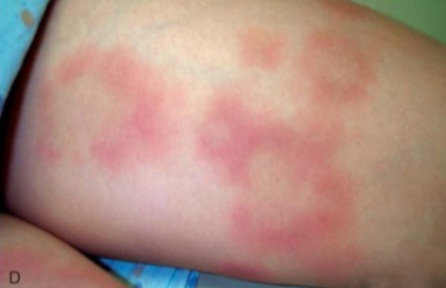
10‑year‑old child is brought in OPD with a large, expanding rash on the thigh.There is H/o camping 10 days back on a school trip.
❓ Q1. Identify the skin condition shown in the image. Describe its characteristic appearance.
✅ Model Answer: • Condition: Erythema migrans (early localized Lyme disease).
• Appearance: Expanding erythematous rash with central clearing (classic "bull's-eye" or target appearance). The rash is typically painless, non-pruritic, and enlarges over days to weeks. It may also appear as a uniformly erythematous patch without central clearing.
• Appearance: Expanding erythematous rash with central clearing (classic "bull's-eye" or target appearance). The rash is typically painless, non-pruritic, and enlarges over days to weeks. It may also appear as a uniformly erythematous patch without central clearing.
❓ Q2. What is the etiologic agent of Lyme disease? How is it transmitted?
✅ Model Answer: • Etiologic agent: Borrelia burgdorferi (a spirochete).
• Transmission: Transmitted through the bite of infected Ixodes ticks (deer ticks). In the eastern US: Ixodes scapularis; in the western US: Ixodes pacificus. Ticks must be attached for at least 36-48 hours to transmit the bacteria.
• Transmission: Transmitted through the bite of infected Ixodes ticks (deer ticks). In the eastern US: Ixodes scapularis; in the western US: Ixodes pacificus. Ticks must be attached for at least 36-48 hours to transmit the bacteria.
❓ Q3. What are the three stages of Lyme disease?
✅ Model Answer: • Stage 1 – Early localized (days to weeks): Erythema migrans, flu-like symptoms (fever, fatigue, malaise, myalgia).
• Stage 2 – Early disseminated (weeks to months): Multiple erythema migrans lesions, neurologic manifestations (Bell's palsy, meningitis, radiculopathy), cardiac manifestations (AV block, myocarditis).
• Stage 3 – Late disseminated (months to years): Lyme arthritis (oligoarticular, knee most common), chronic encephalopathy, peripheral neuropathy.
• Stage 2 – Early disseminated (weeks to months): Multiple erythema migrans lesions, neurologic manifestations (Bell's palsy, meningitis, radiculopathy), cardiac manifestations (AV block, myocarditis).
• Stage 3 – Late disseminated (months to years): Lyme arthritis (oligoarticular, knee most common), chronic encephalopathy, peripheral neuropathy.
❓ Q4. How is erythema migrans diagnosed? What is the role of serology?
✅ Model Answer: • Erythema migrans is a clinical diagnosis.
• Serology (ELISA followed by Western blot) is often negative in early disease (sensitivity ~30-50%) and is NOT recommended for diagnosis of EM.
• Treatment should be started based on the characteristic rash and history of tick exposure.
• Serology is useful for: disseminated disease, arthritis, neurologic symptoms, or when the rash is atypical.
• Serology (ELISA followed by Western blot) is often negative in early disease (sensitivity ~30-50%) and is NOT recommended for diagnosis of EM.
• Treatment should be started based on the characteristic rash and history of tick exposure.
• Serology is useful for: disseminated disease, arthritis, neurologic symptoms, or when the rash is atypical.
❓ Q5. What is the first-line treatment for erythema migrans in children?
✅ Model Answer: • Children ≥8 years: Doxycycline 4.4 mg/kg/day (max 100 mg/dose) BID for 10-14 days.
• Children <8 years or pregnant: Amoxicillin 50 mg/kg/day (max 500 mg/dose) TID for 14 days.
• Alternative: Cefuroxime axetil 30 mg/kg/day BID for 14 days.
• Duration: 10-14 days for early localized Lyme disease; 14-21 days for disseminated disease.
• Children <8 years or pregnant: Amoxicillin 50 mg/kg/day (max 500 mg/dose) TID for 14 days.
• Alternative: Cefuroxime axetil 30 mg/kg/day BID for 14 days.
• Duration: 10-14 days for early localized Lyme disease; 14-21 days for disseminated disease.
❓ Q6. What is the rationale for using doxycycline in children ≥8 years? Why is it avoided in younger children?
✅ Model Answer: • Doxycycline is effective against Borrelia burgdorferi and also treats co-infections (e.g., Anaplasma).
• Use in ≥8 years: Safe; risk of tooth discoloration is minimal after permanent teeth have formed.
• Avoid in <8 years: Risk of permanent tooth discoloration and enamel hypoplasia (though newer studies suggest short courses may be safe).
• Alternatives: Amoxicillin or cefuroxime axetil for younger children.
• Use in ≥8 years: Safe; risk of tooth discoloration is minimal after permanent teeth have formed.
• Avoid in <8 years: Risk of permanent tooth discoloration and enamel hypoplasia (though newer studies suggest short courses may be safe).
• Alternatives: Amoxicillin or cefuroxime axetil for younger children.
❓ Q7. What are the common co-infections transmitted by the same tick vector?
✅ Model Answer: • Babesiosis – Babesia microti (intraerythrocytic parasite) → hemolytic anemia, fever, thrombocytopenia.
• Anaplasmosis (ehrlichiosis) – Anaplasma phagocytophilum → fever, leukopenia, thrombocytopenia, elevated transaminases.
• Powassan virus – rare, causes encephalitis.
• Borrelia miyamotoi – relapsing fever.
• Co-infection should be suspected if the patient has more severe symptoms or does not respond to Lyme treatment.
• Anaplasmosis (ehrlichiosis) – Anaplasma phagocytophilum → fever, leukopenia, thrombocytopenia, elevated transaminases.
• Powassan virus – rare, causes encephalitis.
• Borrelia miyamotoi – relapsing fever.
• Co-infection should be suspected if the patient has more severe symptoms or does not respond to Lyme treatment.
❓ Q8. What are the neurologic manifestations of Lyme disease in children?
✅ Model Answer: • Facial nerve palsy (Bell's palsy): Most common neurologic manifestation in children; may be bilateral.
• Lymphocytic meningitis: Headache, neck stiffness, CSF lymphocytic pleocytosis.
• Radiculopathy: Radicular pain, paresthesias, motor weakness.
• Rare: Encephalitis, myelitis.
• Treatment: Oral doxycycline or amoxicillin for 14-21 days (IV ceftriaxone for severe cases).
• Lymphocytic meningitis: Headache, neck stiffness, CSF lymphocytic pleocytosis.
• Radiculopathy: Radicular pain, paresthesias, motor weakness.
• Rare: Encephalitis, myelitis.
• Treatment: Oral doxycycline or amoxicillin for 14-21 days (IV ceftriaxone for severe cases).
❓ Q9. What are the cardiac manifestations of Lyme disease?
✅ Model Answer: • Lyme carditis: Occurs in 1-4% of patients (stage 2, early disseminated).
• Manifestations: Atrioventricular (AV) block (first, second, or third degree), myocarditis, pericarditis, myopericarditis.
• Diagnosis: ECG, echocardiogram, Lyme serology.
• Treatment: IV ceftriaxone (or oral doxycycline if mild) for 14-21 days. Temporary pacing may be needed for high-grade AV block.
• Prognosis: Usually resolves with antibiotic treatment.
• Manifestations: Atrioventricular (AV) block (first, second, or third degree), myocarditis, pericarditis, myopericarditis.
• Diagnosis: ECG, echocardiogram, Lyme serology.
• Treatment: IV ceftriaxone (or oral doxycycline if mild) for 14-21 days. Temporary pacing may be needed for high-grade AV block.
• Prognosis: Usually resolves with antibiotic treatment.
❓ Q10. What is Lyme arthritis? How is it diagnosed and treated?
✅ Model Answer: • Lyme arthritis: Late disseminated stage (stage 3).
• Presentation: Oligoarticular arthritis, most commonly affecting the knee (swollen, warm, effusion). Pain is often less than expected for the degree of swelling.
• Diagnosis: Clinical + Lyme serology (IgG Western blot positive). Joint aspiration: WBC 10,000-25,000, negative culture (B. burgdorferi is not cultured from synovial fluid).
• Treatment: Oral doxycycline or amoxicillin for 28 days. If refractory, IV ceftriaxone for 2-4 weeks. Arthrocentesis for symptom relief.
• Presentation: Oligoarticular arthritis, most commonly affecting the knee (swollen, warm, effusion). Pain is often less than expected for the degree of swelling.
• Diagnosis: Clinical + Lyme serology (IgG Western blot positive). Joint aspiration: WBC 10,000-25,000, negative culture (B. burgdorferi is not cultured from synovial fluid).
• Treatment: Oral doxycycline or amoxicillin for 28 days. If refractory, IV ceftriaxone for 2-4 weeks. Arthrocentesis for symptom relief.
❓ Q11. What is post-treatment Lyme disease syndrome (PTLDS)?
✅ Model Answer: • PTLDS: Persistent symptoms (fatigue, musculoskeletal pain, cognitive difficulties) lasting ≥6 months after standard antibiotic therapy for Lyme disease.
• Incidence: 10-20% of patients with Lyme disease.
• Pathophysiology: Not fully understood; possibly immune-mediated inflammation, residual tissue damage, or persistent antigens.
• Management: Symptomatic treatment (pain management, cognitive therapy, exercise). Additional antibiotics are not recommended (studies show no benefit and may cause harm).
• Incidence: 10-20% of patients with Lyme disease.
• Pathophysiology: Not fully understood; possibly immune-mediated inflammation, residual tissue damage, or persistent antigens.
• Management: Symptomatic treatment (pain management, cognitive therapy, exercise). Additional antibiotics are not recommended (studies show no benefit and may cause harm).
❓ Q12. How can Lyme disease be prevented?
✅ Model Answer: • Personal protection: Use insect repellents (DEET 20-30%, picaridin, IR3535).
• Clothing: Wear long sleeves, long pants, and tuck pants into socks.
• Permethrin: Treat clothing and gear with permethrin.
• Tick checks: Perform daily tick checks after outdoor activities, especially in endemic areas.
• Prompt removal: Remove ticks with fine-tipped tweezers within 24-48 hours (reduces transmission risk).
• Single-dose doxycycline: Consider for high-risk tick bites (i.e., identified Ixodes tick, attached ≥36 hours, endemic area, within 72 hours).
• Clothing: Wear long sleeves, long pants, and tuck pants into socks.
• Permethrin: Treat clothing and gear with permethrin.
• Tick checks: Perform daily tick checks after outdoor activities, especially in endemic areas.
• Prompt removal: Remove ticks with fine-tipped tweezers within 24-48 hours (reduces transmission risk).
• Single-dose doxycycline: Consider for high-risk tick bites (i.e., identified Ixodes tick, attached ≥36 hours, endemic area, within 72 hours).
❓ Q13. How would you counsel a parent whose child has erythema migrans?
✅ Model Answer: • "Your child has Lyme disease, which is caused by a bacteria spread by tick bites. The rash (erythema migrans) is the hallmark of early infection."
• "We are prescribing antibiotics (doxycycline/amoxicillin) for 10-14 days. This is very effective and will clear the infection."
• "The rash may take a few days to fade, and some children may feel tired or have a headache – this is normal."
• "Watch for any new symptoms like fever, joint pain, facial weakness, or eye problems – these are rare but need immediate attention."
• "Prevent future tick bites: wear protective clothing, use DEET, and do tick checks after outdoor play."
• "We are prescribing antibiotics (doxycycline/amoxicillin) for 10-14 days. This is very effective and will clear the infection."
• "The rash may take a few days to fade, and some children may feel tired or have a headache – this is normal."
• "Watch for any new symptoms like fever, joint pain, facial weakness, or eye problems – these are rare but need immediate attention."
• "Prevent future tick bites: wear protective clothing, use DEET, and do tick checks after outdoor play."
❓ Q14. What are the differential diagnoses of erythema migrans?
✅ Model Answer: • Other tick-borne illnesses: Southern tick-associated rash illness (STARI) – similar rash but caused by Borrelia lonestari, milder course.
• Cellulitis: Tender, warm, erythematous without central clearing; no tick exposure.
• Erythema multiforme: Target lesions but typically not expanding; associated with HSV or drug reactions.
• Nummular eczema: Coin-shaped patches, pruritic.
• Tinea corporis (ringworm): Usually scaly, smaller, not expanding at the same rate.
• Key differentiator: Erythema migrans expands slowly over days, has a history of tick exposure, and is painless.
• Cellulitis: Tender, warm, erythematous without central clearing; no tick exposure.
• Erythema multiforme: Target lesions but typically not expanding; associated with HSV or drug reactions.
• Nummular eczema: Coin-shaped patches, pruritic.
• Tinea corporis (ringworm): Usually scaly, smaller, not expanding at the same rate.
• Key differentiator: Erythema migrans expands slowly over days, has a history of tick exposure, and is painless.
❓ Q15. What is the role of prophylactic antibiotics after a tick bite?
✅ Model Answer: • Single-dose doxycycline (200 mg for adults, 4.4 mg/kg for children ≥8y, max 200 mg) can be given within 72 hours of tick removal for high-risk bites.
• High-risk criteria: Identified Ixodes tick, attached ≥36 hours, endemic area, and prophylaxis is not contraindicated.
• Effectiveness: Reduces the risk of Lyme disease by >80%.
• Not recommended for low-risk bites or if >72 hours have passed.
• High-risk criteria: Identified Ixodes tick, attached ≥36 hours, endemic area, and prophylaxis is not contraindicated.
• Effectiveness: Reduces the risk of Lyme disease by >80%.
• Not recommended for low-risk bites or if >72 hours have passed.
📋 Mock Test Feedback
💡 Examiner's note: Compare your answers with model answers. In real TOACS, you would discuss these with the examiner.