FCPS MCPS IMM MD Paediatrics TOACS
Observed Station | CPSP Format | 8 minutes
⏱️ TIME REMAINING
08:00
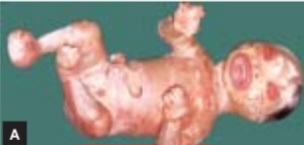
❓ Q1. Identify the skin condition shown in the image. Describe its characteristic features.
✅ Model Answer: • Condition: Harlequin ichthyosis – the most severe form of congenital ichthyosis.
• Characteristic features: Thick, rigid, plate-like (armor-like) scales covering the entire body; deep, red fissures between the scales; severe ectropion (eversion of eyelids); eclabion (eversion of lips); flexion contractures of the digits; ears may be flattened or absent; nasal flattening.
• Characteristic features: Thick, rigid, plate-like (armor-like) scales covering the entire body; deep, red fissures between the scales; severe ectropion (eversion of eyelids); eclabion (eversion of lips); flexion contractures of the digits; ears may be flattened or absent; nasal flattening.
❓ Q2. What is the genetic basis of harlequin ichthyosis?
✅ Model Answer: • Gene: ABCA12 (ATP-binding cassette transporter A12) located on chromosome 2q34.
• Inheritance: Autosomal recessive.
• Function: ABCA12 encodes a lipid transporter that is essential for epidermal lipid transport and barrier function. Mutations lead to defective lipid transport, resulting in the severe skin phenotype.
• Mutation type: Nonsense, frameshift, or splice-site mutations that lead to a nonfunctional protein.
• Inheritance: Autosomal recessive.
• Function: ABCA12 encodes a lipid transporter that is essential for epidermal lipid transport and barrier function. Mutations lead to defective lipid transport, resulting in the severe skin phenotype.
• Mutation type: Nonsense, frameshift, or splice-site mutations that lead to a nonfunctional protein.
❓ Q3. What are the clinical features of harlequin ichthyosis?
✅ Model Answer: • Clinical features:
- Skin: Thick, rigid, plate-like (armor-like) scales covering the entire body; deep, red fissures between plates; skin feels hard and immobile.
- Eyes: Severe ectropion (eversion of eyelids) – exposes conjunctiva, can lead to drying and infection.
- Mouth: Eclabion (eversion of lips) – lips are pulled outward, giving a "fish-mouth" appearance; interferes with feeding.
- Extremities: Flexion contractures of fingers and toes; ears may be small, flattened, or absent; nasal flattening.
- Systemic: Respiratory distress (restrictive chest), feeding difficulties, temperature instability, increased insensible water loss → dehydration and hypernatremia.
- Skin: Thick, rigid, plate-like (armor-like) scales covering the entire body; deep, red fissures between plates; skin feels hard and immobile.
- Eyes: Severe ectropion (eversion of eyelids) – exposes conjunctiva, can lead to drying and infection.
- Mouth: Eclabion (eversion of lips) – lips are pulled outward, giving a "fish-mouth" appearance; interferes with feeding.
- Extremities: Flexion contractures of fingers and toes; ears may be small, flattened, or absent; nasal flattening.
- Systemic: Respiratory distress (restrictive chest), feeding difficulties, temperature instability, increased insensible water loss → dehydration and hypernatremia.
❓ Q4. What is the incidence of harlequin ichthyosis?
✅ Model Answer: • Incidence: Extremely rare – approximately 1 in 300,000 to 1,000,000 live births.
• It is the most severe form of congenital ichthyosis.
• Prevalence is higher in populations with consanguinity due to the autosomal recessive inheritance pattern.
• Previously considered universally fatal in infancy; with modern intensive care and oral retinoids, survival has improved to ~80%.
• It is the most severe form of congenital ichthyosis.
• Prevalence is higher in populations with consanguinity due to the autosomal recessive inheritance pattern.
• Previously considered universally fatal in infancy; with modern intensive care and oral retinoids, survival has improved to ~80%.
❓ Q5. What is the immediate management of a neonate with harlequin ichthyosis?
✅ Model Answer: • Immediate management (NICU):
- Admission to NICU for intensive monitoring.
- Humidified incubator: High humidity (60-80%) to reduce insensible water loss.
- Fluid and electrolyte management: Monitor for dehydration, hypernatremia; provide IV fluids as needed.
- Skin care: Apply thick emollients (petrolatum, Aquaphor) frequently; use non-adherent dressings; avoid aggressive debridement.
- Monitor for infection: Fissures predispose to bacterial infection (sepsis).
- Respiratory support: Monitor for restrictive chest wall; provide CPAP or ventilation if needed.
- Ophthalmology: Consult for ectropion (lubrication, protect cornea).
- Nutrition: NG tube feeding if oral feeding is difficult.
- Admission to NICU for intensive monitoring.
- Humidified incubator: High humidity (60-80%) to reduce insensible water loss.
- Fluid and electrolyte management: Monitor for dehydration, hypernatremia; provide IV fluids as needed.
- Skin care: Apply thick emollients (petrolatum, Aquaphor) frequently; use non-adherent dressings; avoid aggressive debridement.
- Monitor for infection: Fissures predispose to bacterial infection (sepsis).
- Respiratory support: Monitor for restrictive chest wall; provide CPAP or ventilation if needed.
- Ophthalmology: Consult for ectropion (lubrication, protect cornea).
- Nutrition: NG tube feeding if oral feeding is difficult.
❓ Q6. What is the role of oral retinoids in harlequin ichthyosis?
✅ Model Answer: • Oral retinoids (acitretin):
- Indications: Used in the management of severe ichthyoses, including harlequin ichthyosis.
- Mechanism: Reduces keratinocyte hyperproliferation and normalizes epidermal differentiation, leading to thinning of the scales.
- Dose: Acitretin 0.5-1 mg/kg/day (starting low, titrating up).
- Benefits: Significant improvement in scaling, skin mobility, and overall appearance; reduces fissures and prevents contractures.
- Monitoring: Liver function tests, lipid profile, bone health (long-term use).
- Timing: Often started in the neonatal period or early infancy.
- Response: Noticeable improvement within weeks.
- Indications: Used in the management of severe ichthyoses, including harlequin ichthyosis.
- Mechanism: Reduces keratinocyte hyperproliferation and normalizes epidermal differentiation, leading to thinning of the scales.
- Dose: Acitretin 0.5-1 mg/kg/day (starting low, titrating up).
- Benefits: Significant improvement in scaling, skin mobility, and overall appearance; reduces fissures and prevents contractures.
- Monitoring: Liver function tests, lipid profile, bone health (long-term use).
- Timing: Often started in the neonatal period or early infancy.
- Response: Noticeable improvement within weeks.
❓ Q7. What are the complications of harlequin ichthyosis?
✅ Model Answer: • Complications:
- Dehydration and hypernatremia: Increased insensible water loss through the abnormal skin barrier.
- Infection: Deep fissures provide a portal for bacterial entry → sepsis, cellulitis, pneumonia.
- Respiratory distress: Restrictive chest wall from tight skin → hypoventilation.
- Feeding difficulties: Eclabion and oral fissures interfere with sucking and swallowing; may require NG tube or gastrostomy.
- Ocular complications: Ectropion → corneal exposure, ulceration, and blindness.
- Contractures: Flexion contractures of digits can lead to functional impairment.
- Temperature instability.
- Failure to thrive.
- Dehydration and hypernatremia: Increased insensible water loss through the abnormal skin barrier.
- Infection: Deep fissures provide a portal for bacterial entry → sepsis, cellulitis, pneumonia.
- Respiratory distress: Restrictive chest wall from tight skin → hypoventilation.
- Feeding difficulties: Eclabion and oral fissures interfere with sucking and swallowing; may require NG tube or gastrostomy.
- Ocular complications: Ectropion → corneal exposure, ulceration, and blindness.
- Contractures: Flexion contractures of digits can lead to functional impairment.
- Temperature instability.
- Failure to thrive.
❓ Q8. What is the role of genetic testing in harlequin ichthyosis?
✅ Model Answer: • Role of genetic testing:
- Confirms diagnosis: Identifies pathogenic variants in ABCA12.
- Prognostic value: Certain mutations (nonsense, frameshift) are associated with a more severe phenotype.
- Carrier testing: For at-risk family members (autosomal recessive).
- Prenatal diagnosis: For families with known mutations (CVS or amniocentesis).
- Genetic counseling: Discuss inheritance, recurrence risk (25% for siblings), and reproductive options.
- Detection rate: >95% with comprehensive sequencing.
- Confirms diagnosis: Identifies pathogenic variants in ABCA12.
- Prognostic value: Certain mutations (nonsense, frameshift) are associated with a more severe phenotype.
- Carrier testing: For at-risk family members (autosomal recessive).
- Prenatal diagnosis: For families with known mutations (CVS or amniocentesis).
- Genetic counseling: Discuss inheritance, recurrence risk (25% for siblings), and reproductive options.
- Detection rate: >95% with comprehensive sequencing.
❓ Q9. What is the role of emollients in the management of harlequin ichthyosis?
✅ Model Answer: • Role of emollients:
- Hydration: Apply thick, fragrance-free emollients (petrolatum, Aquaphor, Cerave ointment) frequently (every 2-4 hours).
- Barrier function: Reduces insensible water loss and helps maintain skin integrity.
- Prevents fissures: Keeps skin moist and pliable, reducing the risk of cracking and bleeding.
- Pain relief: Reduces discomfort from tight, dry skin.
- Application: Use gentle technique – apply without rubbing; avoid forceful removal of scales.
- Contraindications: Avoid salicylic acid, urea, and other keratolytics (can be absorbed and cause toxicity in neonates).
- Frequency: Frequent application is essential; may require 6-8 applications per day.
- Hydration: Apply thick, fragrance-free emollients (petrolatum, Aquaphor, Cerave ointment) frequently (every 2-4 hours).
- Barrier function: Reduces insensible water loss and helps maintain skin integrity.
- Prevents fissures: Keeps skin moist and pliable, reducing the risk of cracking and bleeding.
- Pain relief: Reduces discomfort from tight, dry skin.
- Application: Use gentle technique – apply without rubbing; avoid forceful removal of scales.
- Contraindications: Avoid salicylic acid, urea, and other keratolytics (can be absorbed and cause toxicity in neonates).
- Frequency: Frequent application is essential; may require 6-8 applications per day.
❓ Q10. What is the prognosis for a child with harlequin ichthyosis?
✅ Model Answer: • Prognosis: Previously universally fatal; now significantly improved with modern intensive care and oral retinoids.
- Survival: ~80% survive infancy with aggressive management.
- Quality of life: With retinoid therapy and supportive care, children can lead meaningful lives.
- Long-term: Ongoing skin care, retinoid therapy, and monitoring for complications (contractures, ectropion, dental issues).
- Psychosocial impact: Significant; requires multidisciplinary care and psychological support.
- Life expectancy: Has improved dramatically; many patients survive into adulthood with proper management.
- Survival: ~80% survive infancy with aggressive management.
- Quality of life: With retinoid therapy and supportive care, children can lead meaningful lives.
- Long-term: Ongoing skin care, retinoid therapy, and monitoring for complications (contractures, ectropion, dental issues).
- Psychosocial impact: Significant; requires multidisciplinary care and psychological support.
- Life expectancy: Has improved dramatically; many patients survive into adulthood with proper management.
❓ Q11. What is the difference between harlequin ichthyosis and collodion baby?
✅ Model Answer: • Harlequin ichthyosis:
- Thick, rigid, plate-like (armor-like) scales; deep fissures; severe ectropion and eclabion; ABCA12 mutation; most severe form.
• Collodion baby:
- Shiny, taut, parchment-like membrane covering the entire body; less severe; most evolve into lamellar ichthyosis or CIE; associated with TGM1, ALOX12B, etc.
• Harlequin ichthyosis is more severe than collodion baby, with thicker scales, deeper fissures, and more pronounced ectropion/eclabion. Harlequin is a specific diagnosis (ABCA12), while collodion baby is a phenotype that can evolve into various ichthyoses.
- Thick, rigid, plate-like (armor-like) scales; deep fissures; severe ectropion and eclabion; ABCA12 mutation; most severe form.
• Collodion baby:
- Shiny, taut, parchment-like membrane covering the entire body; less severe; most evolve into lamellar ichthyosis or CIE; associated with TGM1, ALOX12B, etc.
• Harlequin ichthyosis is more severe than collodion baby, with thicker scales, deeper fissures, and more pronounced ectropion/eclabion. Harlequin is a specific diagnosis (ABCA12), while collodion baby is a phenotype that can evolve into various ichthyoses.
❓ Q12. What is the role of ophthalmology in harlequin ichthyosis?
✅ Model Answer: • Role of ophthalmology:
- Ectropion management: Severe ectropion is a hallmark of harlequin ichthyosis and requires urgent ophthalmology consultation.
- Corneal protection: Aggressive lubrication (artificial tears, ointments) to prevent corneal drying and ulceration.
- Monitor for complications: Corneal ulcers, conjunctivitis, symblepharon, and blindness.
- Surgical intervention: May be needed if ectropion persists and causes corneal damage.
- Long-term follow-up: Patients require ongoing ophthalmology care due to the risk of chronic ocular sequelae.
- Ectropion management: Severe ectropion is a hallmark of harlequin ichthyosis and requires urgent ophthalmology consultation.
- Corneal protection: Aggressive lubrication (artificial tears, ointments) to prevent corneal drying and ulceration.
- Monitor for complications: Corneal ulcers, conjunctivitis, symblepharon, and blindness.
- Surgical intervention: May be needed if ectropion persists and causes corneal damage.
- Long-term follow-up: Patients require ongoing ophthalmology care due to the risk of chronic ocular sequelae.
❓ Q13. How would you counsel the parents of a neonate with harlequin ichthyosis?
✅ Model Answer: • "Your baby has a rare genetic skin condition called harlequin ichthyosis. It is caused by a mutation in a gene called ABCA12, which is important for normal skin development."
• "The skin is covered by thick, hard scales, and the eyelids and lips are pulled outward. This can make feeding and breathing difficult."
• "We will provide intensive care in the NICU – including a humidified incubator, frequent skin moisturizing, and medications to help reduce the thickness of the scales."
• "There is a medication (oral retinoid) that can significantly improve the skin condition. We will start this once your baby is stable."
• "We will also involve eye specialists to protect the eyes, and nutrition support to ensure adequate growth."
• "With modern treatment, the outlook has improved greatly. We are here to support you and your baby every step of the way."
• "The skin is covered by thick, hard scales, and the eyelids and lips are pulled outward. This can make feeding and breathing difficult."
• "We will provide intensive care in the NICU – including a humidified incubator, frequent skin moisturizing, and medications to help reduce the thickness of the scales."
• "There is a medication (oral retinoid) that can significantly improve the skin condition. We will start this once your baby is stable."
• "We will also involve eye specialists to protect the eyes, and nutrition support to ensure adequate growth."
• "With modern treatment, the outlook has improved greatly. We are here to support you and your baby every step of the way."
❓ Q14. What is the role of nutrition support in harlequin ichthyosis?
✅ Model Answer: • Nutrition support role:
- Indications: Eclabion, oral fissures, and poor suck/swallow interfere with oral feeding.
- Options:
- NG tube: For short-term feeding until oral feeding improves.
- Gastrostomy tube: For long-term nutrition if oral feeding remains difficult.
- Caloric requirements: Increased due to excessive skin turnover and wound healing; may require high-calorie formulas.
- Monitoring: Track weight gain, growth parameters, and nutritional status.
- Benefits: Prevents failure to thrive, supports growth, and promotes wound healing.
- Indications: Eclabion, oral fissures, and poor suck/swallow interfere with oral feeding.
- Options:
- NG tube: For short-term feeding until oral feeding improves.
- Gastrostomy tube: For long-term nutrition if oral feeding remains difficult.
- Caloric requirements: Increased due to excessive skin turnover and wound healing; may require high-calorie formulas.
- Monitoring: Track weight gain, growth parameters, and nutritional status.
- Benefits: Prevents failure to thrive, supports growth, and promotes wound healing.
❓ Q15. What is the role of physical therapy in harlequin ichthyosis?
✅ Model Answer: • Physical therapy role:
- Prevent contractures: Passive and active range-of-motion exercises to maintain joint mobility.
- Stretching: To prevent flexion contractures of fingers, toes, and joints.
- Splinting: May be used to maintain proper joint position.
- Positioning: Proper positioning to prevent skin breakdown and contractures.
- Skin care: Physical therapists can assist with safe handling and positioning to minimize skin trauma.
- Early intervention: Therapy should start early in infancy and continue throughout childhood.
- Family education: Teach parents how to perform exercises at home.
- Prevent contractures: Passive and active range-of-motion exercises to maintain joint mobility.
- Stretching: To prevent flexion contractures of fingers, toes, and joints.
- Splinting: May be used to maintain proper joint position.
- Positioning: Proper positioning to prevent skin breakdown and contractures.
- Skin care: Physical therapists can assist with safe handling and positioning to minimize skin trauma.
- Early intervention: Therapy should start early in infancy and continue throughout childhood.
- Family education: Teach parents how to perform exercises at home.
📋 Mock Test Feedback
💡 Examiner's note: Compare your answers with model answers. In real TOACS, you would discuss these with the examiner.