· FCPS MCPS MD IMM Paediatrics TOACS
Observed Station | CPSP Format | 8 minutes
⏱️ TIME REMAINING
08:00
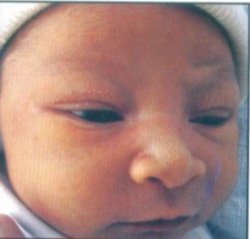
2‑day‑old term newborn is noted to have multiple small white papules on the face
❓ Q1. Identify the skin condition shown in the image. (1 mark)
✅ Model Answer: Milia (neonatal milia). Small (1–2 mm), white/yellowish, dome-shaped papules, keratin-filled epidermal cysts, commonly on face (nose, cheeks, forehead).
❓ Q2. Describe the characteristic clinical features of neonatal milia. (2 marks)
✅ Model Answer: • 1–2 mm white/yellowish papules, dome-shaped, firm.
• Located on face (nose, cheeks, forehead, chin), sometimes palate (Epstein pearls).
• No surrounding erythema or inflammation.
• Present at birth or appears in first few days.
• Asymptomatic, benign.
• Located on face (nose, cheeks, forehead, chin), sometimes palate (Epstein pearls).
• No surrounding erythema or inflammation.
• Present at birth or appears in first few days.
• Asymptomatic, benign.
❓ Q3. What is the pathophysiology of milia? (1 mark)
✅ Model Answer: Keratin-filled epidermal cysts resulting from blocked pilosebaceous units (follicular retention of keratin) – not comedones.
❓ Q4. List TWO important differential diagnoses of neonatal milia. (2 marks)
✅ Model Answer: 1) Erythema toxicum neonatorum (yellow-white pustules with erythematous flare, onset at 24–48 hrs).
2) Transient neonatal pustular melanosis (pustules → hyperpigmented macules, no erythema).
Also: Neonatal acne (papules/pustules on cheeks, onset 2–4 weeks).
2) Transient neonatal pustular melanosis (pustules → hyperpigmented macules, no erythema).
Also: Neonatal acne (papules/pustules on cheeks, onset 2–4 weeks).
❓ Q5. What is the appropriate management and what advice would you give to the mother? (2 marks)
✅ Model Answer: • Reassurance – milia are benign, self-limited, and resolve spontaneously within weeks to months.
• No treatment required; avoid squeezing, topical steroids, or ointments.
• Advise gentle cleansing with water, no scrubbing.
• Reassure that it does not scar or affect health.
• No treatment required; avoid squeezing, topical steroids, or ointments.
• Advise gentle cleansing with water, no scrubbing.
• Reassure that it does not scar or affect health.
❓ Q6. When should you consider a diagnosis other than milia? List two red flags. (2 marks)
✅ Model Answer: • Presence of erythema, inflammation, or pustules (suggests infection or other rash).
• Lesions extending beyond face, or vesicles/ulcers (consider herpes, congenital infection).
• Systemic symptoms (fever, poor feeding, lethargy).
• Lesions extending beyond face, or vesicles/ulcers (consider herpes, congenital infection).
• Systemic symptoms (fever, poor feeding, lethargy).
📋 Mock Test Feedback
💡 Examiner's note: Compare your answers with model answers. In real TOACS, you would discuss these with the examiner.