· FCPS MCPS IMM MD Paediatrics TOACS
Observed Station | CPSP Format | 8 minutes
⏱️ TIME REMAINING
08:00
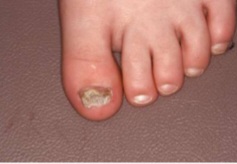
A 14‑year‑old adolescent is brought to the clinic with a thickened, discolored toenail on the left great toe.
❓ Q1. Identify the nail condition shown in the image. Describe its characteristic features.
✅ Model Answer: • Condition: Onychomycosis (tinea unguium – fungal nail infection).
• Characteristic features: Nail plate discoloration (yellow, brown, white, or green), thickening, dystrophy (brittle, crumbly), subungual debris (hyperkeratotic material), and onycholysis (separation of nail from the nail bed). Usually asymptomatic but may cause discomfort with footwear.
• Characteristic features: Nail plate discoloration (yellow, brown, white, or green), thickening, dystrophy (brittle, crumbly), subungual debris (hyperkeratotic material), and onycholysis (separation of nail from the nail bed). Usually asymptomatic but may cause discomfort with footwear.
❓ Q2. What is the most common causative organism of onychomycosis?
✅ Model Answer: • Most common organism: Trichophyton rubrum (accounts for ~70% of cases).
• Other organisms: Trichophyton mentagrophytes (white superficial onychomycosis), Candida species (especially in immunocompromised), and non-dermatophyte molds (e.g., Aspergillus, Fusarium, Scopulariopsis).
• Distal subungual onychomycosis (DSO): Most common clinical type, caused primarily by T. rubrum.
• Other organisms: Trichophyton mentagrophytes (white superficial onychomycosis), Candida species (especially in immunocompromised), and non-dermatophyte molds (e.g., Aspergillus, Fusarium, Scopulariopsis).
• Distal subungual onychomycosis (DSO): Most common clinical type, caused primarily by T. rubrum.
❓ Q3. What are the risk factors for developing onychomycosis?
✅ Model Answer: • Risk factors:
- Tinea pedis (athlete's foot) – concurrent infection.
- Trauma to the nail – sports (soccer, running), tight-fitting shoes.
- Occlusive footwear – creates a warm, moist environment.
- Immunosuppression – diabetes mellitus, HIV, corticosteroid use, organ transplant.
- Family history – genetic predisposition.
- Older age – decreased nail growth and microvascular changes.
- Poor circulation – peripheral vascular disease.
- Hyperhidrosis – excessive sweating.
- Tinea pedis (athlete's foot) – concurrent infection.
- Trauma to the nail – sports (soccer, running), tight-fitting shoes.
- Occlusive footwear – creates a warm, moist environment.
- Immunosuppression – diabetes mellitus, HIV, corticosteroid use, organ transplant.
- Family history – genetic predisposition.
- Older age – decreased nail growth and microvascular changes.
- Poor circulation – peripheral vascular disease.
- Hyperhidrosis – excessive sweating.
❓ Q4. What are the different clinical types of onychomycosis?
✅ Model Answer: • Clinical types:
1. Distal subungual onychomycosis (DSO): Most common. Infection starts at the distal edge of the nail → spreads proximally → yellow/brown discoloration, subungual debris, onycholysis.
2. White superficial onychomycosis (WSO): White, powdery patches on the nail surface. Caused by T. mentagrophytes.
3. Proximal subungual onychomycosis (PSO): Infection starts at the proximal nail fold (cuticle) → spreads distally. Common in immunocompromised patients.
4. Total dystrophic onychomycosis (TDO): Advanced disease with complete nail destruction and thickening.
5. Candida onychomycosis: Often involves fingernails, associated with chronic mucocutaneous candidiasis.
1. Distal subungual onychomycosis (DSO): Most common. Infection starts at the distal edge of the nail → spreads proximally → yellow/brown discoloration, subungual debris, onycholysis.
2. White superficial onychomycosis (WSO): White, powdery patches on the nail surface. Caused by T. mentagrophytes.
3. Proximal subungual onychomycosis (PSO): Infection starts at the proximal nail fold (cuticle) → spreads distally. Common in immunocompromised patients.
4. Total dystrophic onychomycosis (TDO): Advanced disease with complete nail destruction and thickening.
5. Candida onychomycosis: Often involves fingernails, associated with chronic mucocutaneous candidiasis.
❓ Q5. How is onychomycosis diagnosed?
✅ Model Answer: • Diagnostic methods:
- KOH (potassium hydroxide) preparation: Direct microscopy of nail clippings shows septate hyphae and branching (dermatophyte confirmation). Rapid, but sensitivity ~70%.
- Fungal culture: Gold standard – identifies the organism and species. Takes 2-4 weeks to grow.
- PAS (periodic acid-Schiff) staining: Most sensitive (90-95%). Stain nail clippings to visualize fungal elements.
- PCR (polymerase chain reaction): Highly sensitive and specific; can detect fungal DNA rapidly.
- Clinical diagnosis: Often made based on history and physical examination, especially with classic presentation and risk factors.
- KOH (potassium hydroxide) preparation: Direct microscopy of nail clippings shows septate hyphae and branching (dermatophyte confirmation). Rapid, but sensitivity ~70%.
- Fungal culture: Gold standard – identifies the organism and species. Takes 2-4 weeks to grow.
- PAS (periodic acid-Schiff) staining: Most sensitive (90-95%). Stain nail clippings to visualize fungal elements.
- PCR (polymerase chain reaction): Highly sensitive and specific; can detect fungal DNA rapidly.
- Clinical diagnosis: Often made based on history and physical examination, especially with classic presentation and risk factors.
❓ Q6. What is the first-line treatment for toenail onychomycosis?
✅ Model Answer: • First-line treatment: Oral antifungal therapy.
- Terbinafine: 250 mg daily for 12 weeks (adults; weight-based dosing for children: 5-10 mg/kg/day).
- Itraconazole pulse therapy: 200 mg twice daily for 1 week, then 3 weeks off, repeated for 3-4 cycles (pulse therapy).
- Fluconazole: 150-300 mg weekly for 6-12 months (less commonly used).
• Toenails require 12 weeks of treatment due to slow nail growth.
• Fingernails: Terbinafine for 6 weeks.
• Cure rates: Terbinafine ~70-80% for toenails.
- Terbinafine: 250 mg daily for 12 weeks (adults; weight-based dosing for children: 5-10 mg/kg/day).
- Itraconazole pulse therapy: 200 mg twice daily for 1 week, then 3 weeks off, repeated for 3-4 cycles (pulse therapy).
- Fluconazole: 150-300 mg weekly for 6-12 months (less commonly used).
• Toenails require 12 weeks of treatment due to slow nail growth.
• Fingernails: Terbinafine for 6 weeks.
• Cure rates: Terbinafine ~70-80% for toenails.
❓ Q7. What is the treatment for fingernail onychomycosis?
✅ Model Answer: • Fingernail onychomycosis:
- Terbinafine: 250 mg daily for 6 weeks (adults; weight-based for children).
- Itraconazole pulse: 200 mg BID for 1 week/month for 2 months.
- Fingernails grow faster (~3 mm/month) than toenails (~1 mm/month), so treatment duration is shorter.
- Topical lacquers: Ciclopirox 8% or efinaconazole 10% may be considered for mild or superficial involvement, but oral therapy is more effective.
- Terbinafine: 250 mg daily for 6 weeks (adults; weight-based for children).
- Itraconazole pulse: 200 mg BID for 1 week/month for 2 months.
- Fingernails grow faster (~3 mm/month) than toenails (~1 mm/month), so treatment duration is shorter.
- Topical lacquers: Ciclopirox 8% or efinaconazole 10% may be considered for mild or superficial involvement, but oral therapy is more effective.
❓ Q8. What are the topical treatment options for onychomycosis?
✅ Model Answer: • Topical options (nail lacquers):
- Ciclopirox 8% lacquer: Applied daily to the nail plate and adjacent skin. Effective for mild-to-moderate disease, especially white superficial onychomycosis.
- Efinaconazole 10% solution: Newer agent, good penetration, applied daily. Higher efficacy than ciclopirox.
- Tavaborole 5% solution: Boron-based antifungal, applied daily. FDA-approved for onychomycosis.
- Limitations: Topical therapies are less effective than oral therapy for toenails due to poor nail penetration. Useful for mild cases, superficial involvement, or as an adjunct to oral therapy.
- Duration: 48 weeks for ciclopirox.
- Ciclopirox 8% lacquer: Applied daily to the nail plate and adjacent skin. Effective for mild-to-moderate disease, especially white superficial onychomycosis.
- Efinaconazole 10% solution: Newer agent, good penetration, applied daily. Higher efficacy than ciclopirox.
- Tavaborole 5% solution: Boron-based antifungal, applied daily. FDA-approved for onychomycosis.
- Limitations: Topical therapies are less effective than oral therapy for toenails due to poor nail penetration. Useful for mild cases, superficial involvement, or as an adjunct to oral therapy.
- Duration: 48 weeks for ciclopirox.
❓ Q9. What is the role of nail debridement in onychomycosis?
✅ Model Answer: • Nail debridement: Mechanical thinning or removal of the thickened nail plate.
- Purpose: Reduces nail thickness, removes subungual debris, and improves penetration of topical antifungal agents.
- Techniques: Filing, clipping, or chemical debridement with urea cream.
- Nail avulsion: Surgical or chemical removal of the nail plate. Reserved for severe cases, thick nails, or failure of medical therapy.
- Combination therapy: Debridement + oral or topical antifungal therapy improves outcomes.
- Recurrence: Even with debridement, recurrence is common if antifungal therapy is inadequate.
- Purpose: Reduces nail thickness, removes subungual debris, and improves penetration of topical antifungal agents.
- Techniques: Filing, clipping, or chemical debridement with urea cream.
- Nail avulsion: Surgical or chemical removal of the nail plate. Reserved for severe cases, thick nails, or failure of medical therapy.
- Combination therapy: Debridement + oral or topical antifungal therapy improves outcomes.
- Recurrence: Even with debridement, recurrence is common if antifungal therapy is inadequate.
❓ Q10. What are the side effects and monitoring requirements for oral terbinafine?
✅ Model Answer: • Side effects of terbinafine:
- GI upset: Nausea, diarrhea, abdominal pain (10-20%).
- Rash: Mild to moderate (occasional).
- Elevated liver enzymes: 3-5% of patients; requires monitoring.
- Rare: Hepatotoxicity, taste disturbance (loss of taste), blood dyscrasias.
• Monitoring:
- Liver function tests (LFTs): Check at baseline and after 4-6 weeks of therapy.
- Discontinue if hepatic injury is suspected (ALT >3x upper limit of normal).
- Drug interactions: Terbinafine is metabolized by CYP2D6; caution with other CYP2D6 substrates (e.g., antidepressants, beta-blockers).
- Monitoring is especially important in patients with pre-existing liver disease.
- GI upset: Nausea, diarrhea, abdominal pain (10-20%).
- Rash: Mild to moderate (occasional).
- Elevated liver enzymes: 3-5% of patients; requires monitoring.
- Rare: Hepatotoxicity, taste disturbance (loss of taste), blood dyscrasias.
• Monitoring:
- Liver function tests (LFTs): Check at baseline and after 4-6 weeks of therapy.
- Discontinue if hepatic injury is suspected (ALT >3x upper limit of normal).
- Drug interactions: Terbinafine is metabolized by CYP2D6; caution with other CYP2D6 substrates (e.g., antidepressants, beta-blockers).
- Monitoring is especially important in patients with pre-existing liver disease.
❓ Q11. What is the differential diagnosis of onychomycosis?
✅ Model Answer: • Differential diagnoses:
- Psoriasis: Nail pitting, oil spots, subungual hyperkeratosis; often with skin psoriasis.
- Trauma: Subungual hematoma (blood under nail), usually history of injury, resolves as nail grows.
- Yellow nail syndrome: Yellow, thickened nails, lymphedema, pleural effusions; associated with chronic sinusitis.
- Lichen planus: Nail thinning, ridges, pterygium; often with skin lesions.
- Onychogryphosis: Thick, curved "ram's horn" nail; often from trauma or neglect.
- Subungual melanoma: Pigmented band or discoloration, Hutchinson's sign (pigment extending to proximal nail fold), rare but serious.
- Tumors: Glomus tumor, warts, osteochondroma.
- Psoriasis: Nail pitting, oil spots, subungual hyperkeratosis; often with skin psoriasis.
- Trauma: Subungual hematoma (blood under nail), usually history of injury, resolves as nail grows.
- Yellow nail syndrome: Yellow, thickened nails, lymphedema, pleural effusions; associated with chronic sinusitis.
- Lichen planus: Nail thinning, ridges, pterygium; often with skin lesions.
- Onychogryphosis: Thick, curved "ram's horn" nail; often from trauma or neglect.
- Subungual melanoma: Pigmented band or discoloration, Hutchinson's sign (pigment extending to proximal nail fold), rare but serious.
- Tumors: Glomus tumor, warts, osteochondroma.
❓ Q12. What is the relationship between tinea pedis and onychomycosis?
✅ Model Answer: • Association: Tinea pedis (athlete's foot) is a major risk factor for onychomycosis.
• The same organism (Trichophyton rubrum) causes both conditions.
• The infection spreads from the skin (web spaces, soles) to the nail plate.
• Treatment implications: Treating tinea pedis is important to prevent reinfection of the nail.
• Clinical tip: Always examine the feet for tinea pedis in patients with suspected onychomycosis.
• Prevention: Good foot hygiene, avoiding occlusive footwear, and treating athlete's foot promptly.
• The same organism (Trichophyton rubrum) causes both conditions.
• The infection spreads from the skin (web spaces, soles) to the nail plate.
• Treatment implications: Treating tinea pedis is important to prevent reinfection of the nail.
• Clinical tip: Always examine the feet for tinea pedis in patients with suspected onychomycosis.
• Prevention: Good foot hygiene, avoiding occlusive footwear, and treating athlete's foot promptly.
❓ Q13. How would you counsel the parents of an adolescent with onychomycosis?
✅ Model Answer: • "Your child has a fungal nail infection called onychomycosis. It is caused by a fungus that grows under the nail."
• "We will treat it with an oral antifungal medication (terbinafine) for 12 weeks. The medication is very effective, but it takes time for the healthy nail to grow out – you may not see improvement for 3-6 months."
• "The medication can affect the liver, so we will check blood tests before and during treatment."
• "To prevent recurrence, keep the feet clean and dry. Wear breathable footwear and avoid sharing towels or shoes."
• "If there is also athlete's foot, we will treat that too, as it can cause reinfection."
• "Be patient – the fungus is killed quickly, but the nail takes months to regrow."
• "We will treat it with an oral antifungal medication (terbinafine) for 12 weeks. The medication is very effective, but it takes time for the healthy nail to grow out – you may not see improvement for 3-6 months."
• "The medication can affect the liver, so we will check blood tests before and during treatment."
• "To prevent recurrence, keep the feet clean and dry. Wear breathable footwear and avoid sharing towels or shoes."
• "If there is also athlete's foot, we will treat that too, as it can cause reinfection."
• "Be patient – the fungus is killed quickly, but the nail takes months to regrow."
❓ Q14. What is the role of laser therapy in onychomycosis?
✅ Model Answer: • Laser therapy: Use of lasers (e.g., Nd:YAG) to treat onychomycosis.
- Mechanism: Laser energy generates heat → damages fungal cells in the nail plate.
- Evidence: Some studies show efficacy, but results are variable and less consistent than oral therapy.
- Advantages: Non-invasive, no systemic side effects.
- Disadvantages: Expensive, multiple sessions required, often not covered by insurance, lower cure rates than oral therapy.
- Current recommendation: Not a first-line treatment; may be considered for patients who cannot take oral antifungals.
- Mechanism: Laser energy generates heat → damages fungal cells in the nail plate.
- Evidence: Some studies show efficacy, but results are variable and less consistent than oral therapy.
- Advantages: Non-invasive, no systemic side effects.
- Disadvantages: Expensive, multiple sessions required, often not covered by insurance, lower cure rates than oral therapy.
- Current recommendation: Not a first-line treatment; may be considered for patients who cannot take oral antifungals.
❓ Q15. What is the prognosis and recurrence rate of onychomycosis?
✅ Model Answer: • Prognosis: Good with appropriate treatment. Mycological cure rates for terbinafine: 70-80% for toenails, higher for fingernails.
• Clinical cure: Clearance of clinical signs (discoloration, thickening) – takes time as healthy nail grows out (6-12 months for toenails).
• Recurrence: High (20-50% within 1-2 years).
• Risk factors for recurrence: Tinea pedis, immunosuppression, diabetes, failure to treat predisposing factors.
• Prevention: Treat tinea pedis, use antifungal powder in shoes, wear breathable footwear, and maintain good foot hygiene.
• Prognostic factors: Younger age, absence of DM, milder disease, and adherence to treatment improve outcomes.
• Clinical cure: Clearance of clinical signs (discoloration, thickening) – takes time as healthy nail grows out (6-12 months for toenails).
• Recurrence: High (20-50% within 1-2 years).
• Risk factors for recurrence: Tinea pedis, immunosuppression, diabetes, failure to treat predisposing factors.
• Prevention: Treat tinea pedis, use antifungal powder in shoes, wear breathable footwear, and maintain good foot hygiene.
• Prognostic factors: Younger age, absence of DM, milder disease, and adherence to treatment improve outcomes.
📋 Mock Test Feedback
💡 Examiner's note: Compare your answers with model answers. In real TOACS, you would discuss these with the examiner.