⚕️ FCPS MCPS IMM MD Paediatrics TOACS
Observed Station | CPSP Format | 8 minutes
⏱️ TIME REMAINING
08:00
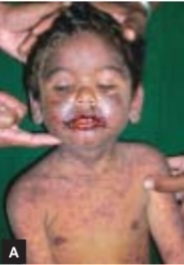
A 10‑year‑old child is brought to the emergency department with a widespread rash and painful mouth ulcers. The mother reports the child was started on lamotrigine for seizures.
❓ Q1. Identify the condition shown in the image. Describe the characteristic rash pattern.
✅ Model Answer: • Condition: Stevens-Johnson syndrome (SJS) – a severe cutaneous adverse reaction (SCAR).
• Rash pattern: Targetoid (atypical target) lesions – erythematous macules with central dusky/necrotic centers. Lesions are often widespread and may coalesce. Blistering and skin detachment occur. Mucosal involvement (oral, ocular, genital) is a hallmark.
• Rash pattern: Targetoid (atypical target) lesions – erythematous macules with central dusky/necrotic centers. Lesions are often widespread and may coalesce. Blistering and skin detachment occur. Mucosal involvement (oral, ocular, genital) is a hallmark.
❓ Q2. What is the difference between SJS, SJS/TEN overlap, and TEN?
✅ Model Answer: • Stevens-Johnson syndrome (SJS): Skin detachment <10% of total body surface area (BSA).
• SJS/TEN overlap: Skin detachment 10-30% BSA.
• Toxic epidermal necrolysis (TEN): Skin detachment >30% BSA.
• All three involve mucosal involvement (≥2 mucosal sites – oral, ocular, genital) and are part of the same disease spectrum.
• SJS/TEN overlap: Skin detachment 10-30% BSA.
• Toxic epidermal necrolysis (TEN): Skin detachment >30% BSA.
• All three involve mucosal involvement (≥2 mucosal sites – oral, ocular, genital) and are part of the same disease spectrum.
❓ Q3. What are the common causes (triggers) of Stevens-Johnson syndrome?
✅ Model Answer: • Most common cause: Medications (drug-induced).
• Common culprit drugs:
- Anticonvulsants: Lamotrigine, carbamazepine, phenytoin, phenobarbital.
- Antibiotics: Sulfonamides (trimethoprim-sulfamethoxazole), penicillins, cephalosporins.
- Allopurinol.
- NSAIDs (especially oxicams).
- Antiretroviral drugs.
• Other triggers: Infections (Mycoplasma pneumoniae, HSV, EBV), vaccinations (rare).
• Common culprit drugs:
- Anticonvulsants: Lamotrigine, carbamazepine, phenytoin, phenobarbital.
- Antibiotics: Sulfonamides (trimethoprim-sulfamethoxazole), penicillins, cephalosporins.
- Allopurinol.
- NSAIDs (especially oxicams).
- Antiretroviral drugs.
• Other triggers: Infections (Mycoplasma pneumoniae, HSV, EBV), vaccinations (rare).
❓ Q4. What are the clinical features of Stevens-Johnson syndrome?
✅ Model Answer: • Clinical features:
- Prodrome: Fever, malaise, headache, arthralgia (1-3 days before rash).
- Rash: Targetoid (atypical target) lesions with dusky/necrotic centers, often widespread; may blister and detach.
- Mucosal involvement: Oral (erosions, hemorrhagic crusts, severe pain), ocular (conjunctivitis, corneal ulceration, photophobia), genital ulcers.
- Nikolsky sign: Positive – lateral pressure causes epidermal detachment.
- Skin detachment: <10% BSA in SJS.
- Systemic symptoms: Fever, anorexia, dehydration.
- Prodrome: Fever, malaise, headache, arthralgia (1-3 days before rash).
- Rash: Targetoid (atypical target) lesions with dusky/necrotic centers, often widespread; may blister and detach.
- Mucosal involvement: Oral (erosions, hemorrhagic crusts, severe pain), ocular (conjunctivitis, corneal ulceration, photophobia), genital ulcers.
- Nikolsky sign: Positive – lateral pressure causes epidermal detachment.
- Skin detachment: <10% BSA in SJS.
- Systemic symptoms: Fever, anorexia, dehydration.
❓ Q5. What is the Nikolsky sign and why is it important in SJS?
✅ Model Answer: • Nikolsky sign: Epidermal detachment (sloughing) when gentle lateral pressure is applied to the skin.
• Significance: Positive Nikolsky sign is a hallmark of SJS/TEN and indicates separation of the epidermis from the dermis due to keratinocyte necrosis.
• It helps differentiate SJS/TEN from other blistering disorders like bullous pemphigoid (where Nikolsky is negative).
• It is a clinical indicator of disease severity and should prompt immediate evaluation and management.
• Significance: Positive Nikolsky sign is a hallmark of SJS/TEN and indicates separation of the epidermis from the dermis due to keratinocyte necrosis.
• It helps differentiate SJS/TEN from other blistering disorders like bullous pemphigoid (where Nikolsky is negative).
• It is a clinical indicator of disease severity and should prompt immediate evaluation and management.
❓ Q6. What is the immediate management of a child with SJS?
✅ Model Answer: • Immediate management:
- STOP the offending drug immediately (do not wait for confirmatory tests).
- Admit to ICU or burn unit for intensive monitoring and supportive care.
- IV fluids: Resuscitation and maintenance to prevent dehydration.
- Wound care: Silver-impregnated dressings or non-adherent dressings; avoid tape.
- Pain control: Opioids (morphine) as needed.
- Nutritional support: NG feeding or TPN if oral intake is compromised.
- Ophthalmology consult: Urgent – risk of blindness from ocular involvement.
- Consider IVIG: 2 g/kg (evidence mixed; may be beneficial if given early).
- Consider cyclosporine: 3-5 mg/kg/day (as alternative to IVIG).
- STOP the offending drug immediately (do not wait for confirmatory tests).
- Admit to ICU or burn unit for intensive monitoring and supportive care.
- IV fluids: Resuscitation and maintenance to prevent dehydration.
- Wound care: Silver-impregnated dressings or non-adherent dressings; avoid tape.
- Pain control: Opioids (morphine) as needed.
- Nutritional support: NG feeding or TPN if oral intake is compromised.
- Ophthalmology consult: Urgent – risk of blindness from ocular involvement.
- Consider IVIG: 2 g/kg (evidence mixed; may be beneficial if given early).
- Consider cyclosporine: 3-5 mg/kg/day (as alternative to IVIG).
❓ Q7. What is the role of IVIG in the treatment of SJS/TEN?
✅ Model Answer: • IVIG role:
- Mechanism: May inhibit Fas-FasL-mediated keratinocyte apoptosis (the primary mechanism of cell death in SJS/TEN).
- Dose: 2 g/kg given over 2-5 days.
- Evidence: Observational studies suggest improved outcomes when given early (<48 hours of onset).
- Recommendation: Considered by many experts as a treatment option, especially in severe cases (TEN, extensive SJS).
- Side effects: Headache, aseptic meningitis, thrombosis, renal impairment.
- Alternatives: Cyclosporine, TNF inhibitors (etanercept).
- Mechanism: May inhibit Fas-FasL-mediated keratinocyte apoptosis (the primary mechanism of cell death in SJS/TEN).
- Dose: 2 g/kg given over 2-5 days.
- Evidence: Observational studies suggest improved outcomes when given early (<48 hours of onset).
- Recommendation: Considered by many experts as a treatment option, especially in severe cases (TEN, extensive SJS).
- Side effects: Headache, aseptic meningitis, thrombosis, renal impairment.
- Alternatives: Cyclosporine, TNF inhibitors (etanercept).
❓ Q8. What is the role of corticosteroids in SJS/TEN?
✅ Model Answer: • Role of corticosteroids: Controversial.
- Early high-dose corticosteroids (e.g., methylprednisolone pulse) may theoretically reduce inflammation and apoptosis.
- However: Corticosteroids may increase the risk of infection and sepsis, impair wound healing, and have not been shown to improve mortality in SJS/TEN.
- Current recommendation: Not routinely recommended. If used, they should be given early in the course with close monitoring.
- Preferred agents: IVIG or cyclosporine are favored over corticosteroids in most centers.
- Early high-dose corticosteroids (e.g., methylprednisolone pulse) may theoretically reduce inflammation and apoptosis.
- However: Corticosteroids may increase the risk of infection and sepsis, impair wound healing, and have not been shown to improve mortality in SJS/TEN.
- Current recommendation: Not routinely recommended. If used, they should be given early in the course with close monitoring.
- Preferred agents: IVIG or cyclosporine are favored over corticosteroids in most centers.
❓ Q9. Why is ophthalmology consultation essential in SJS?
✅ Model Answer: • Ophthalmology is essential because:
- Ocular involvement (conjunctivitis, corneal ulceration, symblepharon) is common in SJS/TEN.
- Complications: Corneal scarring, neovascularization, blindness, and chronic dry eye.
- Urgent intervention: Early ophthalmology involvement can prevent long-term visual impairment.
- Management: Topical lubricants, antibiotics, amniotic membrane transplantation, and removal of necrotic tissue.
- Follow-up: Patients need long-term ophthalmology follow-up due to the risk of late ocular sequelae.
- Ocular involvement (conjunctivitis, corneal ulceration, symblepharon) is common in SJS/TEN.
- Complications: Corneal scarring, neovascularization, blindness, and chronic dry eye.
- Urgent intervention: Early ophthalmology involvement can prevent long-term visual impairment.
- Management: Topical lubricants, antibiotics, amniotic membrane transplantation, and removal of necrotic tissue.
- Follow-up: Patients need long-term ophthalmology follow-up due to the risk of late ocular sequelae.
❓ Q10. What is the SCORTEN score and how is it used in SJS/TEN?
✅ Model Answer: • SCORTEN: A severity-of-illness scoring system for toxic epidermal necrolysis (TEN) and SJS/TEN overlap.
• Parameters (scored within 24 hours):
1. Age >40 years.
2. Malignancy.
3. Heart rate >120/min.
4. BSA >10% detached.
5. Serum urea >10 mmol/L.
6. Serum glucose >14 mmol/L.
7. Bicarbonate <20 mmol/L.
• Score interpretation: 0-1 (10% mortality), 2 (12%), 3 (35%), 4 (58%), ≥5 (90%).
• Used to predict mortality and guide intensity of care.
• Parameters (scored within 24 hours):
1. Age >40 years.
2. Malignancy.
3. Heart rate >120/min.
4. BSA >10% detached.
5. Serum urea >10 mmol/L.
6. Serum glucose >14 mmol/L.
7. Bicarbonate <20 mmol/L.
• Score interpretation: 0-1 (10% mortality), 2 (12%), 3 (35%), 4 (58%), ≥5 (90%).
• Used to predict mortality and guide intensity of care.
❓ Q11. What is the differential diagnosis of Stevens-Johnson syndrome?
✅ Model Answer: • Differential diagnoses:
- Erythema multiforme (EM): Typical target lesions (not atypical), less mucosal involvement, usually HSV-associated.
- DRESS (Drug Reaction with Eosinophilia and Systemic Symptoms): Fever, rash, eosinophilia, organ involvement (hepatitis, nephritis); onset usually 2-6 weeks after drug initiation.
- AGEP (Acute Generalized Exanthematous Pustulosis): Pustular rash, fever, usually less severe; resolves rapidly.
- Staphylococcal scalded skin syndrome (SSSS): Superficial desquamation (skin peeling), no mucosal involvement, caused by exfoliative toxins of S. aureus.
- Pemphigus vulgaris: Flaccid bullae, oral mucosal involvement, autoimmune (anti-desmoglein antibodies).
- Kawasaki disease: Conjunctival injection, oral changes, rash, fever; no blistering or skin detachment.
- Erythema multiforme (EM): Typical target lesions (not atypical), less mucosal involvement, usually HSV-associated.
- DRESS (Drug Reaction with Eosinophilia and Systemic Symptoms): Fever, rash, eosinophilia, organ involvement (hepatitis, nephritis); onset usually 2-6 weeks after drug initiation.
- AGEP (Acute Generalized Exanthematous Pustulosis): Pustular rash, fever, usually less severe; resolves rapidly.
- Staphylococcal scalded skin syndrome (SSSS): Superficial desquamation (skin peeling), no mucosal involvement, caused by exfoliative toxins of S. aureus.
- Pemphigus vulgaris: Flaccid bullae, oral mucosal involvement, autoimmune (anti-desmoglein antibodies).
- Kawasaki disease: Conjunctival injection, oral changes, rash, fever; no blistering or skin detachment.
❓ Q12. What is the role of skin biopsy in SJS?
✅ Model Answer: • Skin biopsy role:
- Confirms diagnosis: Shows full-thickness epidermal necrosis with sparse inflammatory infiltrate.
- Distinguishes from other conditions: Helps differentiate SJS/TEN from erythema multiforme, bullous pemphigoid, and SSSS.
- Immunofluorescence: Negative in SJS/TEN (unlike autoimmune blistering diseases).
- Timing: Should be performed early in the course (within 24-48 hours) for maximum diagnostic yield.
- Procedure: Punch biopsy at the edge of a lesion, avoid areas with blistering.
- Confirms diagnosis: Shows full-thickness epidermal necrosis with sparse inflammatory infiltrate.
- Distinguishes from other conditions: Helps differentiate SJS/TEN from erythema multiforme, bullous pemphigoid, and SSSS.
- Immunofluorescence: Negative in SJS/TEN (unlike autoimmune blistering diseases).
- Timing: Should be performed early in the course (within 24-48 hours) for maximum diagnostic yield.
- Procedure: Punch biopsy at the edge of a lesion, avoid areas with blistering.
❓ Q13. How would you counsel the parents of a child with SJS?
✅ Model Answer: • "Your child has Stevens-Johnson syndrome (SJS), a severe reaction that affects the skin and mucous membranes. It is often caused by a medication."
• "We have stopped the medication that likely triggered this reaction. This is the most important step."
• "Your child will need to be in the intensive care unit for close monitoring and supportive care – IV fluids, wound care, and pain management."
• "The eyes are at risk of serious damage, so an eye specialist (ophthalmologist) will examine your child immediately and follow up regularly."
• "The skin will heal over time, but it may take several weeks. We will do everything to keep your child comfortable and prevent complications."
• "Please tell us if you notice any new symptoms like difficulty breathing, worsening pain, or changes in urine output."
• "We have stopped the medication that likely triggered this reaction. This is the most important step."
• "Your child will need to be in the intensive care unit for close monitoring and supportive care – IV fluids, wound care, and pain management."
• "The eyes are at risk of serious damage, so an eye specialist (ophthalmologist) will examine your child immediately and follow up regularly."
• "The skin will heal over time, but it may take several weeks. We will do everything to keep your child comfortable and prevent complications."
• "Please tell us if you notice any new symptoms like difficulty breathing, worsening pain, or changes in urine output."
❓ Q14. What is the relationship between lamotrigine and SJS?
✅ Model Answer: • Lamotrigine is a known trigger for SJS:
- Risk is higher in children (<16 years) and with rapid dose escalation.
- Also associated with concomitant use of valproic acid (which increases lamotrigine levels).
- SJS typically occurs within 2-8 weeks of starting lamotrigine.
- Management: Stop lamotrigine immediately. Do not restart.
- Prevention: Slow titration of lamotrigine reduces the risk of SJS.
- Future avoidance: Lamotrigine should be permanently avoided in patients who have developed SJS.
- Risk is higher in children (<16 years) and with rapid dose escalation.
- Also associated with concomitant use of valproic acid (which increases lamotrigine levels).
- SJS typically occurs within 2-8 weeks of starting lamotrigine.
- Management: Stop lamotrigine immediately. Do not restart.
- Prevention: Slow titration of lamotrigine reduces the risk of SJS.
- Future avoidance: Lamotrigine should be permanently avoided in patients who have developed SJS.
❓ Q15. What is the prognosis for a child with SJS?
✅ Model Answer: • Prognosis:
- SJS mortality: ~5-10% (lower than TEN).
- SJS/TEN overlap: ~20-30%.
- TEN mortality: ~30-40% (higher in elderly, those with comorbidities).
- Factors affecting prognosis: Age, extent of skin detachment (BSA), early intervention, infection, SCORTEN score.
- Long-term complications: Ocular scarring (symblepharon, dry eye, blindness), oral strictures, genital scarring, nail dystrophy, chronic skin changes.
- Recovery: Skin healing takes 2-4 weeks. Re-epithelialization occurs from hair follicles and sweat glands.
- Important: The culprit drug should be avoided lifelong.
- SJS mortality: ~5-10% (lower than TEN).
- SJS/TEN overlap: ~20-30%.
- TEN mortality: ~30-40% (higher in elderly, those with comorbidities).
- Factors affecting prognosis: Age, extent of skin detachment (BSA), early intervention, infection, SCORTEN score.
- Long-term complications: Ocular scarring (symblepharon, dry eye, blindness), oral strictures, genital scarring, nail dystrophy, chronic skin changes.
- Recovery: Skin healing takes 2-4 weeks. Re-epithelialization occurs from hair follicles and sweat glands.
- Important: The culprit drug should be avoided lifelong.
📋 Mock Test Feedback
💡 Examiner's note: Compare your answers with model answers. In real TOACS, you would discuss these with the examiner.