FCPS MCPS IMM MD Paediatrics TOACS
Observed Station | CPSP Format | 8 minutes
⏱️ TIME REMAINING
08:00
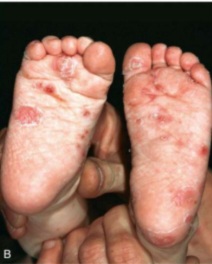
A 9‑month‑old infant is brought in with a rash on the feet and hands that has been present for 3 weeks. The mother reports the infant is irritable and not sleeping well.
❓ Q1. Identify the skin condition shown in the image. What is the most likely diagnosis?
✅ Model Answer: • Condition: Scabies (infantile scabies).
• Diagnosis: Infestation with Sarcoptes scabiei (the human itch mite).
• Key features: Papules, vesicles, and pustules on the palms, soles, and scalp (in infants); intense nocturnal pruritus; excoriations; family history of itch.
• Diagnosis: Infestation with Sarcoptes scabiei (the human itch mite).
• Key features: Papules, vesicles, and pustules on the palms, soles, and scalp (in infants); intense nocturnal pruritus; excoriations; family history of itch.
❓ Q2. What is the etiologic agent of scabies? How is it transmitted?
✅ Model Answer: • Etiologic agent: Sarcoptes scabiei var. hominis – a microscopic mite (arachnid).
• Transmission: Direct, prolonged skin-to-skin contact with an infected person. Less commonly, via fomites (clothing, bedding) – mites can survive 48-72 hours off the host.
• The female mite burrows into the stratum corneum to lay eggs, causing the characteristic rash and pruritus.
• Transmission: Direct, prolonged skin-to-skin contact with an infected person. Less commonly, via fomites (clothing, bedding) – mites can survive 48-72 hours off the host.
• The female mite burrows into the stratum corneum to lay eggs, causing the characteristic rash and pruritus.
❓ Q3. What are the clinical features of scabies in infants compared to older children and adults?
✅ Model Answer: • Infants/young children:
- Papules, vesicles, and pustules on palms, soles, and scalp (classic burrows may be absent).
- May affect face, neck, and diaper area.
- Intense pruritus leading to irritability, poor sleep.
- Often misdiagnosed as atopic dermatitis or eczema.
• Older children/adults:
- Classic burrows (serpiginous gray-white lines) on interdigital spaces, wrists, axillae, groin, and genitalia.
- Papules, excoriations, and nodules (scabietic nodules) in genital areas.
- No involvement of face and scalp (except in crusted scabies).
- Papules, vesicles, and pustules on palms, soles, and scalp (classic burrows may be absent).
- May affect face, neck, and diaper area.
- Intense pruritus leading to irritability, poor sleep.
- Often misdiagnosed as atopic dermatitis or eczema.
• Older children/adults:
- Classic burrows (serpiginous gray-white lines) on interdigital spaces, wrists, axillae, groin, and genitalia.
- Papules, excoriations, and nodules (scabietic nodules) in genital areas.
- No involvement of face and scalp (except in crusted scabies).
❓ Q4. What is the diagnostic approach for scabies?
✅ Model Answer: • Diagnostic approach:
- Clinical diagnosis: History of intense nocturnal pruritus, characteristic rash, and family/contact history is often sufficient.
- Mineral oil skin scraping: Scrape a burrow or papule with a scalpel blade, place on a glass slide with mineral oil, and examine under a microscope for mites, eggs, or fecal pellets (scybala).
- Dermoscopy: May reveal the "delta wing" sign or a burrow with a mite at the end.
- Skin biopsy: Rarely needed; may show mite parts in the stratum corneum.
- Treatment is often given empirically based on clinical suspicion and family history.
- Clinical diagnosis: History of intense nocturnal pruritus, characteristic rash, and family/contact history is often sufficient.
- Mineral oil skin scraping: Scrape a burrow or papule with a scalpel blade, place on a glass slide with mineral oil, and examine under a microscope for mites, eggs, or fecal pellets (scybala).
- Dermoscopy: May reveal the "delta wing" sign or a burrow with a mite at the end.
- Skin biopsy: Rarely needed; may show mite parts in the stratum corneum.
- Treatment is often given empirically based on clinical suspicion and family history.
❓ Q5. What is the first-line treatment for scabies in infants?
✅ Model Answer: • First-line treatment: Permethrin 5% cream (Elimite).
- Application: Apply to the entire body from neck to toes (in infants, also apply to the scalp, face, and behind the ears – avoid contact with eyes, mouth, and nose).
- Duration: Leave on for 8-14 hours (usually overnight).
- Wash off: Wash off with soap and water.
- Repeat: A second application is recommended 7 days later to kill any newly hatched mites.
- All household and close contacts must be treated simultaneously (even if asymptomatic) to prevent reinfestation.
- Application: Apply to the entire body from neck to toes (in infants, also apply to the scalp, face, and behind the ears – avoid contact with eyes, mouth, and nose).
- Duration: Leave on for 8-14 hours (usually overnight).
- Wash off: Wash off with soap and water.
- Repeat: A second application is recommended 7 days later to kill any newly hatched mites.
- All household and close contacts must be treated simultaneously (even if asymptomatic) to prevent reinfestation.
❓ Q6. What is the second-line treatment for scabies?
✅ Model Answer: • Second-line options:
- Permethrin 5% cream: If resistance is suspected or treatment failure occurs.
- Benzyl benzoate 25%: Effective but may cause skin irritation; not recommended for infants.
- Sulfur 5-10% ointment: Safe for infants and pregnant women; applied for 3 consecutive days.
- Oral ivermectin: 200 μg/kg single dose (repeat in 7-14 days). Used for:
- Crusted (Norwegian) scabies.
- Treatment failure with permethrin.
- In patients who cannot tolerate topical therapy.
- Combination therapy: Permethrin + oral ivermectin for crusted scabies.
- Permethrin 5% cream: If resistance is suspected or treatment failure occurs.
- Benzyl benzoate 25%: Effective but may cause skin irritation; not recommended for infants.
- Sulfur 5-10% ointment: Safe for infants and pregnant women; applied for 3 consecutive days.
- Oral ivermectin: 200 μg/kg single dose (repeat in 7-14 days). Used for:
- Crusted (Norwegian) scabies.
- Treatment failure with permethrin.
- In patients who cannot tolerate topical therapy.
- Combination therapy: Permethrin + oral ivermectin for crusted scabies.
❓ Q7. What is crusted (Norwegian) scabies? How is it managed?
✅ Model Answer: • Crusted scabies: A severe, highly contagious form of scabies characterized by thick, hyperkeratotic crusts containing thousands of mites.
• Risk factors: Immunocompromise (HIV, malignancy, organ transplant), neurologic disease (spinal cord injury, dementia), Down syndrome, and elderly patients.
• Clinical presentation: Thick, crusted plaques on the scalp, face, hands, feet, and nails; may have minimal pruritus.
• Management:
- Combination therapy: Permethrin 5% cream applied daily for 7 days + oral ivermectin 200 μg/kg on days 1, 2, 8, 9, and 15.
- Keratolytic agents: To remove crusts (e.g., salicylic acid, urea).
- Nail clipping to remove mites.
- Strict infection control: Contact isolation, treatment of all contacts, and environmental decontamination.
• Risk factors: Immunocompromise (HIV, malignancy, organ transplant), neurologic disease (spinal cord injury, dementia), Down syndrome, and elderly patients.
• Clinical presentation: Thick, crusted plaques on the scalp, face, hands, feet, and nails; may have minimal pruritus.
• Management:
- Combination therapy: Permethrin 5% cream applied daily for 7 days + oral ivermectin 200 μg/kg on days 1, 2, 8, 9, and 15.
- Keratolytic agents: To remove crusts (e.g., salicylic acid, urea).
- Nail clipping to remove mites.
- Strict infection control: Contact isolation, treatment of all contacts, and environmental decontamination.
❓ Q8. What is the role of environmental decontamination in scabies treatment?
✅ Model Answer: • Environmental decontamination: Essential to prevent reinfestation.
- Clothing and bedding: Wash in hot water (≥54°C) and dry on high heat.
- Items that cannot be washed: Place in a sealed plastic bag for 72 hours (mites cannot survive off the host for more than 72 hours).
- Vacuuming: Thoroughly vacuum carpets, upholstery, and mattresses.
- Timing: Decontamination should be done on the day of treatment initiation.
- Treatment of contacts: All household members and close contacts (including those asymptomatic) must be treated simultaneously to prevent reinfestation.
- Clothing and bedding: Wash in hot water (≥54°C) and dry on high heat.
- Items that cannot be washed: Place in a sealed plastic bag for 72 hours (mites cannot survive off the host for more than 72 hours).
- Vacuuming: Thoroughly vacuum carpets, upholstery, and mattresses.
- Timing: Decontamination should be done on the day of treatment initiation.
- Treatment of contacts: All household members and close contacts (including those asymptomatic) must be treated simultaneously to prevent reinfestation.
❓ Q9. Why is nocturnal pruritus a hallmark of scabies?
✅ Model Answer: • Nocturnal pruritus: The female mite is most active at night, burrowing into the skin and depositing eggs.
• The pruritus is an allergic/hypersensitivity reaction to the mite's saliva, eggs, and feces (scybala).
• It typically intensifies 4-6 weeks after initial infestation (in previously sensitized individuals, it may occur within 1-2 days on reinfestation).
• The itching is often severe enough to disturb sleep, leading to irritability in children.
• Clinical significance: Nocturnal pruritus is a key diagnostic clue and helps differentiate scabies from other pruritic conditions.
• The pruritus is an allergic/hypersensitivity reaction to the mite's saliva, eggs, and feces (scybala).
• It typically intensifies 4-6 weeks after initial infestation (in previously sensitized individuals, it may occur within 1-2 days on reinfestation).
• The itching is often severe enough to disturb sleep, leading to irritability in children.
• Clinical significance: Nocturnal pruritus is a key diagnostic clue and helps differentiate scabies from other pruritic conditions.
❓ Q10. What is the differential diagnosis of scabies in infants?
✅ Model Answer: • Differential diagnoses in infants:
- Atopic dermatitis (eczema): Chronic, pruritic, typically flexural distribution; family history of atopy; no family history of itch.
- Contact dermatitis: Irritant or allergic; history of exposure; usually not nocturnal.
- Papular urticaria: Insect bite reaction; grouped papules; no family history.
- Impetigo: Honey-crusted lesions; bacterial superinfection; no burrows.
- Miliaria (heat rash): Small papules/vesicles; associated with heat/humidity; resolves with cooling.
- Acropustulosis of infancy: Recurrent pustular eruption on palms and soles; occurs in young infants; no family history; self-limiting.
- Atopic dermatitis (eczema): Chronic, pruritic, typically flexural distribution; family history of atopy; no family history of itch.
- Contact dermatitis: Irritant or allergic; history of exposure; usually not nocturnal.
- Papular urticaria: Insect bite reaction; grouped papules; no family history.
- Impetigo: Honey-crusted lesions; bacterial superinfection; no burrows.
- Miliaria (heat rash): Small papules/vesicles; associated with heat/humidity; resolves with cooling.
- Acropustulosis of infancy: Recurrent pustular eruption on palms and soles; occurs in young infants; no family history; self-limiting.
❓ Q11. What are scabietic nodules? How are they managed?
✅ Model Answer: • Scabietic nodules: Firm, erythematous, pruritic nodules that develop in response to the mite's antigens.
• Common locations: Genitalia, axillae, buttocks, and nipples in adults; in infants, they may occur on the palms and soles.
• Pathophysiology: Hypersensitivity reaction (type IV) to mite antigens.
• Management:
- Persistent nodules: May persist for weeks to months after successful treatment.
- Topical steroids: Potent corticosteroids (e.g., betamethasone, clobetasol) can be applied to nodules for 2-4 weeks to reduce inflammation and pruritus.
- Intralesional steroid injections: For refractory nodules.
- Reassurance: Nodules are not a sign of treatment failure; they are a hypersensitivity reaction.
• Common locations: Genitalia, axillae, buttocks, and nipples in adults; in infants, they may occur on the palms and soles.
• Pathophysiology: Hypersensitivity reaction (type IV) to mite antigens.
• Management:
- Persistent nodules: May persist for weeks to months after successful treatment.
- Topical steroids: Potent corticosteroids (e.g., betamethasone, clobetasol) can be applied to nodules for 2-4 weeks to reduce inflammation and pruritus.
- Intralesional steroid injections: For refractory nodules.
- Reassurance: Nodules are not a sign of treatment failure; they are a hypersensitivity reaction.
❓ Q12. What is the role of antihistamines in scabies treatment?
✅ Model Answer: • Antihistamines: Used for symptomatic relief of pruritus.
- Indications: To help control itching and improve sleep, especially during the first 2-4 weeks after treatment.
- Types: Oral antihistamines (e.g., hydroxyzine, diphenhydramine, cetirizine) may be used.
- Mechanism: Antihistamines block the H1 receptor, reducing the histamine-mediated itch response.
- Limitations: Antihistamines do NOT kill the mites or treat the infestation; they only provide symptomatic relief.
- Post-treatment pruritus: Itching may persist for 2-4 weeks after successful treatment due to continued hypersensitivity; antihistamines can be helpful during this period.
- Indications: To help control itching and improve sleep, especially during the first 2-4 weeks after treatment.
- Types: Oral antihistamines (e.g., hydroxyzine, diphenhydramine, cetirizine) may be used.
- Mechanism: Antihistamines block the H1 receptor, reducing the histamine-mediated itch response.
- Limitations: Antihistamines do NOT kill the mites or treat the infestation; they only provide symptomatic relief.
- Post-treatment pruritus: Itching may persist for 2-4 weeks after successful treatment due to continued hypersensitivity; antihistamines can be helpful during this period.
❓ Q13. How would you counsel the parents of an infant with scabies?
✅ Model Answer: • "Your baby has scabies, a skin infestation caused by a tiny mite. It is very contagious, but it is treatable."
• "We will prescribe a cream (permethrin) to apply to your baby's entire body, including the scalp and face (avoid the eyes). Leave it on for 8-14 hours, then wash it off."
• "All family members and close contacts must be treated at the same time, even if they don't have symptoms, to prevent reinfestation."
• "Wash all clothing, bedding, and towels in hot water and dry on high heat. Items that cannot be washed should be sealed in a plastic bag for 3 days."
• "The itching may continue for a few weeks after treatment – this is normal and not a sign of treatment failure. We can give medication to help with the itching."
• "Please keep your baby's nails short to reduce scratching and prevent secondary infection."
• "We will prescribe a cream (permethrin) to apply to your baby's entire body, including the scalp and face (avoid the eyes). Leave it on for 8-14 hours, then wash it off."
• "All family members and close contacts must be treated at the same time, even if they don't have symptoms, to prevent reinfestation."
• "Wash all clothing, bedding, and towels in hot water and dry on high heat. Items that cannot be washed should be sealed in a plastic bag for 3 days."
• "The itching may continue for a few weeks after treatment – this is normal and not a sign of treatment failure. We can give medication to help with the itching."
• "Please keep your baby's nails short to reduce scratching and prevent secondary infection."
❓ Q14. What is the role of topical corticosteroids after scabies treatment?
✅ Model Answer: • Topical corticosteroids: Used for persistent pruritus and inflammation after successful scabies treatment.
- Indications: Post-scabietic pruritus (itching lasting >2-4 weeks after treatment).
- Mechanism: Reduces inflammation and the hypersensitivity reaction to mite antigens.
- Dose: Mild to moderate potency steroids (e.g., hydrocortisone 2.5%, triamcinolone 0.1%) applied once or twice daily for 1-2 weeks.
- Scabietic nodules: May require potent topical steroids (e.g., betamethasone, clobetasol) or intralesional injections.
- Caution: Do not use topical steroids alone without scabicidal treatment – they can mask symptoms and allow the infestation to persist.
- Indications: Post-scabietic pruritus (itching lasting >2-4 weeks after treatment).
- Mechanism: Reduces inflammation and the hypersensitivity reaction to mite antigens.
- Dose: Mild to moderate potency steroids (e.g., hydrocortisone 2.5%, triamcinolone 0.1%) applied once or twice daily for 1-2 weeks.
- Scabietic nodules: May require potent topical steroids (e.g., betamethasone, clobetasol) or intralesional injections.
- Caution: Do not use topical steroids alone without scabicidal treatment – they can mask symptoms and allow the infestation to persist.
❓ Q15. What is the prognosis and recurrence rate of scabies?
✅ Model Answer: • Prognosis: Excellent with appropriate treatment. Permethrin 5% cream has a cure rate of >95% when applied correctly and when all contacts are treated.
• Recurrence: Common (20-30%) due to:
- Failure to treat all household and close contacts.
- Incorrect application of permethrin (not covering entire body, washing off too early).
- Environmental contamination (failure to wash bedding/clothing).
- Re-infestation from untreated contacts.
• Prevention: Simultaneous treatment of all contacts, proper environmental decontamination, and patient education are key to preventing recurrence.
• Post-treatment itch: May persist for 2-4 weeks; reassure parents that this is normal and not a sign of treatment failure.
• Recurrence: Common (20-30%) due to:
- Failure to treat all household and close contacts.
- Incorrect application of permethrin (not covering entire body, washing off too early).
- Environmental contamination (failure to wash bedding/clothing).
- Re-infestation from untreated contacts.
• Prevention: Simultaneous treatment of all contacts, proper environmental decontamination, and patient education are key to preventing recurrence.
• Post-treatment itch: May persist for 2-4 weeks; reassure parents that this is normal and not a sign of treatment failure.
📋 Mock Test Feedback
💡 Examiner's note: Compare your answers with model answers. In real TOACS, you would discuss these with the examiner.