🫁 FCPS Paediatrics TOACS · Spirometry in Childhood Asthma
📖 Nelson's Chapter 183 – Diagnosis of Allergic Disease · ERS 2021 Guideline
📚 paeds.online – Paeds Online
🩺 OBSERVED/INTERACTIVE STATION · CPSP FORMAT · 8 MINUTES · SPIROMETRY + BRONCHODILATOR REVERSIBILITY IN CHILD
📋 Observed Station – “8-year-old with suspected asthma – perform and interpret spirometry + bronchodilator reversibility”
👦🏻 Clinical Scenario (TOACS – read aloud / displayed):
An 8-year-old boy presents with recurrent episodes of wheeze, cough, and chest tightness occurring 2-3 times per week, often at night and triggered by exercise and cold air. He is otherwise healthy, no known allergies. On examination between episodes, chest is clear. You suspect asthma.
🎯 Task (examiner observed): Explain the spirometry and bronchodilator reversibility (BDR) test to the child and his parent. Demonstrate (or verbalize) the correct technique, expected maneuvers, and interpret a set of mock results. Discuss how spirometry helps diagnose asthma, the role of FEV1/FVC ratio, what constitutes a positive reversibility test, and limitations of testing.
📸 Spirometry testing image (child using spirometer):
An 8-year-old boy presents with recurrent episodes of wheeze, cough, and chest tightness occurring 2-3 times per week, often at night and triggered by exercise and cold air. He is otherwise healthy, no known allergies. On examination between episodes, chest is clear. You suspect asthma.
🎯 Task (examiner observed): Explain the spirometry and bronchodilator reversibility (BDR) test to the child and his parent. Demonstrate (or verbalize) the correct technique, expected maneuvers, and interpret a set of mock results. Discuss how spirometry helps diagnose asthma, the role of FEV1/FVC ratio, what constitutes a positive reversibility test, and limitations of testing.
📸 Spirometry testing image (child using spirometer):
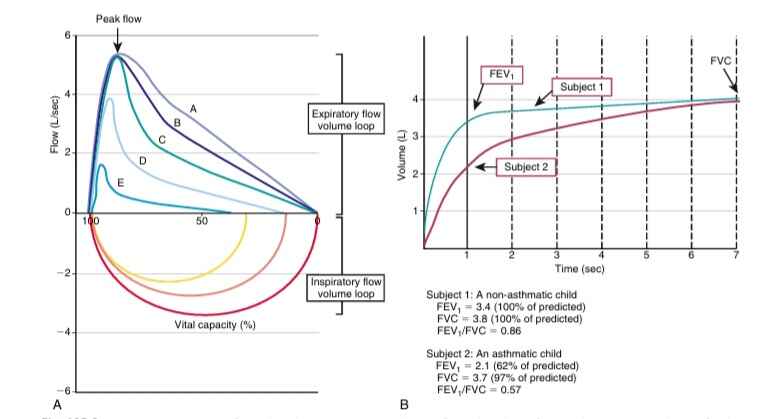
Figure: Child performing spirometry. Nose clip ensures mouth-only exhalation; mouthpiece seal is critical. Device measures FEV1 and FVC.
📊 MOCK SPIROMETRY RESULTS (pre- and post-bronchodilator):
Pre-bronchodilator:
FEV1 = 1.25 L (68% predicted)
FVC = 1.65 L (72% predicted)
FEV1/FVC = 0.76 (↓ below LLN)
Post-bronchodilator (15 min after 400 mcg salbutamol via spacer):
FEV1 = 1.58 L (85% predicted)
FVC = 1.80 L (78% predicted)
FEV1/FVC = 0.88
∆FEV1 = +26% (improvement of >12% and >200 mL) → POSITIVE BRONCHODILATOR REVERSIBILITY → supports asthma diagnosis.
FEV1 = 1.25 L (68% predicted)
FVC = 1.65 L (72% predicted)
FEV1/FVC = 0.76 (↓ below LLN)
Post-bronchodilator (15 min after 400 mcg salbutamol via spacer):
FEV1 = 1.58 L (85% predicted)
FVC = 1.80 L (78% predicted)
FEV1/FVC = 0.88
∆FEV1 = +26% (improvement of >12% and >200 mL) → POSITIVE BRONCHODILATOR REVERSIBILITY → supports asthma diagnosis.
💡 Examiner instruction: Candidate must: (1) explain purpose of spirometry (detect airflow obstruction), (2) describe correct technique (deep breath, blast out, continue until empty, repeat for consistency), (3) define FEV1, FVC, and FEV1/FVC ratio, (4) interpret pre- and post-bronchodilator values, (5) state diagnostic criteria (FEV1 improvement ≥12% and ≥200 mL), (6) discuss that normal spirometry does not exclude asthma (variable disease), and (7) explain that two positive tests among spirometry/BDR/FeNO are needed per ERS guideline.
🫁 Spirometry & Bronchodilator Reversibility – Step-by-Step
1 Prepare the child
Explain test, ensure no tight clothing. Record age, sex, height. Child should be seated upright. Avoid vigorous exercise or large meal before test.
Explain test, ensure no tight clothing. Record age, sex, height. Child should be seated upright. Avoid vigorous exercise or large meal before test.
2 Check contraindications
Recent pneumothorax, hemoptysis, thoracic/abdominal surgery, unstable cardiovascular status, current chest infection.
Recent pneumothorax, hemoptysis, thoracic/abdominal surgery, unstable cardiovascular status, current chest infection.
3 Attach disposable mouthpiece & nose clip
Nose clip prevents air leak. Ensure tight seal around mouthpiece.
Nose clip prevents air leak. Ensure tight seal around mouthpiece.
4 Demonstrate maneuver
“Take a deep breath in, seal lips around mouthpiece, then blast out as fast and hard as you can, and keep blowing until all air is out.”
“Take a deep breath in, seal lips around mouthpiece, then blast out as fast and hard as you can, and keep blowing until all air is out.”
5 Perform pre-bronchodilator spirometry
Obtain at least 3 acceptable maneuvers (FVC and FEV1 within 5% or 100 mL). Record best values.
Obtain at least 3 acceptable maneuvers (FVC and FEV1 within 5% or 100 mL). Record best values.
6 Administer bronchodilator
Give 4 puffs (400 mcg) salbutamol via spacer (or 2.5 mg nebulized). Wait 15-20 minutes.
Give 4 puffs (400 mcg) salbutamol via spacer (or 2.5 mg nebulized). Wait 15-20 minutes.
7 Repeat spirometry post-BD
Same protocol. Calculate % change: (FEV1_post - FEV1_pre)/FEV1_pre × 100.
Same protocol. Calculate % change: (FEV1_post - FEV1_pre)/FEV1_pre × 100.
8 Interpretation
Positive reversibility: FEV1 increase ≥12% and ≥200 mL (children) OR FEV1/FVC < LLN with improvement to normal.
Positive reversibility: FEV1 increase ≥12% and ≥200 mL (children) OR FEV1/FVC < LLN with improvement to normal.
9 Quality control
Ensure test meets ATS/ERS acceptability criteria: good start, no cough/glottis closure, smooth exhalation, back-extrapolation volume <5% FVC or <100 mL.
Ensure test meets ATS/ERS acceptability criteria: good start, no cough/glottis closure, smooth exhalation, back-extrapolation volume <5% FVC or <100 mL.
10 Document and report
Record predicted values, percent predicted, FEV1/FVC ratio, and % change. Provide interpretation.
Record predicted values, percent predicted, FEV1/FVC ratio, and % change. Provide interpretation.
⚠️ SAFETY & PRECAUTIONS:
• Do not perform spirometry if child has uncontrolled asthma, recent pneumothorax, or hemoptysis.
• Bronchodilator administration may cause tachycardia, tremor; monitor for adverse effects.
• Emergency equipment (adrenaline, oxygen, bronchodilator) must be available.
• If FEV1 is <40% predicted, consider caution with forced maneuvers.
• Do not perform spirometry if child has uncontrolled asthma, recent pneumothorax, or hemoptysis.
• Bronchodilator administration may cause tachycardia, tremor; monitor for adverse effects.
• Emergency equipment (adrenaline, oxygen, bronchodilator) must be available.
• If FEV1 is <40% predicted, consider caution with forced maneuvers.
📌 KEY DEFINITIONS (Nelson's / ERS):
• FEV1: Forced expiratory volume in 1 second – measure of large airway obstruction.
• FVC: Forced vital capacity – total volume exhaled.
• FEV1/FVC ratio: Normally >0.80 in children. Ratio < lower limit of normal (LLN) suggests obstructive pattern (asthma, CF, bronchiolitis obliterans).
• Obstructive pattern: FEV1/FVC reduced, FEV1 reduced, FVC normal or reduced.
• Restrictive pattern: FEV1/FVC normal or high, FVC reduced (not typical for asthma).
• FEV1: Forced expiratory volume in 1 second – measure of large airway obstruction.
• FVC: Forced vital capacity – total volume exhaled.
• FEV1/FVC ratio: Normally >0.80 in children. Ratio < lower limit of normal (LLN) suggests obstructive pattern (asthma, CF, bronchiolitis obliterans).
• Obstructive pattern: FEV1/FVC reduced, FEV1 reduced, FVC normal or reduced.
• Restrictive pattern: FEV1/FVC normal or high, FVC reduced (not typical for asthma).
🗨️ Examiner Q&A · Spirometry · Asthma Diagnosis · ERS 2021 Guideline
❓ Q1 (Examiner): “What are the three key tests recommended by the 2021 ERS guideline for diagnosing asthma in children 5-16 years?”
✅ 1. Spirometry (with bronchodilator reversibility testing)
2. Bronchodilator reversibility (BDR) testing – part of spirometry
3. Fractional exhaled nitric oxide (FeNO) testing
Diagnosis requires at least two positive test results consistent with asthma, interpreted alongside clinical history.
2. Bronchodilator reversibility (BDR) testing – part of spirometry
3. Fractional exhaled nitric oxide (FeNO) testing
Diagnosis requires at least two positive test results consistent with asthma, interpreted alongside clinical history.
❓ Q2 (Examiner): “How do you define a positive bronchodilator reversibility test in children?”
✅ Increase in FEV1 by ≥12% from baseline AND absolute increase ≥200 mL (post-bronchodilator). Alternatively, normalization of FEV1/FVC ratio that was below LLN. The test is done 15-20 minutes after inhalation of 400 mcg salbutamol (4 puffs) via spacer.
❓ Q3 (Examiner): “Can normal spirometry exclude asthma?”
✅ NO. Normal spirometry does NOT exclude asthma. Asthma is variable; between exacerbations, lung function can be normal. If history is highly suggestive, proceed with FeNO, BDR, or home peak flow monitoring. Some children may have normal spirometry but positive BDR after exercise or methacholine challenge.
❓ Q4 (Examiner): “What is the minimum age for reliable spirometry in children?”
✅ Most children ≥6 years can perform acceptable spirometry. Some cooperative 5-year-olds may succeed. Below 5 years, oscillometry (impulse oscillometry) or alternative tests are used. Success depends on ability to follow instructions and perform forced maneuver.
❓ Q5 (Examiner): “What is the role of FeNO testing in asthma diagnosis?”
✅ FeNO measures airway inflammation (eosinophilic). Elevated FeNO (>35 ppb in children) suggests type 2 inflammation, supporting asthma diagnosis, predicting responsiveness to inhaled corticosteroids, and guiding steroid dose. However, FeNO can be elevated in atopy/allergic rhinitis without asthma, and normal FeNO does not exclude non-eosinophilic asthma.
❓ Q6 (Examiner): “What is an obstructive pattern on spirometry? How do you differentiate from restriction?”
✅ Obstructive pattern: FEV1/FVC ratio < lower limit of normal (LLN), FEV1 reduced (<80% predicted), FVC may be normal or reduced. Indicates airway narrowing (asthma, COPD, CF). Restrictive pattern: FEV1/FVC normal or increased, FVC reduced (<80% predicted). Suggests interstitial lung disease, chest wall deformity, neuromuscular weakness.
❓ Q7 (Examiner): “What is a peak flow meter? Can it be used to diagnose asthma?”
✅ Peak flow meter measures peak expiratory flow rate (PEFR) – effort-dependent. It is NOT recommended for diagnosis (less sensitive/specific than spirometry). However, home PEFR diaries over 2 weeks showing >20% diurnal variability may support asthma in resource-limited settings. Preferred diagnostic tests: spirometry, BDR, FeNO.
❓ Q8 (Examiner): “What are acceptable spirometry quality criteria in children?”
✅ ATS/ERS criteria:
• Good start (no hesitation, back-extrapolation volume <5% FVC or <100 mL)
• No cough or glottic closure during first second
• Smooth, continuous exhalation with plateau (≥6 seconds in older children)
• Repeatability: FEV1 and FVC within 5% or 100 mL of best value
• At least 3 acceptable maneuvers
• Good start (no hesitation, back-extrapolation volume <5% FVC or <100 mL)
• No cough or glottic closure during first second
• Smooth, continuous exhalation with plateau (≥6 seconds in older children)
• Repeatability: FEV1 and FVC within 5% or 100 mL of best value
• At least 3 acceptable maneuvers
❓ Q9 (Examiner): “What is a bronchial challenge test (provocation test)? When is it indicated?”
✅ Bronchial challenge (methacholine, mannitol, or exercise) measures airway hyperresponsiveness. Indicated when spirometry and BDR are normal but clinical suspicion remains. A positive test (≥20% fall in FEV1) supports asthma. Only performed in specialist settings due to risk of severe bronchospasm. Contraindicated in unstable asthma or low baseline FEV1.
❓ Q10 (Examiner): “What is exercise-induced bronchoconstriction (EIB) testing? How is it done?”
✅ Child exercises on treadmill or cycle to achieve target heart rate (≥80% maximum) for 6-8 minutes. Spirometry is performed before and at intervals after exercise. A fall in FEV1 ≥12-15% from baseline is positive. Useful when exercise is a main trigger and other tests are inconclusive. Requires resuscitation equipment.
❓ Q11 (Examiner): “What does the ERS guideline say about a trial of asthma medication for diagnosis?”
✅ A therapeutic trial of inhaled corticosteroids (ICS) is NOT recommended as a sole diagnostic tool because symptom improvement is subjective and not specific. However, if objective tests cannot be performed (e.g., young child), a trial of ICS for 4-8 weeks followed by repeat spirometry/FeNO may provide supportive evidence. Diagnosis should not rely on symptom improvement alone.
❓ Q12 (Examiner): “How do you interpret pre-bronchodilator FEV1 of 68% predicted and post-BD FEV1 85% predicted with 26% improvement?”
✅ This demonstrates significant reversible airflow obstruction. Pre-BD FEV1 is reduced (<80% predicted) with low FEV1/FVC ratio. Post-BD improvement >12% and >200 mL confirms significant reversibility. This pattern is highly supportive of asthma. Normalization of FEV1 to >80% predicted with treatment indicates good response to bronchodilator.
📢 Examiner probe: “How do you manage a child with strong asthma symptoms but normal spirometry, BDR, and FeNO?” → Consider bronchial challenge test, home peak flow diary, or trial of ICS with repeat testing in 4-8 weeks. Also consider alternative diagnoses (vocal cord dysfunction, airway malacia, GERD, etc.).
📘 Nelson's Pediatrics & ERS 2021 Guideline – Asthma Diagnosis Core
📖 Nelson's Chapter 183
Spirometry is the primary objective test for asthma. Bronchodilator reversibility (≥12% FEV1 increase) confirms variable airflow obstruction. Diagnosis requires symptom pattern + objective evidence of obstruction/variability.
Spirometry is the primary objective test for asthma. Bronchodilator reversibility (≥12% FEV1 increase) confirms variable airflow obstruction. Diagnosis requires symptom pattern + objective evidence of obstruction/variability.
🏛️ ERS 2021 Key Recommendation
Children ≥5 years: use two out of three positive tests (spirometry with BDR, FeNO, or PEF variability) to confirm asthma. Avoid over-reliance on single test. Negative testing should prompt re-evaluation.
Children ≥5 years: use two out of three positive tests (spirometry with BDR, FeNO, or PEF variability) to confirm asthma. Avoid over-reliance on single test. Negative testing should prompt re-evaluation.
🧪 FeNO Interpretation
High FeNO (>35 ppb in children, >50 ppb in adolescents) indicates eosinophilic inflammation. Supports asthma, predicts steroid responsiveness. Normal FeNO does not exclude non-allergic asthma.
High FeNO (>35 ppb in children, >50 ppb in adolescents) indicates eosinophilic inflammation. Supports asthma, predicts steroid responsiveness. Normal FeNO does not exclude non-allergic asthma.
📏 Predicted Values
Spirometry results compared to reference equations (GLI 2012 for children). LLN = 5th percentile. Abnormal if FEV1/FVC < LLN or FEV1 <80% predicted.
Spirometry results compared to reference equations (GLI 2012 for children). LLN = 5th percentile. Abnormal if FEV1/FVC < LLN or FEV1 <80% predicted.
🔄 Repeat Testing
If initial tests normal but high suspicion: repeat when symptomatic, or perform bronchial challenge (methacholine, exercise, mannitol). Also consider home peak flow diary (2-4 weeks).
If initial tests normal but high suspicion: repeat when symptomatic, or perform bronchial challenge (methacholine, exercise, mannitol). Also consider home peak flow diary (2-4 weeks).
🚫 Excluding Asthma
Normal spirometry, negative BDR, normal FeNO, and negative challenge test essentially exclude asthma. Reassess for alternative diagnoses (vocal cord dysfunction, CF, PCD, etc.).
Normal spirometry, negative BDR, normal FeNO, and negative challenge test essentially exclude asthma. Reassess for alternative diagnoses (vocal cord dysfunction, CF, PCD, etc.).
📖 Nelson's Textbook Reference: “Spirometry is the recommended test to confirm asthma. It measures airflow obstruction and can document reversibility. A positive bronchodilator response is defined as an increase in FEV1 of ≥12% and ≥200 mL from baseline. Spirometry should be performed in children old enough to cooperate (typically ≥6 years).”
⭐ TOACS TAKE-HOME POINTS:
1. Spirometry is gold standard for asthma diagnosis in children ≥6 years.
2. FEV1/FVC < LLN = obstructive pattern.
3. Positive BDR: FEV1 increase ≥12% and ≥200 mL post-salbutamol.
4. Normal spirometry does NOT exclude asthma – disease is variable.
5. ERS 2021: at least two positive tests among spirometry/BDR/FeNO for diagnosis.
6. Quality control is critical: acceptable maneuvers, repeatability.
7. Always interpret results in clinical context – history of episodic symptoms, triggers.
8. Challenge tests reserved for inconclusive cases in specialist centers.
1. Spirometry is gold standard for asthma diagnosis in children ≥6 years.
2. FEV1/FVC < LLN = obstructive pattern.
3. Positive BDR: FEV1 increase ≥12% and ≥200 mL post-salbutamol.
4. Normal spirometry does NOT exclude asthma – disease is variable.
5. ERS 2021: at least two positive tests among spirometry/BDR/FeNO for diagnosis.
6. Quality control is critical: acceptable maneuvers, repeatability.
7. Always interpret results in clinical context – history of episodic symptoms, triggers.
8. Challenge tests reserved for inconclusive cases in specialist centers.
🔗 Online resources for candidates & families:
• NUHS – Asthma in Children
• Asthma+Lung UK – Spirometry & BDR
• Asthma Canada – Children's Asthma
• AAFA – Lung Function Tests
• NUHS – Asthma in Children
• Asthma+Lung UK – Spirometry & BDR
• Asthma Canada – Children's Asthma
• AAFA – Lung Function Tests