🧬 TOACS FCPS Station · Coarse Facies in Mucopolysaccharidosis
📷 Clinical Photograph – Coarse Facies
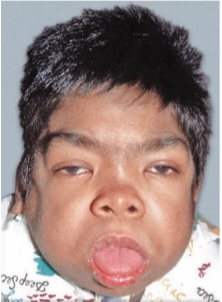
🔍 Key clinical features:
- ✓ Coarse, thickened facial features
- ✓ Prominent forehead (macrocephaly)
- ✓ Depressed nasal bridge
- ✓ Wide-set eyes (hypertelorism)
- ✓ Thick lips, macroglossia
- ✓ Corneal clouding – present in MPS I, IV, VI, VII; absent in MPS II
📋 Clinical scenario (examiner prompt)
A 3‑year‑old child is brought to the clinic because of unusual facial features that have become more noticeable over time. The child has a large head, a prominent forehead, a flat nasal bridge, and thickened facial features. The parents also report developmental delay, stiff joints, and a protruding abdomen. On examination, there is hepatosplenomegaly and corneal clouding. The child has a history of frequent ear infections and umbilical hernia.
🧑⚕️ Examiner tasks · TOACS
1. Identify the diagnosis from the clinical image and context.
2. Describe the clinical features (coarse facies, macrocephaly, depressed nasal bridge, corneal clouding, organomegaly, joint stiffness).
3. Explain the underlying condition (mucopolysaccharidosis, lysosomal storage disorder, GAG accumulation).
4. Discuss differential diagnosis and management (MPS types, enzyme assay, ERT, HSCT).
🎯 Expected answers (for examiners)
- • Diagnosis: Mucopolysaccharidosis (likely MPS I, Hurler syndrome)
- • Clinical features: Coarse facies (macrocephaly, prominent forehead, depressed nasal bridge, wide-set eyes, thick lips, macroglossia), corneal clouding, hepatosplenomegaly, joint stiffness (contractures), dysostosis multiplex, developmental delay, hernia, recurrent infections
- • Pathophysiology: Deficiency of lysosomal enzymes → accumulation of glycosaminoglycans (GAGs) in tissues → progressive organomegaly, skeletal dysplasia, CNS involvement
- • Differential diagnosis: MPS I (Hurler, Scheie), MPS II (Hunter – X-linked, no corneal clouding), MPS VI (Maroteaux-Lamy – normal intelligence), MPS VII (Sly – severe, hydrops fetalis)
- • Diagnostic workup: Urine GAGs (qualitative/quantitative), enzyme assay in leukocytes/fibroblasts, gene sequencing
- • Treatment: ERT (laronidase for MPS I, idursulfase for MPS II, elosulfase for MPS IVA, galsulfase for MPS VI, vestronidase for MPS VII); HSCT for MPS I (Hurler) before age 2 years to prevent cognitive decline
• Common in MPS: I, II, VI, VII (and other lysosomal disorders)
• Features: Macrocephaly, prominent forehead, depressed nasal bridge, hypertelorism, thick lips, macroglossia
• Corneal clouding: Present in MPS I, IV, VI, VII; absent in MPS II
• Associated: Organomegaly, skeletal dysplasia (dysostosis multiplex), developmental delay (variable)
• Diagnosis: Urine GAGs, enzyme assay
• Treatment: ERT (available for several MPS types), HSCT (MPS I Hurler)
⚡ Quick FCPS‑style MCQ
A 3-year-old child with coarse facies, macrocephaly, depressed nasal bridge, corneal clouding, hepatosplenomegaly, and developmental delay. The most likely diagnosis is:
A. Hunter syndrome (MPS II) B. Hurler syndrome (MPS I) C. Sanfilippo syndrome (MPS III) D. Morquio syndrome (MPS IV)📌 Topic summary · Coarse Facies in Mucopolysaccharidosis
Thickened facial features due to GAG storage
Macrocephaly, depressed nasal bridge, thick lips
MPS I, IV, VI, VII (not MPS II)
Organomegaly, dysostosis multiplex
Urine GAGs, enzyme assay
ERT, HSCT (MPS I Hurler)
| Feature | MPS I (Hurler) | MPS II (Hunter) |
|---|---|---|
| Enzyme | α-L-iduronidase | Iduronate sulfatase |
| Inheritance | AR | X-linked |
| Corneal clouding | Yes | No |
| Coarse facies | Yes | Yes |
| Intelligence | Severe ID | Mild to severe |
| ERT | Laronidase | Idursulfase |
| HSCT | Yes | No |