🧬 TOACS FCPS Station · Kayser-Fleischer Ring in Wilson Disease
📷 Clinical Photograph – Kayser-Fleischer Ring
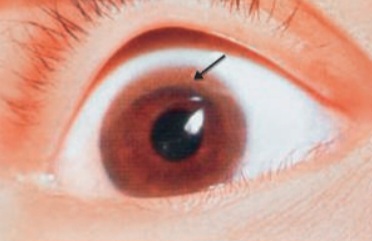
🔍 Key clinical features:
- ✓ Golden-brown or greenish ring at the corneal limbus
- ✓ Pathognomonic for Wilson disease (present in ~95% of neurologic cases)
- ✓ Copper deposition in Descemet's membrane
- ✓ Detected by slit-lamp examination (not visible to naked eye)
- ✓ May be absent in early hepatic or asymptomatic disease
📋 Clinical scenario (examiner prompt)
A 15‑year‑old adolescent is referred for tremor, dysarthria, and deteriorating school performance over the past 6 months. The family reports a history of jaundice and easy bruising in the patient. On physical examination, there is hepatosplenomegaly and subtle dystonia. A slit-lamp eye examination reveals a golden-brown ring at the limbus of both corneas.
🧑⚕️ Examiner tasks · TOACS
1. Identify the diagnosis from the clinical image and context.
2. Describe the Kayser-Fleischer ring (location, appearance, pathogenesis).
3. Explain the underlying disease (Wilson disease, ATP7B mutation, copper accumulation).
4. Discuss diagnosis and management (ceruloplasmin, urinary copper, chelation, zinc, liver transplant).
🎯 Expected answers (for examiners)
- • Diagnosis: Wilson disease (hepatolenticular degeneration)
- • Kayser-Fleischer ring: Golden-brown or greenish ring at the corneal limbus (Descemet's membrane); due to copper deposition; detected by slit-lamp; pathognomonic for Wilson disease
- • Clinical features: Hepatic (hepatitis, cirrhosis, acute liver failure with Coombs-negative hemolysis), Neurologic (tremor, dysarthria, dystonia, parkinsonism, ataxia), Psychiatric (depression, personality changes, psychosis)
- • Diagnosis: Low serum ceruloplasmin (<20 mg/dL), high 24-hour urinary copper (>100 µg), hepatic copper >250 µg/g dry weight, ATP7B mutation
- • Treatment: Chelation (trientine preferred in neurologic disease; penicillamine can worsen neuro symptoms), zinc acetate for maintenance, liver transplant for acute liver failure
- • Inheritance: Autosomal recessive
• Location: Corneal limbus (Descemet's membrane)
• Appearance: Golden-brown/greenish ring
• Pathognomonic for Wilson disease
• Detection: Slit-lamp examination (not visible to naked eye)
• Prevalence: ~95% of neurologic Wilson disease
• Other causes: Can occur in other cholestatic liver diseases, but Wilson is the classic association
⚡ Quick FCPS‑style MCQ
A 16-year-old with tremor, dysarthria, and jaundice is found to have a golden-brown ring at the corneal limbus on slit-lamp examination. The most likely diagnosis is:
A. Primary biliary cirrhosis B. Wilson disease C. Autoimmune hepatitis D. Niemann-Pick type C📌 Topic summary · Wilson Disease & Kayser-Fleischer Ring
ATP7B (chromosome 13)
Autosomal recessive
Copper in Descemet's membrane
Low ceruloplasmin, high urinary Cu, hepatic Cu >250 µg/g
Trientine/penicillamine + zinc
Liver transplant
| Feature | Wilson Disease |
|---|---|
| Gene | ATP7B (copper-transporting ATPase) |
| Kayser-Fleischer ring | Golden-brown ring at corneal limbus; copper in Descemet's membrane; pathognomonic |
| Hepatic manifestations | Hepatitis, cirrhosis, acute liver failure with Coombs-negative hemolytic anemia |
| Neurologic manifestations | Tremor, dysarthria, dystonia, parkinsonism, ataxia |
| Diagnosis | Low ceruloplasmin (<20 mg/dL), 24h urinary copper >100 µg, hepatic copper >250 µg/g |
| Treatment | Trientine/penicillamine (chelation) + zinc; liver transplant for fulminant failure |
| Inheritance | Autosomal recessive |