🌸 TOACS FCPS Station · Congenital Rubella Syndrome (CRS)
📷 Clinical Photograph – Congenital Rubella Syndrome
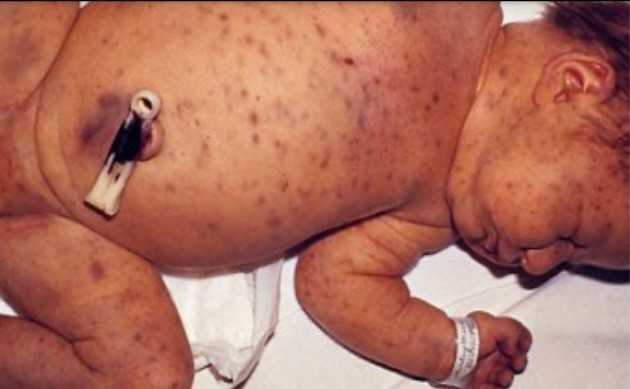
🔍 Key clinical features:
- ✓ 'Blueberry muffin' rash – bluish-red papules/nodules (extramedullary hematopoiesis)
- ✓ Classic triad – cataracts, congenital heart disease (PDA, pulmonary stenosis), sensorineural hearing loss
- ✓ Hepatosplenomegaly, jaundice – from chronic infection
- ✓ Thrombocytopenia – petechiae, purpura
- ✓ Microcephaly – due to direct viral damage to the brain
📋 Clinical scenario (examiner prompt)
A newborn is evaluated for petechiae, jaundice, and hepatosplenomegaly. On examination, the infant has a 'blueberry muffin' rash (bluish-red papules), bilateral cataracts, and a loud continuous murmur at the left infraclavicular area. The infant is microcephalic. The mother reports a mild febrile illness with rash during the first trimester of pregnancy.
🧑⚕️ Examiner tasks · TOACS
1. Identify the diagnosis from the clinical image and context.
2. Describe the clinical features (blueberry muffin rash, cataracts, PDA, microcephaly, hepatosplenomegaly).
3. Explain the etiology and transmission (maternal rubella, first trimester, transplacental infection).
4. Discuss diagnosis, management, and prevention (rubella IgM, supportive care, MMR vaccine).
🎯 Expected answers (for examiners)
- • Diagnosis: Congenital rubella syndrome (CRS)
- • Clinical features: Classic triad: sensorineural hearing loss, PDA/pulmonary artery stenosis, cataracts; blueberry muffin rash (extramedullary hematopoiesis), microcephaly, hepatosplenomegaly, thrombocytopenia, jaundice, glaucoma, retinopathy, radiolucent bone lesions
- • Risk: Highest in first trimester (0-12 weeks) – ~90% risk of CRS
- • Diagnosis: Rubella IgM in newborn; PCR of nasopharynx, urine, CSF
- • Isolation: Contact precautions for 1 year (virus shedding)
- • Treatment: Symptomatic (hearing aids, cataract surgery, cardiac intervention, transfusion/IVIG for thrombocytopenia)
- • Prevention: MMR vaccine (2 doses); screen pregnant women for rubella immunity; avoid pregnancy for 1 month after MMR
• Classic triad: Hearing loss + PDA/pulmonary stenosis + cataracts
• 'Blueberry muffin' rash: Extramedullary hematopoiesis
• Risk: First trimester (~90%)
• Diagnosis: Rubella IgM at birth
• Prevention: Rubella vaccination (MMR) – entirely preventable
⚡ Quick FCPS‑style MCQ
A newborn with cataracts, PDA, and sensorineural hearing loss, along with a 'blueberry muffin' rash, most likely has:
A. Congenital CMV B. Congenital rubella syndrome C. Congenital toxoplasmosis D. Down syndrome📌 Topic summary · Congenital Rubella Syndrome (CRS)
Rubella virus
First trimester (~90%)
Hearing loss, PDA/pulmonary stenosis, cataracts
Extramedullary hematopoiesis
Rubella IgM at birth
MMR vaccine (2 doses)
| Feature | Congenital Rubella Syndrome |
|---|---|
| Virus | Rubella virus (Togaviridae) |
| Transmission | Transplacental (maternal infection first trimester) |
| Classic triad | Sensorineural hearing loss, PDA/pulmonary artery stenosis, cataracts |
| Other features | Blueberry muffin rash, microcephaly, hepatosplenomegaly, thrombocytopenia, glaucoma, retinopathy, radiolucent bone lesions |
| Late manifestations | Diabetes mellitus, thyroiditis, growth hormone deficiency, progressive rubella panencephalitis |
| Diagnosis | Rubella IgM at birth; PCR of nasopharynx, urine, CSF |
| Isolation | Contact precautions for 1 year (virus shedding) |
| Treatment | Supportive care; no cure |
| Prevention | Rubella vaccination (MMR) – 2 doses |