🕷️ TOACS FCPS Station · Erythema Migrans in Lyme Disease
📷 Clinical Photograph – Erythema Migrans
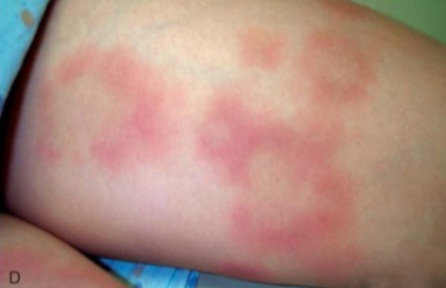
🔍 Key clinical features:
- ✓ Expanding erythematous rash – enlarges over days to weeks
- ✓ Central clearing – classic 'bull's-eye' appearance (may be uniformly erythematous)
- ✓ Painless, not pruritic – often asymptomatic
- ✓ Appears 3–30 days after tick bite – at the site of the bite
- ✓ Pathognomonic – clinical diagnosis, no serology needed to treat
📋 Clinical scenario (examiner prompt)
A 10‑year‑old child is brought in during July with a large, expanding rash on the thigh. The rash started as a small red spot 7 days ago and has grown to about 10 cm in diameter with a central clearing (a 'bull's-eye' appearance). The child recalls a tick bite 2 weeks ago while camping. He is afebrile and otherwise well, but his mother is concerned about the rash.
🧑⚕️ Examiner tasks · TOACS
1. Identify the diagnosis from the clinical image and context.
2. Describe the clinical features (erythema migrans – expanding rash, central clearing, painless).
3. Explain the etiology and transmission (Borrelia burgdorferi, Ixodes ticks).
4. Discuss diagnosis and management (clinical diagnosis, oral antibiotics, prevention).
🎯 Expected answers (for examiners)
- • Diagnosis: Erythema migrans (early localized Lyme disease)
- • Clinical features: Expanding erythematous rash, central clearing (bull's-eye), painless, at site of tick bite
- • Etiology: Borrelia burgdorferi transmitted by Ixodes scapularis (deer tick) in the eastern US
- • Diagnosis: Clinical – serology not needed for EM; can be negative early
- • Treatment: Doxycycline (≥8y) 4.4 mg/kg/day BID ×10-14 days; Amoxicillin (<8y or pregnant) 50 mg/kg/day TID ×14 days
- • Prevention: Tick checks, DEET, permethrin, single-dose doxycycline for high-risk bites
• Pathognomonic for Lyme disease – treat without serology
• Classic appearance: Expanding rash with central clearing ('bull's-eye')
• May be uniformly erythematous – not all have central clearing
• Appears 3–30 days after tick bite
• Treatment with oral antibiotics is highly effective (>95% cure)
⚡ Quick FCPS‑style MCQ
A child with an expanding erythematous rash with central clearing on the thigh after a tick bite. The most appropriate next step is:
A. Order Lyme serology (ELISA and Western blot) B. Treat with oral doxycycline or amoxicillin based on clinical diagnosis C. Perform skin biopsy D. Observe without treatment📌 Topic summary · Erythema Migrans in Lyme Disease
Borrelia burgdorferi
Ixodes scapularis (deer tick)
Expanding 'bull's-eye' (erythema migrans)
Clinical (no serology needed for EM)
Oral doxycycline or amoxicillin ×10-14 days
Excellent (>95% cure)
| Feature | Erythema Migrans (Lyme Disease) |
|---|---|
| Stage | Early localized |
| Onset | 3–30 days after tick bite |
| Rash characteristics | Expanding erythematous rash, central clearing (bull's-eye), painless |
| Serology at this stage | Often negative (sensitivity ~30-50%) |
| Treatment | Doxycycline (≥8y) or Amoxicillin (<8y) ×10-14 days |
| Prevention | Tick checks, DEET, permethrin, single-dose doxycycline for high-risk bites |