FCPS Paediatrics TOACS · Interactive Station
🩺 Bilateral Cleft Lip Deformity — Orofacial cleft, embryology, feeding difficulties, surgical repair (Millard), multidisciplinary care
📚 Paeds Online – paeds.online
⚕️ OBSERVED STATION · CPSP FORMAT · 8 MINUTES · SEPARATE TABS · CLINICAL PHOTO INCLUDED
📖 Problem-oriented Clinical Scenario + Photograph
👶🏻 Clinical Scenario (read aloud – 2 min):
A 1-day-old term female infant is examined in the newborn nursery. The mother had an uncomplicated pregnancy but did not take periconceptional folic acid. On examination, the infant has a midline protrusion of the premaxilla with bilateral, complete clefts of the upper lip extending from the vermilion border to the nasal floor. The nasal cartilages are flattened, and the columella is short. There is no cleft palate. The remainder of the physical examination is normal. The mother is distressed and asks about feeding, future surgery, speech, and whether this is her fault.
A clinical photograph of the facial deformity is shown below.
Task: Describe the findings, propose the most likely diagnosis, classify the cleft, discuss the embryological basis, outline immediate feeding management, and discuss surgical repair and long-term outcomes.
A 1-day-old term female infant is examined in the newborn nursery. The mother had an uncomplicated pregnancy but did not take periconceptional folic acid. On examination, the infant has a midline protrusion of the premaxilla with bilateral, complete clefts of the upper lip extending from the vermilion border to the nasal floor. The nasal cartilages are flattened, and the columella is short. There is no cleft palate. The remainder of the physical examination is normal. The mother is distressed and asks about feeding, future surgery, speech, and whether this is her fault.
A clinical photograph of the facial deformity is shown below.
Task: Describe the findings, propose the most likely diagnosis, classify the cleft, discuss the embryological basis, outline immediate feeding management, and discuss surgical repair and long-term outcomes.
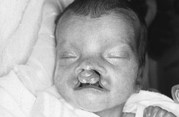
🔍 Figure: Bilateral complete cleft lip deformity. The premaxilla (central portion of the upper lip and alveolus) protrudes forward. There are bilateral clefts extending from the vermilion border to the nasal floor. The nasal tip is flattened, and the columella is short.
💡 Examiner instruction (interactive): The candidate will be asked to identify bilateral cleft lip, classify the cleft (Veau classification, LAHSHAL system), discuss embryology (failure of fusion of medial nasal and maxillary processes), outline feeding management (special nipples, nasogastric tube if needed), discuss surgical repair (Millard rotation-advancement for unilateral, but bilateral repair challenges), and list associated anomalies (Pierre Robin sequence, Van der Woude syndrome, cardiac defects).
🔍 Examiner Questions (interactive) – Click to reveal model answers
❓ Q1 (Examiner): “Describe the findings in the image. What is the most likely diagnosis? How would you classify this cleft?”
✅ Candidate's structured answer:
• Findings: Bilateral complete clefts of the upper lip extending into the nasal floor. The premaxilla (central portion) is protruding. Nasal tip flattened, columella short.
• Diagnosis: Bilateral complete cleft lip (with or without cleft alveolus/palate – in this case appears isolated cleft lip).
• Classification:
- Veau classification: Group III – bilateral complete cleft lip (unilateral or bilateral).
- LAHSHAL system: Each letter indicates lip (L), alveolus (A), hard palate (H), soft palate (S). Capital letter = complete cleft, lowercase = incomplete. For bilateral complete lip: L A H S H A L (both sides complete lip and alveolus).
- Complete vs incomplete: Complete cleft extends to the nasal floor; incomplete does not.
• Findings: Bilateral complete clefts of the upper lip extending into the nasal floor. The premaxilla (central portion) is protruding. Nasal tip flattened, columella short.
• Diagnosis: Bilateral complete cleft lip (with or without cleft alveolus/palate – in this case appears isolated cleft lip).
• Classification:
- Veau classification: Group III – bilateral complete cleft lip (unilateral or bilateral).
- LAHSHAL system: Each letter indicates lip (L), alveolus (A), hard palate (H), soft palate (S). Capital letter = complete cleft, lowercase = incomplete. For bilateral complete lip: L A H S H A L (both sides complete lip and alveolus).
- Complete vs incomplete: Complete cleft extends to the nasal floor; incomplete does not.
❓ Q2 (Examiner): “What is the embryological basis of bilateral cleft lip?”
✅ Candidate's answer:
• The upper lip and primary palate develop between the 4th and 7th weeks of gestation.
• Key structures: Paired medial nasal processes (form the philtrum, columella, premaxilla) and paired maxillary processes (form the lateral upper lip).
• Bilateral cleft lip: Failure of both maxillary processes to fuse with the medial nasal process.
• Consequently, the central premaxilla remains separate and protrudes forward.
• Cleft palate (if present) results from failure of palatal shelf fusion (6th-9th week).
• Risk factors: Folic acid deficiency, maternal smoking, diabetes, valproate use, genetic predisposition.
• The upper lip and primary palate develop between the 4th and 7th weeks of gestation.
• Key structures: Paired medial nasal processes (form the philtrum, columella, premaxilla) and paired maxillary processes (form the lateral upper lip).
• Bilateral cleft lip: Failure of both maxillary processes to fuse with the medial nasal process.
• Consequently, the central premaxilla remains separate and protrudes forward.
• Cleft palate (if present) results from failure of palatal shelf fusion (6th-9th week).
• Risk factors: Folic acid deficiency, maternal smoking, diabetes, valproate use, genetic predisposition.
❓ Q3 (Examiner): “What is the incidence of cleft lip ± palate? What is the recurrence risk in siblings?”
✅ Candidate's answer:
• Incidence: 1 in 700-1,000 live births (highest among Asians and Native Americans, lowest in Africans).
• Male:Female – cleft lip ± palate more common in males (2:1).
• Bilateral cleft lip accounts for ~10-15% of cleft lip cases.
• Recurrence risk (if one child affected, no family history): 2-4% for another child.
• If one parent affected: 4% risk per child.
• If two children affected: recurrence risk ~10-15%.
• If parent and child affected: 15-20% risk.
• Prevention: Periconceptional folic acid (4 mg/day for high-risk mothers) reduces risk by 30-50%.
• Incidence: 1 in 700-1,000 live births (highest among Asians and Native Americans, lowest in Africans).
• Male:Female – cleft lip ± palate more common in males (2:1).
• Bilateral cleft lip accounts for ~10-15% of cleft lip cases.
• Recurrence risk (if one child affected, no family history): 2-4% for another child.
• If one parent affected: 4% risk per child.
• If two children affected: recurrence risk ~10-15%.
• If parent and child affected: 15-20% risk.
• Prevention: Periconceptional folic acid (4 mg/day for high-risk mothers) reduces risk by 30-50%.
❓ Q4 (Examiner): “What syndromes are associated with bilateral cleft lip?”
✅ Candidate's answer:
• Most cleft lip ± palate are non-syndromic (70%). However, syndromic causes (30% of cleft lip/palate) include:
1️⃣ Van der Woude syndrome – autosomal dominant (IRF6 gene); lower lip pits (pathognomonic), cleft lip ± palate, hypodontia.
2️⃣ Pierre Robin sequence – micrognathia, glossoptosis, U-shaped cleft palate (may have cleft lip less common).
3️⃣ 22q11.2 deletion syndrome (DiGeorge/VCFS) – conotruncal cardiac defects, hypocalcemia, palatal anomalies, typical facies.
4️⃣ Stickler syndrome – cleft palate, myopia, retinal detachment, hearing loss.
5️⃣ Treacher Collins syndrome – microtia, colobomas, zygomatic hypoplasia.
6️⃣ CHARGE syndrome, Apert syndrome, Goldenhar syndrome.
• Evaluation: Dysmorphology exam, ophthalmology, audiology, echocardiogram, genetic testing (microarray, IRF6).
• Most cleft lip ± palate are non-syndromic (70%). However, syndromic causes (30% of cleft lip/palate) include:
1️⃣ Van der Woude syndrome – autosomal dominant (IRF6 gene); lower lip pits (pathognomonic), cleft lip ± palate, hypodontia.
2️⃣ Pierre Robin sequence – micrognathia, glossoptosis, U-shaped cleft palate (may have cleft lip less common).
3️⃣ 22q11.2 deletion syndrome (DiGeorge/VCFS) – conotruncal cardiac defects, hypocalcemia, palatal anomalies, typical facies.
4️⃣ Stickler syndrome – cleft palate, myopia, retinal detachment, hearing loss.
5️⃣ Treacher Collins syndrome – microtia, colobomas, zygomatic hypoplasia.
6️⃣ CHARGE syndrome, Apert syndrome, Goldenhar syndrome.
• Evaluation: Dysmorphology exam, ophthalmology, audiology, echocardiogram, genetic testing (microarray, IRF6).
❓ Q5 (Examiner): “What feeding problems occur in an infant with bilateral cleft lip? How do you manage them?”
✅ Candidate's answer:
• Problems: Inability to create negative pressure (suction) due to oronasal communication → nasal regurgitation, air swallowing, choking, coughing, slow feeding, aspiration risk, poor weight gain.
• Management:
1️⃣ Special nipples: Large, soft, cross-cut nipple (e.g., Mead-Johnson cleft lip/palate nipple, pigeon nipple, Haberman feeder) – requires less suction.
2️⃣ Palatal obturator (dental plate) – temporary appliance to separate oral and nasal cavities, improves feeding.
3️⃣ Positioning: Upright or semi-upright during feeding; avoid supine.
4️⃣ Nasogastric (NG) tube – if poor weight gain or severe reflux/aspiration.
5️⃣ Breastfeeding: Difficult but possible with nipple shields. Express breast milk and feed with special bottle.
6️⃣ Monitor growth carefully – weekly weight checks.
7️⃣ Speech therapy / feeding team involvement.
• Problems: Inability to create negative pressure (suction) due to oronasal communication → nasal regurgitation, air swallowing, choking, coughing, slow feeding, aspiration risk, poor weight gain.
• Management:
1️⃣ Special nipples: Large, soft, cross-cut nipple (e.g., Mead-Johnson cleft lip/palate nipple, pigeon nipple, Haberman feeder) – requires less suction.
2️⃣ Palatal obturator (dental plate) – temporary appliance to separate oral and nasal cavities, improves feeding.
3️⃣ Positioning: Upright or semi-upright during feeding; avoid supine.
4️⃣ Nasogastric (NG) tube – if poor weight gain or severe reflux/aspiration.
5️⃣ Breastfeeding: Difficult but possible with nipple shields. Express breast milk and feed with special bottle.
6️⃣ Monitor growth carefully – weekly weight checks.
7️⃣ Speech therapy / feeding team involvement.
❓ Q6 (Examiner): “What is nasoalveolar molding (NAM)? When is it used in bilateral cleft lip?”
✅ Candidate's answer:
• Definition: A presurgical orthodontic technique using a custom-made intraoral appliance (dental plate with nasal stents) to gradually reposition the protruding premaxilla, alveolar segments, and nasal cartilages before lip repair.
• Indication: Used in complete bilateral cleft lip with severe premaxillary protrusion (to reduce tension during lip closure).
• Process: Started within first 2 weeks of life, adjusted weekly for 3-6 months, until premaxilla is aligned and nasal tip improved.
• Benefits: Reduces gap, improves surgical outcome (symmetry), reduces need for premaxillary osteotomy or staged repair.
• Post-NAM, lip repair is performed.
• Definition: A presurgical orthodontic technique using a custom-made intraoral appliance (dental plate with nasal stents) to gradually reposition the protruding premaxilla, alveolar segments, and nasal cartilages before lip repair.
• Indication: Used in complete bilateral cleft lip with severe premaxillary protrusion (to reduce tension during lip closure).
• Process: Started within first 2 weeks of life, adjusted weekly for 3-6 months, until premaxilla is aligned and nasal tip improved.
• Benefits: Reduces gap, improves surgical outcome (symmetry), reduces need for premaxillary osteotomy or staged repair.
• Post-NAM, lip repair is performed.
❓ Q7 (Examiner): “What is the optimal timing for cleft lip repair in a term infant? Describe the principles of repair.”
✅ Candidate's answer:
• Timing (Rule of 10s): 10 weeks of age, 10 pounds (4.5 kg), hemoglobin 10 g/dL. Typically at 3-6 months of age.
• Goals: Achieve symmetric lip and nasal contour, functional oral competence, and minimize scar.
• Techniques for unilateral cleft lip: Millard rotation-advancement (most common).
• Bilateral cleft lip repair: More challenging. Requires simultaneous repair of both sides, often staged (one side at a time) or single stage with premaxillary setback if indicated. Techniques: Mulliken repair, Manchester repair.
• Key steps: Release of abnormal muscle attachments, muscle reconstruction, skin closure, nasal tip columella lengthening.
• Cleft palate repair (if present) is delayed to 9-12 months.
• Timing (Rule of 10s): 10 weeks of age, 10 pounds (4.5 kg), hemoglobin 10 g/dL. Typically at 3-6 months of age.
• Goals: Achieve symmetric lip and nasal contour, functional oral competence, and minimize scar.
• Techniques for unilateral cleft lip: Millard rotation-advancement (most common).
• Bilateral cleft lip repair: More challenging. Requires simultaneous repair of both sides, often staged (one side at a time) or single stage with premaxillary setback if indicated. Techniques: Mulliken repair, Manchester repair.
• Key steps: Release of abnormal muscle attachments, muscle reconstruction, skin closure, nasal tip columella lengthening.
• Cleft palate repair (if present) is delayed to 9-12 months.
❓ Q8 (Examiner): “In this child with bilateral cleft lip, how would you assess for cleft palate? When is palate repaired?”
✅ Candidate's answer:
• Examination: Inspect the palate visually (depress tongue with a tongue depressor or laryngoscope). Palpate the hard palate for a submucous cleft (bifid uvula, midline notch, translucency).
• Cleft palate can be isolated (does not involve lip) or combined with cleft lip.
• Bilateral cleft lip is associated with cleft palate in ~50-70% of cases.
• Timing of palate repair (palatoplasty): Typically 9-12 months to allow maxillary growth and minimize speech impairment. Earlier repair (6-9 months) may reduce middle ear disease but may impact maxillary growth. Later repair (>12 months) increases risk of speech abnormalities.
• Techniques: Furlow palatoplasty, Veau-Wardill-Kilner pushback.
• Examination: Inspect the palate visually (depress tongue with a tongue depressor or laryngoscope). Palpate the hard palate for a submucous cleft (bifid uvula, midline notch, translucency).
• Cleft palate can be isolated (does not involve lip) or combined with cleft lip.
• Bilateral cleft lip is associated with cleft palate in ~50-70% of cases.
• Timing of palate repair (palatoplasty): Typically 9-12 months to allow maxillary growth and minimize speech impairment. Earlier repair (6-9 months) may reduce middle ear disease but may impact maxillary growth. Later repair (>12 months) increases risk of speech abnormalities.
• Techniques: Furlow palatoplasty, Veau-Wardill-Kilner pushback.
❓ Q9 (Examiner): “Why are children with cleft palate at risk for hearing loss? How is it managed?”
✅ Candidate's answer:
• Cleft palate causes dysfunction of the Eustachian tube (abnormal insertion of tensor veli palatini muscle) → impaired middle ear ventilation → persistent otitis media with effusion (OME).
• OME leads to conductive hearing loss (20-40 dB) → delayed speech and language development if untreated.
• Management:
- Newborn hearing screen (OAE/ABR) for all infants.
- Myringotomy and ventilation tube insertion (grommets) at time of cleft palate repair (or earlier if recurrent acute otitis media).
- Audiology follow-up every 6-12 months until school age.
- Sensorineural hearing loss may occur in syndromic clefts (Stickler, 22q11.2 deletion).
• Cleft palate causes dysfunction of the Eustachian tube (abnormal insertion of tensor veli palatini muscle) → impaired middle ear ventilation → persistent otitis media with effusion (OME).
• OME leads to conductive hearing loss (20-40 dB) → delayed speech and language development if untreated.
• Management:
- Newborn hearing screen (OAE/ABR) for all infants.
- Myringotomy and ventilation tube insertion (grommets) at time of cleft palate repair (or earlier if recurrent acute otitis media).
- Audiology follow-up every 6-12 months until school age.
- Sensorineural hearing loss may occur in syndromic clefts (Stickler, 22q11.2 deletion).
❓ Q10 (Examiner): “What dental and orthodontic problems occur in bilateral cleft lip and palate?”
✅ Candidate's answer:
• Common problems:
- Missing, malformed, or supernumerary teeth (especially lateral incisors).
- Malocclusion (class III, crossbite, open bite).
- Hypodontia (tooth agenesis) or delayed tooth eruption.
- Alveolar cleft (gap in the maxillary bone) – requires bone grafting.
• Management:
- Alveolar bone grafting: At 6-10 years (mixed dentition) using iliac crest bone graft to bridge the cleft, allow canine eruption, and provide nasal support.
- Orthodontic treatment (braces) often needed in mixed dentition and adolescence.
- Regular dental checkups, fluoride, and oral hygiene emphasized.
• Common problems:
- Missing, malformed, or supernumerary teeth (especially lateral incisors).
- Malocclusion (class III, crossbite, open bite).
- Hypodontia (tooth agenesis) or delayed tooth eruption.
- Alveolar cleft (gap in the maxillary bone) – requires bone grafting.
• Management:
- Alveolar bone grafting: At 6-10 years (mixed dentition) using iliac crest bone graft to bridge the cleft, allow canine eruption, and provide nasal support.
- Orthodontic treatment (braces) often needed in mixed dentition and adolescence.
- Regular dental checkups, fluoride, and oral hygiene emphasized.
❓ Q11 (Examiner): “What is velopharyngeal insufficiency (VPI) after cleft palate repair? How is it managed?”
✅ Candidate's answer:
• Definition: Inability to close the velopharyngeal port (soft palate against posterior pharyngeal wall) during speech, leading to hypernasal speech (excessive nasal resonance), nasal air emission, and articulation errors.
• Incidence: 10-20% after palatoplasty.
• Risk factors: Wide cleft, syndromic, poor surgical technique, age at repair.
• Management:
- Speech therapy – first-line for mild VPI.
- Nasopharyngoscopy / videofluoroscopy – to assess gap size and pattern.
- Surgical correction: Pharyngeal flap (posterior pharyngeal flap), sphincter pharyngoplasty, or Furlow palatoplasty revision.
- Speech bulb prosthesis – temporary appliance.
- Early diagnosis and treatment are critical for normal speech development.
• Definition: Inability to close the velopharyngeal port (soft palate against posterior pharyngeal wall) during speech, leading to hypernasal speech (excessive nasal resonance), nasal air emission, and articulation errors.
• Incidence: 10-20% after palatoplasty.
• Risk factors: Wide cleft, syndromic, poor surgical technique, age at repair.
• Management:
- Speech therapy – first-line for mild VPI.
- Nasopharyngoscopy / videofluoroscopy – to assess gap size and pattern.
- Surgical correction: Pharyngeal flap (posterior pharyngeal flap), sphincter pharyngoplasty, or Furlow palatoplasty revision.
- Speech bulb prosthesis – temporary appliance.
- Early diagnosis and treatment are critical for normal speech development.
❓ Q12 (Examiner): “What is the long-term prognosis for a child with repaired bilateral cleft lip? What psychosocial support is needed?”
✅ Candidate's answer:
• Excellent prognosis with multidisciplinary team care (plastic surgery, dentistry, orthodontics, speech therapy, audiology, genetics, psychology).
• Cosmetic outcomes: Modern repair gives good symmetry, but bilateral clefts may have residual nasal deformity and scarring; further revisions (rhinoplasty, scar revision) may be done in adolescence.
• Speech: Most achieve normal intelligible speech; some may have mild VPI requiring secondary surgery.
• Feeding and growth: Usually normal after lip and palate repair.
• School performance: May have higher risk of learning difficulties, especially in syndromic clefts; neurodevelopmental assessment recommended.
• Psychosocial support: Counseling for parents and child, peer support groups (e.g., Smile Train, Cleft Lip and Palate Association), early intervention for any developmental delays. Prevent social stigmatization and bullying.
• Excellent prognosis with multidisciplinary team care (plastic surgery, dentistry, orthodontics, speech therapy, audiology, genetics, psychology).
• Cosmetic outcomes: Modern repair gives good symmetry, but bilateral clefts may have residual nasal deformity and scarring; further revisions (rhinoplasty, scar revision) may be done in adolescence.
• Speech: Most achieve normal intelligible speech; some may have mild VPI requiring secondary surgery.
• Feeding and growth: Usually normal after lip and palate repair.
• School performance: May have higher risk of learning difficulties, especially in syndromic clefts; neurodevelopmental assessment recommended.
• Psychosocial support: Counseling for parents and child, peer support groups (e.g., Smile Train, Cleft Lip and Palate Association), early intervention for any developmental delays. Prevent social stigmatization and bullying.
❓ Q13 (Examiner): “Can bilateral cleft lip be diagnosed prenatally? How is it managed prenatally?”
✅ Candidate's answer:
• Yes, prenatal diagnosis is possible. 2D/3D ultrasound at 18-22 weeks can detect cleft lip (sensitivity >90%), but cleft palate is more difficult.
• Findings: Failure to visualize the normal upper lip contour; "notched" appearance; possible protruding premaxilla.
• Prenatal management:
- Detailed fetal anatomy scan to rule out associated anomalies (cardiac, brain, spine, abdominal).
- Amniocentesis for karyotype/microarray (especially if other anomalies).
- Fetal echocardiogram.
- Referral to craniofacial team and neonatology for postnatal planning.
- Parental counseling: Explain the condition, excellent outcomes, feeding management, surgical plan, and recurrence risk (2-4%).
- Plan delivery at a hospital with NICU and pediatric surgery/craniofacial expertise.
• Yes, prenatal diagnosis is possible. 2D/3D ultrasound at 18-22 weeks can detect cleft lip (sensitivity >90%), but cleft palate is more difficult.
• Findings: Failure to visualize the normal upper lip contour; "notched" appearance; possible protruding premaxilla.
• Prenatal management:
- Detailed fetal anatomy scan to rule out associated anomalies (cardiac, brain, spine, abdominal).
- Amniocentesis for karyotype/microarray (especially if other anomalies).
- Fetal echocardiogram.
- Referral to craniofacial team and neonatology for postnatal planning.
- Parental counseling: Explain the condition, excellent outcomes, feeding management, surgical plan, and recurrence risk (2-4%).
- Plan delivery at a hospital with NICU and pediatric surgery/craniofacial expertise.
❓ Q14 (Examiner): “How will you counsel the mother of this newborn with bilateral cleft lip (who did not take folic acid)? Address guilt, treatment plan, and prognosis.”
✅ Candidate's structured answer:
• “Your baby has a bilateral cleft lip – the upper lip did not fully join during early pregnancy. This is a very common birth defect, and it is not your fault. Many causes are unknown; even with folic acid, clefts can still occur.”
• “The good news is that cleft lip is completely correctable with surgery. Your baby will have a normal appearance and function. Most children with cleft lip grow up to live completely normal lives.”
• “Right now, we will focus on feeding. Because the lip is open, your baby cannot suck well. We will give you special bottles/nipples, and a feeding specialist will help. We will also check for a cleft in the palate (roof of mouth) – if present, that will be repaired when the baby is older.”
• “Surgery to close the lip is usually done at 3-6 months of age, when the baby is about 10 pounds. The scar will fade over time.”
• “We will also check your baby’s hearing, heart, and genetics because some children with cleft lip have associated conditions.”
• “You will be supported by a team of specialists (craniofacial team). Many children with clefts have successful surgeries and go on to lead healthy, happy lives.”
• “For future pregnancies, you should take 4 mg (4000 mcg) of folic acid daily, starting 1 month before conception and through the first trimester. This reduces the risk of recurrence, which is about 2-4%.”
• “Your baby has a bilateral cleft lip – the upper lip did not fully join during early pregnancy. This is a very common birth defect, and it is not your fault. Many causes are unknown; even with folic acid, clefts can still occur.”
• “The good news is that cleft lip is completely correctable with surgery. Your baby will have a normal appearance and function. Most children with cleft lip grow up to live completely normal lives.”
• “Right now, we will focus on feeding. Because the lip is open, your baby cannot suck well. We will give you special bottles/nipples, and a feeding specialist will help. We will also check for a cleft in the palate (roof of mouth) – if present, that will be repaired when the baby is older.”
• “Surgery to close the lip is usually done at 3-6 months of age, when the baby is about 10 pounds. The scar will fade over time.”
• “We will also check your baby’s hearing, heart, and genetics because some children with cleft lip have associated conditions.”
• “You will be supported by a team of specialists (craniofacial team). Many children with clefts have successful surgeries and go on to lead healthy, happy lives.”
• “For future pregnancies, you should take 4 mg (4000 mcg) of folic acid daily, starting 1 month before conception and through the first trimester. This reduces the risk of recurrence, which is about 2-4%.”
🗣️ Examiner's probing / high-yield points:
• "What is the LAHSHAL classification?" → Letters represent lip, alveolus, hard palate, soft palate. Bilateral complete: L A H S H A L (both sides complete).
• "What is the rule of 10s for cleft lip repair?" → 10 weeks of age, 10 pounds, hemoglobin 10 g/dL.
• "What is the most common syndrome with cleft lip?" → Van der Woude syndrome (IRF6 gene, lower lip pits).
• "What is nasoalveolar molding (NAM)?" → Presurgical appliance to align premaxilla and nasal cartilage.
• "Why are ventilation tubes (grommets) placed?" → For Eustachian tube dysfunction → otitis media with effusion → conductive hearing loss.
• "What is the recurrence risk for siblings?" → 2-4% (isolated cleft lip ± palate).
• "When is cleft palate repaired?" → 9-12 months.
• "What is the LAHSHAL classification?" → Letters represent lip, alveolus, hard palate, soft palate. Bilateral complete: L A H S H A L (both sides complete).
• "What is the rule of 10s for cleft lip repair?" → 10 weeks of age, 10 pounds, hemoglobin 10 g/dL.
• "What is the most common syndrome with cleft lip?" → Van der Woude syndrome (IRF6 gene, lower lip pits).
• "What is nasoalveolar molding (NAM)?" → Presurgical appliance to align premaxilla and nasal cartilage.
• "Why are ventilation tubes (grommets) placed?" → For Eustachian tube dysfunction → otitis media with effusion → conductive hearing loss.
• "What is the recurrence risk for siblings?" → 2-4% (isolated cleft lip ± palate).
• "When is cleft palate repaired?" → 9-12 months.
📘 Bilateral Cleft Lip Deformity – Core Revision for TOACS
🔍 Definition
Failure of fusion of both maxillary processes with the medial nasal process during weeks 4-7 → bilateral cleft extending to nasal floor, protruding premaxilla.
Failure of fusion of both maxillary processes with the medial nasal process during weeks 4-7 → bilateral cleft extending to nasal floor, protruding premaxilla.
📊 Classification
Veau Group III, LAHSHAL (L A H S H A L). Complete vs incomplete, with or without cleft palate (~50-70%).
Veau Group III, LAHSHAL (L A H S H A L). Complete vs incomplete, with or without cleft palate (~50-70%).
🧬 Genetics
Multifactorial. Syndromes: Van der Woude (IRF6), 22q11.2 deletion, Stickler, Pierre Robin. Recurrence risk 2-4%.
Multifactorial. Syndromes: Van der Woude (IRF6), 22q11.2 deletion, Stickler, Pierre Robin. Recurrence risk 2-4%.
🩺 Management
Feeding: Special nipples, palatal obturator, NG tube if needed. NAM for premaxillary protrusion.
Lip repair: Rule of 10s (3-6 months). Palate repair: 9-12 months.
Feeding: Special nipples, palatal obturator, NG tube if needed. NAM for premaxillary protrusion.
Lip repair: Rule of 10s (3-6 months). Palate repair: 9-12 months.
📋 Multidisciplinary Care
Plastics, ENT (grommets for OME), audiology, speech therapy, orthodontics, dentistry (alveolar bone graft at 6-10 years), genetics, psychology.
Plastics, ENT (grommets for OME), audiology, speech therapy, orthodontics, dentistry (alveolar bone graft at 6-10 years), genetics, psychology.
📈 Prognosis
Excellent with modern care. Good cosmetic and functional outcomes. Speech therapy and possible secondary surgery (pharyngeal flap) for VPI.
Excellent with modern care. Good cosmetic and functional outcomes. Speech therapy and possible secondary surgery (pharyngeal flap) for VPI.
⭐ High-yield pearls for TOACS (Bilateral Cleft Lip):
• Embryology: Failure of maxillary + medial nasal process fusion (bilateral).
• Feeding: Special nipples; inability to create suction.
• Rule of 10s – 10 weeks, 10 pounds, Hb 10 g/dL for lip repair.
• Van der Woude syndrome: Lower lip pits (pathognomonic for cleft lip).
• VENTILATION TUBES (grommets) – for OME and conductive hearing loss.
• Alveolar bone graft at 6-10 years for dental arch continuity.
• Recurrence risk: 2-4% (isolated); 4 mg folic acid for prevention.
• Nasoalveolar molding (NAM) – presurgical reduction of premaxillary protrusion.
• Embryology: Failure of maxillary + medial nasal process fusion (bilateral).
• Feeding: Special nipples; inability to create suction.
• Rule of 10s – 10 weeks, 10 pounds, Hb 10 g/dL for lip repair.
• Van der Woude syndrome: Lower lip pits (pathognomonic for cleft lip).
• VENTILATION TUBES (grommets) – for OME and conductive hearing loss.
• Alveolar bone graft at 6-10 years for dental arch continuity.
• Recurrence risk: 2-4% (isolated); 4 mg folic acid for prevention.
• Nasoalveolar molding (NAM) – presurgical reduction of premaxillary protrusion.
🗣️ Candidate's role-play & examiner feedback
💬 To the candidate (role‑play): You will be asked the 14 questions from the Examiner Q&A tab (including classification, embryology, feeding, surgical timing, associated syndromes, hearing loss, dental issues, and parental counseling). Provide concise, evidence‑based answers. Examiner may ask about the LAHSHAL system or Van der Woude syndrome. Use structured points and demonstrate empathy when counseling the mother.
📝 Examiner Marking Grid (Bilateral Cleft Lip – TOACS station):
- ✅ Correctly identifies bilateral complete cleft lip from image
- ✅ Classifies using Veau (III) or LAHSHAL (L A H S H A L)
- ✅ Explains embryology (maxillary + medial nasal process failure)
- ✅ Recommends feeding modifications (special nipples, positioning, NG if needed)
- ✅ States rule of 10s and timing of lip repair (3-6 months) and palate repair (9-12 months)
- ✅ Lists associated syndromes (Van der Woude, 22q11.2, Stickler)
- ✅ Discusses need for grommets (ventilation tubes) for otitis media
- ✅ Describes dental/orthodontic issues (alveolar bone graft at 6-10 years)
- ✅ Discusses velopharyngeal insufficiency (VPI) and pharyngeal flap
- ✅ Provides appropriate parental counseling (reassurance, folic acid for future pregnancies, excellent prognosis)
📚 Key references: Nelson Textbook of Pediatrics 22e (Chapter 358 – Cleft Lip and Palate), Van der Woude syndrome literature, CPSP guidelines on congenital craniofacial anomalies, American Cleft Palate-Craniofacial Association.