FCPS Paediatrics TOACS · Interactive Station
🩺 Bronchopulmonary Dysplasia (BPD) – Definition (NICHD 2018), Pulmonary Hypertension (PH), Ventilator Strategies, Dexamethasone Controversy, Home Oxygen, Neurodevelopmental Impairment, Pulmonary Outcomes
📚 Paeds Online – paeds.online
⚕️ OBSERVED STATION · CPSP FORMAT · 8 MINUTES · SEPARATE TABS · CLINICAL SCENARIO + CXR IMAGE
📖 Problem-oriented Clinical Scenario + Chest X-ray
👶🏻 Clinical Scenario (read aloud – 2 min):
An infant born at 26 weeks’ gestation with a birth weight of 900 g is now 42 weeks postmenstrual age (PMA). He had severe respiratory distress syndrome (RDS) in his early neonatal intensive care unit (NICU) course, requiring intubation, surfactant, and mechanical ventilation for 28 days. He was extubated to nasal CPAP at 30 weeks PMA but has continued to require supplemental oxygen. Currently, at 42 weeks PMA, he is receiving nasal cannula oxygen at 0.3 L/min to maintain SpO2 between 90-95%. He has episodic desaturations (<85%) with feeding and agitation, occasional retractions, and poor weight gain (weight 2.5 kg at 42 weeks PMA, <3rd percentile). A chest X-ray (provided) shows bilateral hyperinflation, coarse interstitial markings, and small cystic lucencies. The parents are anxious and ask: “Why does our baby still need oxygen? Will he ever breathe normally? What is his long-term outlook?”
An infant born at 26 weeks’ gestation with a birth weight of 900 g is now 42 weeks postmenstrual age (PMA). He had severe respiratory distress syndrome (RDS) in his early neonatal intensive care unit (NICU) course, requiring intubation, surfactant, and mechanical ventilation for 28 days. He was extubated to nasal CPAP at 30 weeks PMA but has continued to require supplemental oxygen. Currently, at 42 weeks PMA, he is receiving nasal cannula oxygen at 0.3 L/min to maintain SpO2 between 90-95%. He has episodic desaturations (<85%) with feeding and agitation, occasional retractions, and poor weight gain (weight 2.5 kg at 42 weeks PMA, <3rd percentile). A chest X-ray (provided) shows bilateral hyperinflation, coarse interstitial markings, and small cystic lucencies. The parents are anxious and ask: “Why does our baby still need oxygen? Will he ever breathe normally? What is his long-term outlook?”
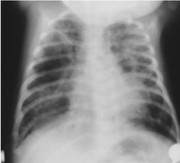
🔍 Figure: Chest X-ray findings in bronchopulmonary dysplasia (BPD): bilateral hyperinflation, coarse interstitial opacities, and cystic lucencies (pneumatoceles/cysts), typical of moderate to severe BPD.
💡 Examiner instruction (interactive): This is a case of Bronchopulmonary Dysplasia (BPD) (chronic lung disease of prematurity). The candidate must recognize the definition of BPD (oxygen requirement at 36 weeks PMA or discharge), the radiographic features (hyperinflation, interstitial markings, cysts), and associated complications (pulmonary hypertension, neurodevelopmental impairment, growth failure). The candidate should discuss the pathophysiology (arrested alveolar and vascular development), management (oxygen targeting, diuretics, bronchodilators, dexamethasone for severe BPD, pulmonary hypertension evaluation, nutrition), and long-term prognosis (pulmonary function, neurodevelopmental follow-up, need for home oxygen).
🔍 Examiner Questions (interactive) – Click to reveal model answers
❓ Q1 (Examiner): “What is the definition of bronchopulmonary dysplasia (BPD)? Classify the severity of BPD in this infant based on the NICHD 2018 criteria.”
✅ Candidate's answer:
• Definition (NICHD 2018): For infants <32 weeks gestation, BPD is diagnosed at 36 weeks PMA if the infant requires supplemental oxygen for ≥28 days AND has ≥3 consecutive days of oxygen/positive pressure at 36 weeks PMA.
• Classification (NICHD 2018) at 36 weeks PMA:
- Grade I (Mild BPD): Breathing room air (no supplemental O2).
- Grade II (Moderate BPD): Requires nasal cannula ≤2 L/min to maintain SpO2 90-95%.
- Grade III (Severe BPD): Requires nasal cannula >2 L/min, or non-invasive positive pressure (CPAP/BiPAP), or invasive ventilation.
- Grade III(A) (Lethal BPD): Death from respiratory failure between 14 days and 36 weeks PMA.
• This infant: At 42 weeks PMA (still meeting criteria for BPD as ongoing oxygen requirement), he requires 0.3 L/min nasal cannula → Moderate BPD (Grade II).
• Note: If he still requires oxygen at 36 weeks PMA, he would be classified accordingly.
• Definition (NICHD 2018): For infants <32 weeks gestation, BPD is diagnosed at 36 weeks PMA if the infant requires supplemental oxygen for ≥28 days AND has ≥3 consecutive days of oxygen/positive pressure at 36 weeks PMA.
• Classification (NICHD 2018) at 36 weeks PMA:
- Grade I (Mild BPD): Breathing room air (no supplemental O2).
- Grade II (Moderate BPD): Requires nasal cannula ≤2 L/min to maintain SpO2 90-95%.
- Grade III (Severe BPD): Requires nasal cannula >2 L/min, or non-invasive positive pressure (CPAP/BiPAP), or invasive ventilation.
- Grade III(A) (Lethal BPD): Death from respiratory failure between 14 days and 36 weeks PMA.
• This infant: At 42 weeks PMA (still meeting criteria for BPD as ongoing oxygen requirement), he requires 0.3 L/min nasal cannula → Moderate BPD (Grade II).
• Note: If he still requires oxygen at 36 weeks PMA, he would be classified accordingly.
❓ Q2 (Examiner): “Explain the pathophysiology of the ‘new BPD’ (modern BPD). How does it differ from classic BPD described by Northway in 1967?”
✅ Candidate's answer:
• Classic BPD (Northway 1967): Occurred in relatively more mature preterm infants (32-34 weeks) who required high-pressure ventilation and high FiO2 for severe RDS. Pathology: airway injury, fibrosis, smooth muscle hypertrophy, alternating atelectasis and hyperinflation (“bubbly” lungs).
• New BPD (modern era, post-surfactant and antenatal steroids): Affects extremely preterm infants (<28 weeks). Pathology: arrest of alveolar and vascular development (alveolar simplification, dysmorphic capillaries) rather than severe fibrosis. Interruption of normal septation leads to fewer, larger alveoli and reduced surface area for gas exchange.
• Key contributors:
- Prematurity (saccular stage lung development).
- Mechanical ventilation (volutrauma, barotrauma).
- Oxygen toxicity (free radical injury).
- Inflammation (antenatal chorioamnionitis, postnatal sepsis).
- Patent ductus arteriosus (PDA).
- Inadequate nutrition.
• Result: Impaired gas exchange, decreased lung compliance, increased airway resistance, and susceptibility to pulmonary hypertension.
• Classic BPD (Northway 1967): Occurred in relatively more mature preterm infants (32-34 weeks) who required high-pressure ventilation and high FiO2 for severe RDS. Pathology: airway injury, fibrosis, smooth muscle hypertrophy, alternating atelectasis and hyperinflation (“bubbly” lungs).
• New BPD (modern era, post-surfactant and antenatal steroids): Affects extremely preterm infants (<28 weeks). Pathology: arrest of alveolar and vascular development (alveolar simplification, dysmorphic capillaries) rather than severe fibrosis. Interruption of normal septation leads to fewer, larger alveoli and reduced surface area for gas exchange.
• Key contributors:
- Prematurity (saccular stage lung development).
- Mechanical ventilation (volutrauma, barotrauma).
- Oxygen toxicity (free radical injury).
- Inflammation (antenatal chorioamnionitis, postnatal sepsis).
- Patent ductus arteriosus (PDA).
- Inadequate nutrition.
• Result: Impaired gas exchange, decreased lung compliance, increased airway resistance, and susceptibility to pulmonary hypertension.
❓ Q3 (Examiner): “What are the major risk factors for developing BPD in extremely preterm infants?”
✅ Candidate's answer:
• Extreme prematurity (GA <28 weeks) – most important risk factor.
• Low birth weight (<1000 g) – VLBW/ELBW.
• Respiratory distress syndrome (RDS) requiring mechanical ventilation and supplemental oxygen.
• Prolonged mechanical ventilation (especially >7 days).
• High FiO2 exposure (oxygen toxicity).
• Patent ductus arteriosus (PDA) – hemodynamically significant PDA increases pulmonary blood flow and pulmonary edema.
• Chorioamnionitis / postnatal sepsis / necrotizing enterocolitis (NEC) – inflammation exacerbates lung injury.
• Fluid overload (excessive fluid administration in first week).
• Male sex.
• Intrauterine growth restriction (IUGR).
• Lack of antenatal corticosteroids.
• Extreme prematurity (GA <28 weeks) – most important risk factor.
• Low birth weight (<1000 g) – VLBW/ELBW.
• Respiratory distress syndrome (RDS) requiring mechanical ventilation and supplemental oxygen.
• Prolonged mechanical ventilation (especially >7 days).
• High FiO2 exposure (oxygen toxicity).
• Patent ductus arteriosus (PDA) – hemodynamically significant PDA increases pulmonary blood flow and pulmonary edema.
• Chorioamnionitis / postnatal sepsis / necrotizing enterocolitis (NEC) – inflammation exacerbates lung injury.
• Fluid overload (excessive fluid administration in first week).
• Male sex.
• Intrauterine growth restriction (IUGR).
• Lack of antenatal corticosteroids.
❓ Q4 (Examiner): “Describe the chest X-ray findings in BPD as seen in the image. What other imaging modalities are used?”
✅ Candidate's answer:
• Chest X-ray findings in BPD:
- Hyperinflation (flattened diaphragms, increased anteroposterior diameter).
- Coarse bilateral interstitial markings (reticular pattern).
- Cystic lucencies (pneumatoceles, alternating areas of overinflation and atelectasis).
- Cardiomegaly (if pulmonary hypertension or cor pulmonale is present).
- Wandering atelectasis (patchy opacities).
• Other imaging modalities:
- CT scan (high-resolution): Shows more detailed cystic changes, air trapping, and mosaic perfusion. Not routinely performed but useful for research or refractory cases.
- Echocardiography: Essential to evaluate for pulmonary hypertension (PH) – a common complication of BPD (present in 15-40% of severe BPD). Assesses right ventricular hypertrophy, septal flattening, tricuspid regurgitation jet velocity.
- Ventilation-perfusion (V/Q) scan: Rarely used.
• Chest X-ray findings in BPD:
- Hyperinflation (flattened diaphragms, increased anteroposterior diameter).
- Coarse bilateral interstitial markings (reticular pattern).
- Cystic lucencies (pneumatoceles, alternating areas of overinflation and atelectasis).
- Cardiomegaly (if pulmonary hypertension or cor pulmonale is present).
- Wandering atelectasis (patchy opacities).
• Other imaging modalities:
- CT scan (high-resolution): Shows more detailed cystic changes, air trapping, and mosaic perfusion. Not routinely performed but useful for research or refractory cases.
- Echocardiography: Essential to evaluate for pulmonary hypertension (PH) – a common complication of BPD (present in 15-40% of severe BPD). Assesses right ventricular hypertrophy, septal flattening, tricuspid regurgitation jet velocity.
- Ventilation-perfusion (V/Q) scan: Rarely used.
❓ Q5 (Examiner): “What is the recommended target oxygen saturation range for infants with BPD? Why is hyperoxia and hypoxia both harmful?”
✅ Candidate's answer:
• Target SpO2 range: 90-95% for most infants with BPD (some guidelines use 92-96%).
• Why avoid hypoxia (SpO2 <88-90%):
- Worsens pulmonary vasoconstriction → exacerbates pulmonary hypertension.
- Increases work of breathing and oxygen consumption.
- Impairs growth and neurodevelopment.
• Why avoid hyperoxia (SpO2 >96-97%):
- Free radical injury (oxygen toxicity) to developing lungs.
- May contribute to worsening BPD.
- Potential association with severe retinopathy of prematurity (ROP).
• Individualized targets may be needed for infants with PH (aim for SpO2 92-96%).
• Weaning oxygen: Stepwise reduction (e.g., decrease by 0.05-0.1 L/min q24-48h if stable) and monitor SpO2 and clinical signs.
• Target SpO2 range: 90-95% for most infants with BPD (some guidelines use 92-96%).
• Why avoid hypoxia (SpO2 <88-90%):
- Worsens pulmonary vasoconstriction → exacerbates pulmonary hypertension.
- Increases work of breathing and oxygen consumption.
- Impairs growth and neurodevelopment.
• Why avoid hyperoxia (SpO2 >96-97%):
- Free radical injury (oxygen toxicity) to developing lungs.
- May contribute to worsening BPD.
- Potential association with severe retinopathy of prematurity (ROP).
• Individualized targets may be needed for infants with PH (aim for SpO2 92-96%).
• Weaning oxygen: Stepwise reduction (e.g., decrease by 0.05-0.1 L/min q24-48h if stable) and monitor SpO2 and clinical signs.
❓ Q6 (Examiner): “What is the role of diuretics (furosemide, chlorothiazide) in BPD management? Discuss benefits and risks.”
✅ Candidate's answer:
• Role: Diuretics reduce pulmonary interstitial edema, improving lung compliance and gas exchange. They are used for acute worsening or chronic management of BPD.
• Furosemide (loop diuretic):
- Dose: 1-2 mg/kg/dose IV/PO q12-24h.
- Provides rapid improvement in pulmonary function (hours).
- Side effects: Hypokalemia, hypochloremia, metabolic alkalosis, hypocalcemia, nephrocalcinosis, ototoxicity.
• Chlorothiazide (thiazide) ± spironolactone:
- Used for chronic therapy.
- Less potent, fewer electrolyte disturbances than loop diuretics.
- Often used in combination to offset potassium loss.
• Risks of long-term diuretics:
- Electrolyte imbalance (monitor Na, K, Cl, Ca).
- Nephrocalcinosis (especially furosemide in premature infants).
- Ototoxicity.
- May impair growth.
• Diuretics are not routinely recommended for all BPD infants; use when there is clinical evidence of pulmonary edema.
• Role: Diuretics reduce pulmonary interstitial edema, improving lung compliance and gas exchange. They are used for acute worsening or chronic management of BPD.
• Furosemide (loop diuretic):
- Dose: 1-2 mg/kg/dose IV/PO q12-24h.
- Provides rapid improvement in pulmonary function (hours).
- Side effects: Hypokalemia, hypochloremia, metabolic alkalosis, hypocalcemia, nephrocalcinosis, ototoxicity.
• Chlorothiazide (thiazide) ± spironolactone:
- Used for chronic therapy.
- Less potent, fewer electrolyte disturbances than loop diuretics.
- Often used in combination to offset potassium loss.
• Risks of long-term diuretics:
- Electrolyte imbalance (monitor Na, K, Cl, Ca).
- Nephrocalcinosis (especially furosemide in premature infants).
- Ototoxicity.
- May impair growth.
• Diuretics are not routinely recommended for all BPD infants; use when there is clinical evidence of pulmonary edema.
❓ Q7 (Examiner): “Do bronchodilators (albuterol, ipratropium) have a role in BPD? When should they be used?”
✅ Candidate's answer:
• Inhaled bronchodilators (β2-agonists like albuterol, anticholinergics like ipratropium) are used to treat bronchospasm and airway reactivity in infants with BPD.
• Indications for trial of bronchodilator:
- Wheezing, increased work of breathing, acute desaturations responsive to albuterol.
- Positive response to a trial dose (improved pulmonary function or clinical status).
• Albuterol (salbutamol) – dose: 2 puffs (100 mcg/puff) via MDI with spacer/mask or 0.05-0.1 mg/kg neb (max 1.25 mg) q4-6h as needed.
• Adverse effects: Tachycardia, hypokalemia, jitteriness.
• Not all infants with BPD respond; use only if clear clinical benefit.
• Ipratropium bromide: May be added in severe cases for additional bronchodilation.
• Inhaled bronchodilators (β2-agonists like albuterol, anticholinergics like ipratropium) are used to treat bronchospasm and airway reactivity in infants with BPD.
• Indications for trial of bronchodilator:
- Wheezing, increased work of breathing, acute desaturations responsive to albuterol.
- Positive response to a trial dose (improved pulmonary function or clinical status).
• Albuterol (salbutamol) – dose: 2 puffs (100 mcg/puff) via MDI with spacer/mask or 0.05-0.1 mg/kg neb (max 1.25 mg) q4-6h as needed.
• Adverse effects: Tachycardia, hypokalemia, jitteriness.
• Not all infants with BPD respond; use only if clear clinical benefit.
• Ipratropium bromide: May be added in severe cases for additional bronchodilation.
❓ Q8 (Examiner): “What is the role and controversy of systemic dexamethasone in BPD? When is it used?”
✅ Candidate's answer:
• Dexamethasone reduces lung inflammation and improves respiratory mechanics, allowing extubation and decreasing BPD risk.
• Controversy: Systemic dexamethasone (especially early use, high doses, prolonged courses) is associated with increased risk of cerebral palsy (CP), neurodevelopmental impairment (NDI), and poor brain growth.
• Current recommendations (NICHD, AAP):
- Avoid routine use in infants at low risk of BPD.
- Reserve for infants at high risk of severe BPD (e.g., still ventilator-dependent at 2-3 weeks of age with high oxygen requirement).
- Use low dose, short course (e.g., cumulative dose ≤0.89 mg/kg over 10 days).
- Taper regimen (e.g., 0.2 mg/kg/day for 3 days, then 0.1, 0.05).
- Informed consent and discussion of risks/benefits with parents.
• Dexamethasone should not be used for prevention of BPD in intubated infants <7 days of age (high risk of NDI).
• Inhaled corticosteroids (budesonide, fluticasone) have minimal systemic effects but limited efficacy for BPD prevention.
• Dexamethasone reduces lung inflammation and improves respiratory mechanics, allowing extubation and decreasing BPD risk.
• Controversy: Systemic dexamethasone (especially early use, high doses, prolonged courses) is associated with increased risk of cerebral palsy (CP), neurodevelopmental impairment (NDI), and poor brain growth.
• Current recommendations (NICHD, AAP):
- Avoid routine use in infants at low risk of BPD.
- Reserve for infants at high risk of severe BPD (e.g., still ventilator-dependent at 2-3 weeks of age with high oxygen requirement).
- Use low dose, short course (e.g., cumulative dose ≤0.89 mg/kg over 10 days).
- Taper regimen (e.g., 0.2 mg/kg/day for 3 days, then 0.1, 0.05).
- Informed consent and discussion of risks/benefits with parents.
• Dexamethasone should not be used for prevention of BPD in intubated infants <7 days of age (high risk of NDI).
• Inhaled corticosteroids (budesonide, fluticasone) have minimal systemic effects but limited efficacy for BPD prevention.
❓ Q9 (Examiner): “How common is pulmonary hypertension (PH) in BPD? How is it diagnosed and managed?”
✅ Candidate's answer:
• Incidence: PH occurs in 15-40% of infants with moderate-severe BPD. Risk increases with BPD severity.
• Diagnosis:
- Screening echocardiogram at 36 weeks PMA (or earlier if clinical suspicion).
- Signs: Right ventricular hypertrophy, septal flattening, tricuspid regurgitation jet velocity >2.5-3 m/s, dilated pulmonary artery, right-to-left or bidirectional shunting.
• Management:
1️⃣ Optimize oxygenation (avoid hypoxia – SpO2 target 92-96%).
2️⃣ Treat underlying BPD (diuretics, bronchodilators, nutrition).
3️⃣ Pulmonary vasodilators: Sildenafil (phosphodiesterase-5 inhibitor) – dose 0.5-1 mg/kg/dose q8h (off-label).
4️⃣ Inhaled nitric oxide (iNO) – used in acute exacerbations.
5️⃣ Bosentan (endothelin antagonist) – second-line.
6️⃣ Avoid hypoxia, acidosis, and hypercapnia.
7️⃣ Prognosis: PH may resolve with lung growth but can persist; associated with increased mortality.
• Incidence: PH occurs in 15-40% of infants with moderate-severe BPD. Risk increases with BPD severity.
• Diagnosis:
- Screening echocardiogram at 36 weeks PMA (or earlier if clinical suspicion).
- Signs: Right ventricular hypertrophy, septal flattening, tricuspid regurgitation jet velocity >2.5-3 m/s, dilated pulmonary artery, right-to-left or bidirectional shunting.
• Management:
1️⃣ Optimize oxygenation (avoid hypoxia – SpO2 target 92-96%).
2️⃣ Treat underlying BPD (diuretics, bronchodilators, nutrition).
3️⃣ Pulmonary vasodilators: Sildenafil (phosphodiesterase-5 inhibitor) – dose 0.5-1 mg/kg/dose q8h (off-label).
4️⃣ Inhaled nitric oxide (iNO) – used in acute exacerbations.
5️⃣ Bosentan (endothelin antagonist) – second-line.
6️⃣ Avoid hypoxia, acidosis, and hypercapnia.
7️⃣ Prognosis: PH may resolve with lung growth but can persist; associated with increased mortality.
❓ Q10 (Examiner): “This infant has poor growth (2.5 kg at 42 weeks PMA). Why is nutrition important in BPD? What nutritional strategies are used?”
✅ Candidate's answer:
• Why nutrition matters: BPD infants have increased caloric expenditure (increased work of breathing, chronic inflammation). Malnutrition impairs lung growth and repair, increases infection risk, and worsens outcomes.
• Goals: Achieve weight gain of 15-30 g/day; head circumference growth is crucial for neurodevelopment.
• Strategies:
1️⃣ Increased caloric density: Fortified breast milk (24-30 kcal/oz) or preterm formula (24-30 kcal/oz).
2️⃣ Fluid restriction: 130-150 mL/kg/day (avoid excess fluid → pulmonary edema).
3️⃣ Vitamin/mineral supplementation: Vitamin A (reduced BPD risk), Vitamin D, calcium, phosphorus (osteopenia of prematurity), iron (for anemia).
4️⃣ Nasogastric (NG) or gastrostomy (G-tube) feeding if oral feeding is unsafe due to tachypnea or risk of aspiration.
5️⃣ Monitor growth and adjust feeds weekly.
• Why nutrition matters: BPD infants have increased caloric expenditure (increased work of breathing, chronic inflammation). Malnutrition impairs lung growth and repair, increases infection risk, and worsens outcomes.
• Goals: Achieve weight gain of 15-30 g/day; head circumference growth is crucial for neurodevelopment.
• Strategies:
1️⃣ Increased caloric density: Fortified breast milk (24-30 kcal/oz) or preterm formula (24-30 kcal/oz).
2️⃣ Fluid restriction: 130-150 mL/kg/day (avoid excess fluid → pulmonary edema).
3️⃣ Vitamin/mineral supplementation: Vitamin A (reduced BPD risk), Vitamin D, calcium, phosphorus (osteopenia of prematurity), iron (for anemia).
4️⃣ Nasogastric (NG) or gastrostomy (G-tube) feeding if oral feeding is unsafe due to tachypnea or risk of aspiration.
5️⃣ Monitor growth and adjust feeds weekly.
❓ Q11 (Examiner): “When is home oxygen therapy indicated for an infant with BPD? What are the criteria for discharge on oxygen?”
✅ Candidate's answer:
• Indications for home oxygen: Infant requires supplemental oxygen to maintain SpO2 ≥90-92% at rest, during feeding, and during sleep, AND has no other significant medical instability.
• Discharge criteria for home oxygen:
1️⃣ Stable oxygen requirement (no acute desaturations).
2️⃣ Adequate weight gain (>20 g/day).
3️⃣ Feeding well (able to take full enteral feeds, or stable on NG/G-tube).
4️⃣ No apnea/bradycardia events for ≥5 days (off caffeine).
5️⃣ Parents trained in oxygen administration, pulse oximetry, and emergency plan.
6️⃣ Home nursing and equipment arranged (oxygen concentrator, portable tanks, pulse oximeter).
7️⃣ Weaning plan established (evaluate stepwise wean every 2-4 weeks as outpatient).
• Follow-up: After discharge, wean oxygen gradually; most infants wean off oxygen by 1-2 years corrected age.
• Indications for home oxygen: Infant requires supplemental oxygen to maintain SpO2 ≥90-92% at rest, during feeding, and during sleep, AND has no other significant medical instability.
• Discharge criteria for home oxygen:
1️⃣ Stable oxygen requirement (no acute desaturations).
2️⃣ Adequate weight gain (>20 g/day).
3️⃣ Feeding well (able to take full enteral feeds, or stable on NG/G-tube).
4️⃣ No apnea/bradycardia events for ≥5 days (off caffeine).
5️⃣ Parents trained in oxygen administration, pulse oximetry, and emergency plan.
6️⃣ Home nursing and equipment arranged (oxygen concentrator, portable tanks, pulse oximeter).
7️⃣ Weaning plan established (evaluate stepwise wean every 2-4 weeks as outpatient).
• Follow-up: After discharge, wean oxygen gradually; most infants wean off oxygen by 1-2 years corrected age.
❓ Q12 (Examiner): “What are the long-term neurodevelopmental outcomes for infants with moderate-severe BPD?”
✅ Candidate's answer:
• Infants with BPD, especially moderate-severe, are at significantly increased risk of neurodevelopmental impairment (NDI) compared to preterm infants without BPD.
• Risks include:
- Cerebral palsy (CP) – spastic diplegia or quadriplegia (10-20%).
- Cognitive delays (IQ scores lower by 10-15 points).
- Language and speech delays.
- Hearing impairment (sensorineural).
- Visual impairment (ROP, cortical visual impairment).
- Attention-deficit/hyperactivity disorder (ADHD).
- School performance problems (learning disabilities).
• Factors contributing: Hypoxemia, hypercapnia, growth failure, prolonged hospitalization, less parent-infant interaction, intraventricular hemorrhage (IVH), periventricular leukomalacia (PVL).
• Follow-up: All infants with BPD need multidisciplinary follow-up (neonatology, developmental pediatrics, neurology, audiology, ophthalmology, physical/occupational/speech therapy).
• Early intervention services improve outcomes.
• Infants with BPD, especially moderate-severe, are at significantly increased risk of neurodevelopmental impairment (NDI) compared to preterm infants without BPD.
• Risks include:
- Cerebral palsy (CP) – spastic diplegia or quadriplegia (10-20%).
- Cognitive delays (IQ scores lower by 10-15 points).
- Language and speech delays.
- Hearing impairment (sensorineural).
- Visual impairment (ROP, cortical visual impairment).
- Attention-deficit/hyperactivity disorder (ADHD).
- School performance problems (learning disabilities).
• Factors contributing: Hypoxemia, hypercapnia, growth failure, prolonged hospitalization, less parent-infant interaction, intraventricular hemorrhage (IVH), periventricular leukomalacia (PVL).
• Follow-up: All infants with BPD need multidisciplinary follow-up (neonatology, developmental pediatrics, neurology, audiology, ophthalmology, physical/occupational/speech therapy).
• Early intervention services improve outcomes.
❓ Q13 (Examiner): “What are the long-term pulmonary outcomes for BPD survivors? Do they have asthma or lung function abnormalities?”
✅ Candidate's answer:
• Childhood:
- Increased risk of wheezing and asthma (2-3x higher than term controls).
- Rehospitalization for respiratory infections (RSV, influenza) in first 2 years – RSV prophylaxis (palivizumab) is indicated.
- Abnormal pulmonary function tests (PFTs): Airflow obstruction (low FEV1, low FEV1/FVC), air trapping (high RV/TLC), reduced diffusion capacity (low DLCO).
• Adolescence and adulthood:
- Many survivors have persistent lung function abnormalities (mild to moderate obstruction).
- Risk of early COPD (chronic obstructive pulmonary disease) phenotype.
- Exercise intolerance (reduced VO2 max).
- No cure, but symptoms often improve over time; most adults with BPD lead normal lives with mild limitations.
• Management: Avoid smoking, monitor lung function, treat wheezing episodes, encourage physical activity.
• Childhood:
- Increased risk of wheezing and asthma (2-3x higher than term controls).
- Rehospitalization for respiratory infections (RSV, influenza) in first 2 years – RSV prophylaxis (palivizumab) is indicated.
- Abnormal pulmonary function tests (PFTs): Airflow obstruction (low FEV1, low FEV1/FVC), air trapping (high RV/TLC), reduced diffusion capacity (low DLCO).
• Adolescence and adulthood:
- Many survivors have persistent lung function abnormalities (mild to moderate obstruction).
- Risk of early COPD (chronic obstructive pulmonary disease) phenotype.
- Exercise intolerance (reduced VO2 max).
- No cure, but symptoms often improve over time; most adults with BPD lead normal lives with mild limitations.
• Management: Avoid smoking, monitor lung function, treat wheezing episodes, encourage physical activity.
❓ Q14 (Examiner): “What strategies are effective in preventing or reducing the severity of BPD?”
✅ Candidate's answer:
• Antenatal:
- Antenatal corticosteroids (betamethasone) for threatened preterm labor.
- Magnesium sulfate for neuroprotection (also may reduce severe BPD? inconclusive).
- Avoid elective C-section before 39 weeks.
• Delivery room:
- Delayed cord clamping (improves hemodynamic stability).
- Gentle ventilation (avoid high tidal volumes, use CPAP if possible).
• Postnatal (NICU):
1️⃣ Surfactant therapy (early rescue surfactant reduces BPD).
2️⃣ Non-invasive ventilation (CPAP, NIPPV, HFNC) – reduce intubation days.
3️⃣ Volume-targeted ventilation (reduces lung injury).
4️⃣ Caffeine therapy (for apnea of prematurity) – reduces BPD and facilitates extubation.
5️⃣ Vitamin A supplementation (5,000 IU IM three times weekly x 4 weeks) – modest reduction in BPD.
6️⃣ Inhaled nitric oxide (iNO) – NOT effective for BPD prevention in preterm infants (no benefit).
7️⃣ Fluid restriction (avoid excess fluid in first week).
8️⃣ Early treatment of PDA (if hemodynamically significant).
9️⃣ Nutritional optimization.
• Avoid postnatal corticosteroids for prevention (use only for treatment of severe BPD).
• Antenatal:
- Antenatal corticosteroids (betamethasone) for threatened preterm labor.
- Magnesium sulfate for neuroprotection (also may reduce severe BPD? inconclusive).
- Avoid elective C-section before 39 weeks.
• Delivery room:
- Delayed cord clamping (improves hemodynamic stability).
- Gentle ventilation (avoid high tidal volumes, use CPAP if possible).
• Postnatal (NICU):
1️⃣ Surfactant therapy (early rescue surfactant reduces BPD).
2️⃣ Non-invasive ventilation (CPAP, NIPPV, HFNC) – reduce intubation days.
3️⃣ Volume-targeted ventilation (reduces lung injury).
4️⃣ Caffeine therapy (for apnea of prematurity) – reduces BPD and facilitates extubation.
5️⃣ Vitamin A supplementation (5,000 IU IM three times weekly x 4 weeks) – modest reduction in BPD.
6️⃣ Inhaled nitric oxide (iNO) – NOT effective for BPD prevention in preterm infants (no benefit).
7️⃣ Fluid restriction (avoid excess fluid in first week).
8️⃣ Early treatment of PDA (if hemodynamically significant).
9️⃣ Nutritional optimization.
• Avoid postnatal corticosteroids for prevention (use only for treatment of severe BPD).
🗣️ Examiner's probing / high-yield points (BPD):
• "What is the definition of BPD at 36 weeks PMA?" → Oxygen requirement for ≥28 days and ≥3 consecutive days of oxygen/PPV at 36 weeks PMA.
• "What is the target SpO2 in BPD?" → 90-95% (92-96% if PH).
• "What is the most serious complication of BPD?" → Pulmonary hypertension (PH).
• "What is the role of dexamethasone?" → Reserved for severe BPD (high risk of NDI with early/high-dose use).
• "What is the pathophysiology of new BPD?" → Arrested alveolar/vascular development, not fibrosis.
• "What prophylaxis is indicated for BPD infants?" → Palivizumab for RSV, Vitamin A.
• "What are long-term pulmonary outcomes?" → Asthma, obstructive PFTs, exercise intolerance.
• "What is the definition of BPD at 36 weeks PMA?" → Oxygen requirement for ≥28 days and ≥3 consecutive days of oxygen/PPV at 36 weeks PMA.
• "What is the target SpO2 in BPD?" → 90-95% (92-96% if PH).
• "What is the most serious complication of BPD?" → Pulmonary hypertension (PH).
• "What is the role of dexamethasone?" → Reserved for severe BPD (high risk of NDI with early/high-dose use).
• "What is the pathophysiology of new BPD?" → Arrested alveolar/vascular development, not fibrosis.
• "What prophylaxis is indicated for BPD infants?" → Palivizumab for RSV, Vitamin A.
• "What are long-term pulmonary outcomes?" → Asthma, obstructive PFTs, exercise intolerance.
📘 Bronchopulmonary Dysplasia (BPD) – Core Revision for TOACS
🔍 Definition (NICHD 2018)
For infants <32 weeks: O2 requirement for ≥28 days AND O2/PPV at 36 weeks PMA. Mild (room air), Moderate (≤2 L/min NC), Severe (>2 L/min NC or PPV).
For infants <32 weeks: O2 requirement for ≥28 days AND O2/PPV at 36 weeks PMA. Mild (room air), Moderate (≤2 L/min NC), Severe (>2 L/min NC or PPV).
🩺 Pathophysiology (New BPD)
Arrested alveolar and vascular development (alveolar simplification, dysmorphic capillaries). Inflammatory injury from MV, O2, infection. Not the fibrotic "classic BPD".
Arrested alveolar and vascular development (alveolar simplification, dysmorphic capillaries). Inflammatory injury from MV, O2, infection. Not the fibrotic "classic BPD".
📋 Clinical Features
Oxygen dependency at 36 weeks PMA, tachypnea, retractions, desaturations with feeds/activity, poor growth, episodic wheezing, signs of PH.
Oxygen dependency at 36 weeks PMA, tachypnea, retractions, desaturations with feeds/activity, poor growth, episodic wheezing, signs of PH.
💊 Management
Target SpO2 90-95%. Diuretics (furosemide, thiazides) for pulmonary edema. Bronchodilators for wheezing. Dexamethasone (low dose, short course) for severe cases. Optimize nutrition (caloric density). Treat PH with sildenafil/oxygen.
Target SpO2 90-95%. Diuretics (furosemide, thiazides) for pulmonary edema. Bronchodilators for wheezing. Dexamethasone (low dose, short course) for severe cases. Optimize nutrition (caloric density). Treat PH with sildenafil/oxygen.
🩺 Complications
Pulmonary hypertension (15-40%), neurodevelopmental impairment, cerebral palsy, growth failure, hearing loss, reactive airway disease, rehospitalization for RSV.
Pulmonary hypertension (15-40%), neurodevelopmental impairment, cerebral palsy, growth failure, hearing loss, reactive airway disease, rehospitalization for RSV.
📈 Long-term Outcomes
Pulmonary: wheezing, obstructive PFTs, exercise intolerance. Neurodevelopmental: lower IQ, CP, ADHD. Most wean oxygen by 1-2 years corrected age.
Pulmonary: wheezing, obstructive PFTs, exercise intolerance. Neurodevelopmental: lower IQ, CP, ADHD. Most wean oxygen by 1-2 years corrected age.
⭐ High-yield pearls for TOACS (BPD):
• Definition at 36 weeks PMA: Mild (RA), Moderate (≤2L NC), Severe (>2L NC or PPV).
• Pathophysiology: Arrested lung development, not fibrosis.
• Target SpO2: 90-95% (92-96% if PH).
• Home oxygen criteria: stable O2, good growth, feeding, parent training.
• Dexamethasone: only for severe BPD, low dose, short course (risk of CP).
• Screen all moderate-severe BPD for pulmonary hypertension (echocardiogram).
• RSV prophylaxis (palivizumab) for BPD infants <12 months.
• Neurodevelopmental follow-up is essential.
• Definition at 36 weeks PMA: Mild (RA), Moderate (≤2L NC), Severe (>2L NC or PPV).
• Pathophysiology: Arrested lung development, not fibrosis.
• Target SpO2: 90-95% (92-96% if PH).
• Home oxygen criteria: stable O2, good growth, feeding, parent training.
• Dexamethasone: only for severe BPD, low dose, short course (risk of CP).
• Screen all moderate-severe BPD for pulmonary hypertension (echocardiogram).
• RSV prophylaxis (palivizumab) for BPD infants <12 months.
• Neurodevelopmental follow-up is essential.
🗣️ Candidate's role-play & examiner feedback
💬 To the candidate (role‑play): You will be asked the 14 questions from the Examiner Q&A tab. This station tests knowledge of bronchopulmonary dysplasia – definition (NICHD 2018, mild/moderate/severe), pathophysiology (arrested alveolar development), radiographic findings (hyperinflation, interstitial markings, cysts), complications (PH, NDI, poor growth), and management (oxygen targeting, diuretics, bronchodilators, nutrition, home oxygen, dexamethasone controversy). Demonstrate understanding of long-term pulmonary and neurodevelopmental outcomes. Provide empathetic counseling to parents about home oxygen and follow-up needs.
📝 Examiner Marking Grid (BPD – TOACS station):
- ✅ Recognizes BPD as the diagnosis and defines BPD per NICHD 2018
- ✅ Describes “new BPD” pathophysiology (arrested alveolar/vascular development)
- ✅ Lists risk factors (prematurity, MV, oxygen, inflammation, PDA, male sex)
- ✅ Interprets chest X-ray (hyperinflation, interstitial markings, cysts)
- ✅ States oxygen target (SpO2 90-95%) and rationale
- ✅ Discusses management: diuretics, bronchodilators, nutrition, home oxygen criteria
- ✅ Explains dexamethasone controversy (risk of CP, use only in severe BPD, low dose)
- ✅ Recognizes pulmonary hypertension as serious complication and need for echocardiography
- ✅ Discusses long-term pulmonary (wheezing, PFT abnormalities) and neurodevelopmental outcomes
- ✅ Counsels parents about home oxygen, follow-up, and prognosis
📚 Key references: Nelson Textbook of Pediatrics 22e (Chapter 127 – Bronchopulmonary Dysplasia), NICHD 2018 BPD consensus definition, AAP guidelines for home oxygen therapy, CPSP protocols for chronic lung disease of prematurity.