FCPS Paediatrics TOACS · Interactive Station
🩺 Chordee (Downward Penile Curvature) — Congenital penile anomaly, associated hypospadias, surgical correction
📚 Paeds Online – paeds.online
⚕️ OBSERVED STATION · CPSP FORMAT · 8 MINUTES · SEPARATE TABS · CLINICAL PHOTO INCLUDED
📖 Problem-oriented Clinical Scenario + Photograph
👶🏻 Clinical Scenario (read aloud – 2 min):
A 4-month-old term male infant is brought to the pediatric surgery clinic by his parents. They are concerned about the appearance of the penis. The mother reports that since birth, she has noticed that the penis curves downward when the baby is changed or during erection (crying). The urethral meatus is normally located at the tip of the glans. There is no history of urinary obstruction, and the baby voids in a straight stream. On examination: The penis is otherwise normal in size. The foreskin is intact (uncircumcised). When the penis is gently stretched, there is a ventral (downward) curvature of the penile shaft without associated hypospadias. The curvature is >30 degrees. No other anomalies are noted.
A clinical photograph of the penile curvature is shown below.
Task: Describe the findings, propose the most likely diagnosis, differentiate from chordee with hypospadias, discuss the indications for surgery, and outline the surgical principles and long-term outcomes.
A 4-month-old term male infant is brought to the pediatric surgery clinic by his parents. They are concerned about the appearance of the penis. The mother reports that since birth, she has noticed that the penis curves downward when the baby is changed or during erection (crying). The urethral meatus is normally located at the tip of the glans. There is no history of urinary obstruction, and the baby voids in a straight stream. On examination: The penis is otherwise normal in size. The foreskin is intact (uncircumcised). When the penis is gently stretched, there is a ventral (downward) curvature of the penile shaft without associated hypospadias. The curvature is >30 degrees. No other anomalies are noted.
A clinical photograph of the penile curvature is shown below.
Task: Describe the findings, propose the most likely diagnosis, differentiate from chordee with hypospadias, discuss the indications for surgery, and outline the surgical principles and long-term outcomes.
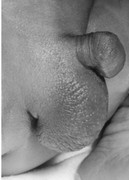
🔍 Figure: Chordee – downward (ventral) curvature of the penis. The urethral meatus is at the tip of the glans (no hypospadias). This is congenital chordee without hypospadias.
💡 Examiner instruction (interactive): The candidate will be asked to identify chordee, differentiate from hypospadias-associated chordee, discuss classification (membranous, corporeal), describe the artificial erection test, outline surgical indications (severe curvature, functional impairment, parental concern), and discuss postoperative outcomes and complications.
🔍 Examiner Questions (interactive) – Click to reveal model answers
❓ Q1 (Examiner): “Describe the findings in the image. What is the most likely diagnosis? Is the urethral meatus normally positioned?”
✅ Candidate's structured answer:
• Findings: Downward (ventral) curvature of the penile shaft. The urethral meatus is at the tip of the glans (normal position). No hypospadias. Foreskin intact.
• Diagnosis: Congenital chordee without hypospadias (isolated chordee).
• Findings: Downward (ventral) curvature of the penile shaft. The urethral meatus is at the tip of the glans (normal position). No hypospadias. Foreskin intact.
• Diagnosis: Congenital chordee without hypospadias (isolated chordee).
❓ Q2 (Examiner): “Define chordee. What is the difference between chordee without hypospadias and chordee associated with hypospadias?”
✅ Candidate's answer:
• Chordee: Ventral (downward) curvature of the penis, due to congenital shortening of the ventral tissues (skin, dartos fascia, corpus spongiosum, or tunica albuginea).
• Chordee without hypospadias (isolated): Urethral meatus is at the tip (normal). Curvature may be mild to severe. Less common (~10% of chordee cases).
• Chordee with hypospadias: Urethral meatus is located ventrally (on shaft, glans, or perineum). The ventral curvature is usually more severe. Much more common. Surgical repair must address both the hypospadias and the chordee.
• In both types, the curvature is due to dysgenetic ventral tissues; treatment involves surgical release (penile degloving, ventral corporotomy or plication).
• Chordee: Ventral (downward) curvature of the penis, due to congenital shortening of the ventral tissues (skin, dartos fascia, corpus spongiosum, or tunica albuginea).
• Chordee without hypospadias (isolated): Urethral meatus is at the tip (normal). Curvature may be mild to severe. Less common (~10% of chordee cases).
• Chordee with hypospadias: Urethral meatus is located ventrally (on shaft, glans, or perineum). The ventral curvature is usually more severe. Much more common. Surgical repair must address both the hypospadias and the chordee.
• In both types, the curvature is due to dysgenetic ventral tissues; treatment involves surgical release (penile degloving, ventral corporotomy or plication).
❓ Q3 (Examiner): “How is chordee classified based on the anatomical structures involved (Devine and Horton classification)?”
✅ Candidate's answer:
• Type I (cutaneous chordee): Due to deficient/scarred ventral skin only. Least common. Corrected by skin release alone (degloving).
• Type II (fascial chordee): Due to fibrosis of dartos fascia (Buck's fascia). Requires excision of fibrotic tissue.
• Type III (corporeal chordee): Most common in isolated chordee. Due to disproportion between ventral and dorsal corpora cavernosa (asymmetric development). Requires ventral corporal tunica albuginea plication or dorsal corporeal grafting.
• Type IV (urethral chordee): Associated with hypospadias – due to dysplastic corpus spongiosum and urethral plate. Requires urethral plate division or urethroplasty.
• Accurate classification is done intraoperatively after degloving and artificial erection test.
• Type I (cutaneous chordee): Due to deficient/scarred ventral skin only. Least common. Corrected by skin release alone (degloving).
• Type II (fascial chordee): Due to fibrosis of dartos fascia (Buck's fascia). Requires excision of fibrotic tissue.
• Type III (corporeal chordee): Most common in isolated chordee. Due to disproportion between ventral and dorsal corpora cavernosa (asymmetric development). Requires ventral corporal tunica albuginea plication or dorsal corporeal grafting.
• Type IV (urethral chordee): Associated with hypospadias – due to dysplastic corpus spongiosum and urethral plate. Requires urethral plate division or urethroplasty.
• Accurate classification is done intraoperatively after degloving and artificial erection test.
❓ Q4 (Examiner): “What is the artificial erection test? How is it performed intraoperatively?”
✅ Candidate's answer:
• Purpose: To objectively assess the degree and cause of penile curvature during surgery, and to confirm complete correction after tissue release.
• Procedure (Gittes test):
1️⃣ A tourniquet (rubber band or Penrose drain) is placed at the base of the penis after degloving.
2️⃣ Normal saline is injected into one corpus cavernosum using a butterfly needle (23-25G) or through a small corporotomy.
3️⃣ The penis is observed for straightness. The angle of curvature is measured (goniometer).
4️⃣ After ventral tissue release (excision of fibrotic dartos, urethral plate division, or corporal plication), the test is repeated to confirm straightening.
5️⃣ The tourniquet is released after completion.
• Goal: Straight penis (<10-15° residual curvature).
• Purpose: To objectively assess the degree and cause of penile curvature during surgery, and to confirm complete correction after tissue release.
• Procedure (Gittes test):
1️⃣ A tourniquet (rubber band or Penrose drain) is placed at the base of the penis after degloving.
2️⃣ Normal saline is injected into one corpus cavernosum using a butterfly needle (23-25G) or through a small corporotomy.
3️⃣ The penis is observed for straightness. The angle of curvature is measured (goniometer).
4️⃣ After ventral tissue release (excision of fibrotic dartos, urethral plate division, or corporal plication), the test is repeated to confirm straightening.
5️⃣ The tourniquet is released after completion.
• Goal: Straight penis (<10-15° residual curvature).
❓ Q5 (Examiner): “When is surgical correction of chordee indicated in a child? At what age should surgery be performed?”
✅ Candidate's answer:
• Indications for surgery:
- Curvature >30 degrees (generally accepted threshold for functional impairment).
- Cosmetic concerns from parents/patient.
- Any degree of curvature associated with hypospadias requiring repair.
- Inability to pass a straight stream (if urethral meatus is displaced).
• Timing: Typically between 6-18 months of age (optimal 9-12 months).
- Early repair minimizes psychological impact, allows for better tissue healing, and avoids patient memory of the procedure.
- Can be performed during infancy (once the infant is >6 months and >10 kg).
- Ideally before toilet training.
• Indications for surgery:
- Curvature >30 degrees (generally accepted threshold for functional impairment).
- Cosmetic concerns from parents/patient.
- Any degree of curvature associated with hypospadias requiring repair.
- Inability to pass a straight stream (if urethral meatus is displaced).
• Timing: Typically between 6-18 months of age (optimal 9-12 months).
- Early repair minimizes psychological impact, allows for better tissue healing, and avoids patient memory of the procedure.
- Can be performed during infancy (once the infant is >6 months and >10 kg).
- Ideally before toilet training.
❓ Q6 (Examiner): “Describe the surgical principles and techniques for correcting isolated chordee without hypospadias.”
✅ Candidate's answer:
• Step 1 – Circumcision and degloving: Circumcision incision and deglove the penile skin down to the penoscrotal junction. This releases skin tethering (if cutaneous chordee).
• Step 2 – Artificial erection test: Assess residual curvature.
• Step 3 – Ventral tissue excision: If curvature persists, excise dysplastic dartos fascia and fibrotic tissue from the ventral midline.
• Step 4 – Corporal plication (Nesbit technique or tunica albuginea plication – TAP): For corporeal chordee. Place 2-4 non-absorbable sutures (PDS or Gore-Tex) in the dorsal tunica albuginea to shorten the dorsal side and straighten the penis. Alternatively, ventral corporotomy with grafting (if severe curvature).
• Step 5 – Recheck artificial erection: Confirm straightness.
• Step 6 – Skin closure: Re-approximate skin, often with a circumcision unless family declines.
• Step 1 – Circumcision and degloving: Circumcision incision and deglove the penile skin down to the penoscrotal junction. This releases skin tethering (if cutaneous chordee).
• Step 2 – Artificial erection test: Assess residual curvature.
• Step 3 – Ventral tissue excision: If curvature persists, excise dysplastic dartos fascia and fibrotic tissue from the ventral midline.
• Step 4 – Corporal plication (Nesbit technique or tunica albuginea plication – TAP): For corporeal chordee. Place 2-4 non-absorbable sutures (PDS or Gore-Tex) in the dorsal tunica albuginea to shorten the dorsal side and straighten the penis. Alternatively, ventral corporotomy with grafting (if severe curvature).
• Step 5 – Recheck artificial erection: Confirm straightness.
• Step 6 – Skin closure: Re-approximate skin, often with a circumcision unless family declines.
❓ Q7 (Examiner): “What is the Nesbit procedure? How does it differ from tunica albuginea plication (TAP) for chordee?”
✅ Candidate's answer:
• Nesbit procedure (classic): Elliptical excision of tunica albuginea from the convex (dorsal) side of the corpora, followed by closure. This shortens the longer side.
• Tunica albuginea plication (TAP): Multiple parallel plicating sutures placed on the dorsal tunica albuginea without excision (e.g., Lue procedure). Less invasive, lower risk of neurovascular bundle injury.
• Advantages of TAP: Simpler, avoids tunical excision, less erectile shortening.
• Advantages of Nesbit: More durable for severe curvatures (>45 degrees).
• Both are effective; TAP is preferred for mild-moderate chordee (<45°).
• Postoperative erectile function is excellent with both.
• Nesbit procedure (classic): Elliptical excision of tunica albuginea from the convex (dorsal) side of the corpora, followed by closure. This shortens the longer side.
• Tunica albuginea plication (TAP): Multiple parallel plicating sutures placed on the dorsal tunica albuginea without excision (e.g., Lue procedure). Less invasive, lower risk of neurovascular bundle injury.
• Advantages of TAP: Simpler, avoids tunical excision, less erectile shortening.
• Advantages of Nesbit: More durable for severe curvatures (>45 degrees).
• Both are effective; TAP is preferred for mild-moderate chordee (<45°).
• Postoperative erectile function is excellent with both.
❓ Q8 (Examiner): “What are the potential complications after chordee repair?”
✅ Candidate's answer:
• Early complications (<6 weeks):
- Bleeding / hematoma.
- Wound infection, wound dehiscence.
- Edema (self-limited).
- Urinary retention (rare).
- Meatal stenosis (if meatus involved).
• Late complications:
- Recurrent chordee (5-15%): Residual or recurrent curvature – may require reoperation.
- Penile shortening: Perceived loss of length (5-10 mm) due to dorsal plication.
- Erectile dysfunction: Rare after childhood plication procedures.
- Penile numbness: Transient or permanent (rare, due to neuropraxia).
- Palpable suture knots (with non-absorbable sutures).
- Urethrocutaneous fistula – only if urethroplasty performed (uncommon in isolated chordee repair).
• Early complications (<6 weeks):
- Bleeding / hematoma.
- Wound infection, wound dehiscence.
- Edema (self-limited).
- Urinary retention (rare).
- Meatal stenosis (if meatus involved).
• Late complications:
- Recurrent chordee (5-15%): Residual or recurrent curvature – may require reoperation.
- Penile shortening: Perceived loss of length (5-10 mm) due to dorsal plication.
- Erectile dysfunction: Rare after childhood plication procedures.
- Penile numbness: Transient or permanent (rare, due to neuropraxia).
- Palpable suture knots (with non-absorbable sutures).
- Urethrocutaneous fistula – only if urethroplasty performed (uncommon in isolated chordee repair).
❓ Q9 (Examiner): “What is the long-term prognosis after successful chordee repair? Is the curvature likely to recur after puberty?”
✅ Candidate's answer:
• Excellent prognosis – >90% of patients have a straight penis after surgery.
• Recurrence: Low (5-15%) but possible, especially if severe chordee was not adequately corrected intraoperatively or if the patient undergoes significant penile growth during puberty. Most recurrences are mild (<20°) and may not require reoperation.
• Erectile function: Normal in vast majority. Parental reassurance: Surgery is performed before puberty; the child will not remember the procedure.
• Cosmesis: Good to excellent. Residual scar (circumcision) is well tolerated.
• Follow-up: Annual visits until puberty, then as needed. Assess for recurrent curvature, erectile function, and psychosocial adjustment.
• Patient satisfaction: High.
• Excellent prognosis – >90% of patients have a straight penis after surgery.
• Recurrence: Low (5-15%) but possible, especially if severe chordee was not adequately corrected intraoperatively or if the patient undergoes significant penile growth during puberty. Most recurrences are mild (<20°) and may not require reoperation.
• Erectile function: Normal in vast majority. Parental reassurance: Surgery is performed before puberty; the child will not remember the procedure.
• Cosmesis: Good to excellent. Residual scar (circumcision) is well tolerated.
• Follow-up: Annual visits until puberty, then as needed. Assess for recurrent curvature, erectile function, and psychosocial adjustment.
• Patient satisfaction: High.
❓ Q10 (Examiner): “Is isolated chordee associated with other genitourinary anomalies? Should any imaging be done?”
✅ Candidate's answer:
• Isolated chordee without hypospadias is rarely associated with major upper tract anomalies.
• However, a thorough examination is necessary:
- Testes: Rule out undescended testis or retractile testis.
- Scrotum: Look for bifid scrotum or other abnormalities (may suggest disorder of sex development).
- Perineum: Exclude imperforate anus.
• Imaging is not routinely indicated for isolated chordee with normal urination and no other anomalies.
• If chordee is associated with hypospadias or bifid scrotum, a renal ultrasound is recommended to rule out vesicoureteral reflux, UPJ obstruction, or other anomalies (associated in 5-10%).
• Genetic evaluation if ambiguous genitalia or syndromes suspected.
• Isolated chordee without hypospadias is rarely associated with major upper tract anomalies.
• However, a thorough examination is necessary:
- Testes: Rule out undescended testis or retractile testis.
- Scrotum: Look for bifid scrotum or other abnormalities (may suggest disorder of sex development).
- Perineum: Exclude imperforate anus.
• Imaging is not routinely indicated for isolated chordee with normal urination and no other anomalies.
• If chordee is associated with hypospadias or bifid scrotum, a renal ultrasound is recommended to rule out vesicoureteral reflux, UPJ obstruction, or other anomalies (associated in 5-10%).
• Genetic evaluation if ambiguous genitalia or syndromes suspected.
❓ Q11 (Examiner): “How will you counsel the parents of this infant regarding the need for surgery and the expected outcome, especially regarding circumcision which is routine practice in Pakistan?”
✅ Candidate's structured answer:
• “Your baby has a downward curve of the penis (chordee). This is a congenital condition present since birth. The urethra (urine tube) is in the normal position at the tip, so this is not hypospadias.”
• “The curvature is significant (>30 degrees). If left uncorrected, it could cause difficulty with normal function when he grows up.”
• “Surgery is recommended at around 9-12 months of age. It is a day-surgery or short-stay procedure under general anesthesia.”
• “During the operation, the surgeon will straighten the penis by shortening the longer side (dorsal plication).”
• “Regarding circumcision: In Pakistan, circumcision is a standard practice. However, I strongly advise you to delay circumcision until the chordee repair surgery. Do not get a routine circumcision done separately. The reason is that during chordee repair, the foreskin is used for degloving and exposure. If a routine circumcision is performed first, it removes the necessary skin and makes the chordee repair much more difficult and less successful. Therefore, we will perform the circumcision at the same time as the chordee repair (under the same anesthesia), so your son will have both procedures together without needing a second operation.”
• “The success rate for straightening the penis is >95%. There is a small risk of recurrence (5-10%) or a mild residual curve that does not affect function.”
• “After surgery, you may see swelling and bruising for 1-2 weeks. Most children recover quickly and have no pain after the first few days.”
• “This surgery does not affect urinary control or fertility. Your son will have normal function in adulthood.”
• “Your baby has a downward curve of the penis (chordee). This is a congenital condition present since birth. The urethra (urine tube) is in the normal position at the tip, so this is not hypospadias.”
• “The curvature is significant (>30 degrees). If left uncorrected, it could cause difficulty with normal function when he grows up.”
• “Surgery is recommended at around 9-12 months of age. It is a day-surgery or short-stay procedure under general anesthesia.”
• “During the operation, the surgeon will straighten the penis by shortening the longer side (dorsal plication).”
• “Regarding circumcision: In Pakistan, circumcision is a standard practice. However, I strongly advise you to delay circumcision until the chordee repair surgery. Do not get a routine circumcision done separately. The reason is that during chordee repair, the foreskin is used for degloving and exposure. If a routine circumcision is performed first, it removes the necessary skin and makes the chordee repair much more difficult and less successful. Therefore, we will perform the circumcision at the same time as the chordee repair (under the same anesthesia), so your son will have both procedures together without needing a second operation.”
• “The success rate for straightening the penis is >95%. There is a small risk of recurrence (5-10%) or a mild residual curve that does not affect function.”
• “After surgery, you may see swelling and bruising for 1-2 weeks. Most children recover quickly and have no pain after the first few days.”
• “This surgery does not affect urinary control or fertility. Your son will have normal function in adulthood.”
❓ Q12 (Examiner): “What are the differential diagnoses of downward penile curvature in a child?”
✅ Candidate's answer:
• Congenital chordee without hypospadias (as in this case).
• Chordee with hypospadias – urethral meatus located ventrally (subcoronal, penile, penoscrotal, perineal).
• Penile torsion – rotational deformity, not isolated ventral curvature.
• Megalourethra – congenital dilation of urethra, often with curvature.
• Epispadias – urethral meatus on dorsal aspect; associated with dorsal chordee (curves upward).
• Peyronie's disease – acquired, not congenital; presents in adulthood.
• Penile fracture (traumatic curvature) – history of trauma.
• Lichen sclerosus (balanitis xerotica obliterans) – acquired scarring, usually presents later in childhood with phimosis and possible curvature.
• Congenital chordee without hypospadias (as in this case).
• Chordee with hypospadias – urethral meatus located ventrally (subcoronal, penile, penoscrotal, perineal).
• Penile torsion – rotational deformity, not isolated ventral curvature.
• Megalourethra – congenital dilation of urethra, often with curvature.
• Epispadias – urethral meatus on dorsal aspect; associated with dorsal chordee (curves upward).
• Peyronie's disease – acquired, not congenital; presents in adulthood.
• Penile fracture (traumatic curvature) – history of trauma.
• Lichen sclerosus (balanitis xerotica obliterans) – acquired scarring, usually presents later in childhood with phimosis and possible curvature.
🗣️ Examiner's probing / high-yield points:
• "What is the difference between chordee without hypospadias and chordee with hypospadias?" → In isolated chordee, meatus is normal at tip; in hypospadias, meatus is ventral.
• "What is the artificial erection test?" → Saline injection into corpora to assess curvature intraoperatively.
• "What is the Nesbit procedure?" → Elliptical excision of tunica from convex side to shorten it.
• "What is the most common cause of isolated chordee?" → Corporeal disproportion (Type III).
• "When is surgery indicated?" → Curvature >30 degrees.
• "What is the optimal age for surgery?" → 9-12 months.
• "What is the risk of recurrence?" → 5-15% (mild usually).
• "Why should circumcision be delayed until the chordee repair?" → To preserve foreskin for degloving and to avoid two separate anaesthetic procedures.
• "What is the difference between chordee without hypospadias and chordee with hypospadias?" → In isolated chordee, meatus is normal at tip; in hypospadias, meatus is ventral.
• "What is the artificial erection test?" → Saline injection into corpora to assess curvature intraoperatively.
• "What is the Nesbit procedure?" → Elliptical excision of tunica from convex side to shorten it.
• "What is the most common cause of isolated chordee?" → Corporeal disproportion (Type III).
• "When is surgery indicated?" → Curvature >30 degrees.
• "What is the optimal age for surgery?" → 9-12 months.
• "What is the risk of recurrence?" → 5-15% (mild usually).
• "Why should circumcision be delayed until the chordee repair?" → To preserve foreskin for degloving and to avoid two separate anaesthetic procedures.
📘 Chordee (Downward Penile Curvature) – Core Revision for TOACS
🔍 Definition
Congenital ventral (downward) curvature of the penis. May occur with or without hypospadias. Isolated chordee has normal urethral meatus.
Congenital ventral (downward) curvature of the penis. May occur with or without hypospadias. Isolated chordee has normal urethral meatus.
📊 Types (Devine & Horton)
I: Cutaneous (skin), II: Fascial (dartos), III: Corporeal (most common in isolated), IV: Urethral (with hypospadias).
I: Cutaneous (skin), II: Fascial (dartos), III: Corporeal (most common in isolated), IV: Urethral (with hypospadias).
🩺 Diagnosis
Clinical examination. Artificial erection test (intraoperative). Differentiate from hypospadias by meatal position.
Clinical examination. Artificial erection test (intraoperative). Differentiate from hypospadias by meatal position.
⚕️ Indications for Surgery
Curvature >30 degrees, functional impairment, parental/cosmetic concern. Optimal age: 9-12 months.
Curvature >30 degrees, functional impairment, parental/cosmetic concern. Optimal age: 9-12 months.
🔪 Surgical Techniques
Degloving → artificial erection → ventral tissue excision → dorsal tunica albuginea plication (Nesbit or TAP).
Degloving → artificial erection → ventral tissue excision → dorsal tunica albuginea plication (Nesbit or TAP).
📈 Prognosis & Complications
>90% straightness. Complications: recurrence (5-15%), penile shortening (mild), erectile dysfunction (rare).
>90% straightness. Complications: recurrence (5-15%), penile shortening (mild), erectile dysfunction (rare).
⭐ High-yield pearls for TOACS (Chordee):
• Isolated chordee = normal meatus at tip. Chordee with hypospadias = ventral meatus.
• Artificial erection test (Gittes) guides intraoperative correction.
• Most common cause of isolated chordee = corporeal disproportion (Type III).
• Indication for surgery: Curvature >30 degrees.
• Surgical repair: Dorsal tunica albuginea plication (Nesbit or TAP).
• Outcome: Excellent; straight penis in >90%.
• Do not confuse with hypospadias – meatal position is key.
• Circumcision in Pakistan: Advise parents to delay routine circumcision until the chordee repair, as it will be performed during the same surgery.
• Isolated chordee = normal meatus at tip. Chordee with hypospadias = ventral meatus.
• Artificial erection test (Gittes) guides intraoperative correction.
• Most common cause of isolated chordee = corporeal disproportion (Type III).
• Indication for surgery: Curvature >30 degrees.
• Surgical repair: Dorsal tunica albuginea plication (Nesbit or TAP).
• Outcome: Excellent; straight penis in >90%.
• Do not confuse with hypospadias – meatal position is key.
• Circumcision in Pakistan: Advise parents to delay routine circumcision until the chordee repair, as it will be performed during the same surgery.
🗣️ Candidate's role-play & examiner feedback
💬 To the candidate (role‑play): You will be asked the 12 questions from the Examiner Q&A tab (including clinical recognition, classification, artificial erection test, surgical indications, techniques, outcomes, and complications). Provide concise, evidence‑based answers. Examiner may ask you to describe the Nesbit procedure or the artificial erection test. Use structured points and demonstrate empathy when counseling parents, especially regarding the important advice to delay circumcision until the chordee repair.
📝 Examiner Marking Grid (Chordee – TOACS station):
- ✅ Correctly identifies chordee from image (downward curvature, normal meatus)
- ✅ Differentiates chordee without hypospadias vs chordee with hypospadias
- ✅ Describes Devine & Horton classification (Types I-IV)
- ✅ Explains artificial erection test (Gittes test) – intraoperative saline injection
- ✅ States indications for surgery (curvature >30 degrees, functional concern)
- ✅ Recommends optimal age for repair (9-12 months)
- ✅ Describes surgical principles (degloving, dorsal plication – Nesbit or TAP)
- ✅ Lists postoperative complications (recurrence, penile shortening, bleeding)
- ✅ Discusses excellent prognosis (>90% straight)
- ✅ Provides appropriate parental counseling (benign condition, good surgical outcomes, normal function, and crucially advises to delay circumcision until the chordee repair)
📚 Key references: Nelson Textbook of Pediatrics 22e (Chapter 558.3), Campbell-Walsh-Wein Urology (Chordee), Devine & Horton classification, CPSP guidelines on congenital penile anomalies.