FCPS Paediatrics TOACS · Interactive Station
🩺 Twin-Twin Transfusion Syndrome (TTTS) — Donor anemia vs Recipient polycythemia, placental anastomoses, laser therapy
📚 Paeds Online – paeds.online
⚕️ OBSERVED STATION · CPSP FORMAT · 8 MINUTES · SEPARATE TABS · CLINICAL PHOTO INCLUDED
📖 Problem-oriented Clinical Scenario + Twin Photograph
👶🏻 Clinical Scenario (read aloud – 2 min):
A set of monochorionic diamniotic twin newborns is delivered at 32 weeks gestation by emergency cesarean section due to worsening polyhydramnios and abnormal Dopplers. The pregnancy was complicated by Twin-Twin Transfusion Syndrome (TTTS) diagnosed at 20 weeks, treated with fetoscopic laser photocoagulation at 21 weeks. On postnatal examination: Twin A (donor) is pale, small for gestational age, with poor peripheral perfusion and tachycardia. Twin B (recipient) is plethoric (ruddy complexion), hypertensive, and has respiratory distress. The clinical photograph below shows the striking color discordance between the two twins.
A clinical photograph of the twins is shown below.
Task: Describe the findings in the image, identify which twin is the donor and which is the recipient, explain the pathophysiology of TTTS, discuss Quintero staging, laser therapy (Solomon technique), and outline neonatal management of anemia and polycythemia.
A set of monochorionic diamniotic twin newborns is delivered at 32 weeks gestation by emergency cesarean section due to worsening polyhydramnios and abnormal Dopplers. The pregnancy was complicated by Twin-Twin Transfusion Syndrome (TTTS) diagnosed at 20 weeks, treated with fetoscopic laser photocoagulation at 21 weeks. On postnatal examination: Twin A (donor) is pale, small for gestational age, with poor peripheral perfusion and tachycardia. Twin B (recipient) is plethoric (ruddy complexion), hypertensive, and has respiratory distress. The clinical photograph below shows the striking color discordance between the two twins.
A clinical photograph of the twins is shown below.
Task: Describe the findings in the image, identify which twin is the donor and which is the recipient, explain the pathophysiology of TTTS, discuss Quintero staging, laser therapy (Solomon technique), and outline neonatal management of anemia and polycythemia.
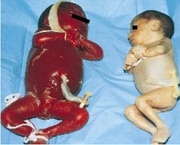
🔍 Figure: Live twin newborns affected by Twin-Twin Transfusion Syndrome (TTTS). The left twin (recipient) is plethoric, ruddy, and appears polycythemic due to hypervolemia and increased red cell mass. The right twin (donor) is pale, small, and anemic due to chronic blood loss to the co-twin via placental vascular anastomoses.
💡 Examiner instruction (interactive): The candidate will be asked to interpret the clinical photograph (donor anemia vs recipient polycythemia), explain the pathophysiology (unbalanced AV anastomoses in monochorionic placenta), stage TTTS using Quintero criteria, describe the Solomon laser technique, and outline immediate neonatal management (CBC, partial exchange transfusion for polycythemia, RBC transfusion for anemia, cardiac and neurological follow-up).
🔍 Examiner Questions (interactive) – Click to reveal model answers
❓ Q1 (Examiner): “Describe the findings in the image. Which twin is the donor and which is the recipient, and why?”
✅ Candidate's structured answer:
• Findings: Left twin – plethoric, ruddy complexion (polycythemic). Right twin – pale, small (anemic). Striking color discordance.
• Recipient (left): Polycythemic, hypervolemic due to receiving blood from donor.
• Donor (right): Anemic, hypovolemic, growth-restricted due to chronic blood loss to recipient.
• Diagnosis: Twin-Twin Transfusion Syndrome (TTTS) – confirmed by postnatal appearance and history of in-utero laser treatment.
• Findings: Left twin – plethoric, ruddy complexion (polycythemic). Right twin – pale, small (anemic). Striking color discordance.
• Recipient (left): Polycythemic, hypervolemic due to receiving blood from donor.
• Donor (right): Anemic, hypovolemic, growth-restricted due to chronic blood loss to recipient.
• Diagnosis: Twin-Twin Transfusion Syndrome (TTTS) – confirmed by postnatal appearance and history of in-utero laser treatment.
❓ Q2 (Examiner): “Describe the pathophysiology of TTTS. What placental vascular connections are responsible?”
✅ Candidate's answer:
• Monochorionic twins share a single placenta with vascular anastomoses (arterio-arterial, veno-venous, arterio-venous).
• TTTS results from unbalanced deep arterio-venous (AV) anastomoses without compensatory superficial bidirectional flow.
• Blood is shunted from donor (via AV anastomosis) to recipient → donor becomes hypovolemic, anemic, growth-restricted, oligohydramnios.
• Recipient becomes hypervolemic, polycythemic, cardiac overload → polyhydramnios, cardiomegaly, hydrops, high-output failure.
• This explains the clinical appearance: donor pale (anemia), recipient ruddy (polycythemia).
• Monochorionic twins share a single placenta with vascular anastomoses (arterio-arterial, veno-venous, arterio-venous).
• TTTS results from unbalanced deep arterio-venous (AV) anastomoses without compensatory superficial bidirectional flow.
• Blood is shunted from donor (via AV anastomosis) to recipient → donor becomes hypovolemic, anemic, growth-restricted, oligohydramnios.
• Recipient becomes hypervolemic, polycythemic, cardiac overload → polyhydramnios, cardiomegaly, hydrops, high-output failure.
• This explains the clinical appearance: donor pale (anemia), recipient ruddy (polycythemia).
❓ Q3 (Examiner): “What is the Quintero staging system for TTTS? Where would this pregnancy have been staged prenatally?”
✅ Candidate's answer:
• Quintero Stages:
- Stage I: Oligo-poly sequence (donor MVP <2 cm, recipient >8 cm), donor bladder visible.
- Stage II: Donor bladder not visible.
- Stage III: Abnormal Doppler (AEDF, reverse a-wave).
- Stage IV: Hydrops (ascites, pericardial effusion, pleural effusion).
- Stage V: Intrauterine demise of one or both twins.
• Given that the pregnancy required laser therapy and twins survived with significant discordance, it was likely at least Stage II or III (possibly Stage IV if hydrops was present).
• Quintero Stages:
- Stage I: Oligo-poly sequence (donor MVP <2 cm, recipient >8 cm), donor bladder visible.
- Stage II: Donor bladder not visible.
- Stage III: Abnormal Doppler (AEDF, reverse a-wave).
- Stage IV: Hydrops (ascites, pericardial effusion, pleural effusion).
- Stage V: Intrauterine demise of one or both twins.
• Given that the pregnancy required laser therapy and twins survived with significant discordance, it was likely at least Stage II or III (possibly Stage IV if hydrops was present).
❓ Q4 (Examiner): “What is the Solomon technique of fetoscopic laser photocoagulation? Why is it preferred?”
✅ Candidate's answer:
• Solomon technique: After selective coagulation of individual anastomoses, a continuous laser line is drawn along the entire vascular equator from one placental margin to the other, destroying any missed small anastomoses.
• Advantages:
- Reduces risk of recurrent TTTS (2-10% → <3%).
- Reduces risk of post-laser Twin Anemia-Polycythemia Sequence (TAPS).
- No increase in PPROM or preterm delivery.
- Improves overall survival and neurological outcomes.
• This procedure is performed fetoscopically under ultrasound guidance at 16-26 weeks.
• Solomon technique: After selective coagulation of individual anastomoses, a continuous laser line is drawn along the entire vascular equator from one placental margin to the other, destroying any missed small anastomoses.
• Advantages:
- Reduces risk of recurrent TTTS (2-10% → <3%).
- Reduces risk of post-laser Twin Anemia-Polycythemia Sequence (TAPS).
- No increase in PPROM or preterm delivery.
- Improves overall survival and neurological outcomes.
• This procedure is performed fetoscopically under ultrasound guidance at 16-26 weeks.
❓ Q5 (Examiner): “What are the specific neonatal complications seen in the donor vs recipient twin after birth?”
✅ Candidate's answer:
• Donor twin (pale, anemic):
- Anemia (low Hb, HCT) – may require RBC transfusion.
- Hypovolemia, hypotension.
- Growth restriction / low birth weight.
- Hypoglycemia (due to poor glycogen stores).
- Thrombocytopenia (possible).
- Risk of intraventricular hemorrhage (due to ischemia).
• Recipient twin (ruddy, polycythemic):
- Polycythemia (HCT >65%) → hyperviscosity.
- Hyperbilirubinemia (jaundice) due to increased RBC breakdown.
- Hypoglycemia (less common than donor).
- Cardiac dysfunction: hypertrophic cardiomyopathy, pulmonary hypertension, tricuspid regurgitation.
- Renal dysfunction (due to hyperviscosity).
- Risk of stroke, NEC (due to hyperviscosity).
• Donor twin (pale, anemic):
- Anemia (low Hb, HCT) – may require RBC transfusion.
- Hypovolemia, hypotension.
- Growth restriction / low birth weight.
- Hypoglycemia (due to poor glycogen stores).
- Thrombocytopenia (possible).
- Risk of intraventricular hemorrhage (due to ischemia).
• Recipient twin (ruddy, polycythemic):
- Polycythemia (HCT >65%) → hyperviscosity.
- Hyperbilirubinemia (jaundice) due to increased RBC breakdown.
- Hypoglycemia (less common than donor).
- Cardiac dysfunction: hypertrophic cardiomyopathy, pulmonary hypertension, tricuspid regurgitation.
- Renal dysfunction (due to hyperviscosity).
- Risk of stroke, NEC (due to hyperviscosity).
❓ Q6 (Examiner): “How would you manage the polycythemic recipient twin?”
✅ Candidate's answer:
• Diagnosis: Peripheral venous or arterial hematocrit >65%.
• Symptomatic polycythemia (lethargy, poor feeding, respiratory distress, jaundice, hypoglycemia, thrombocytopenia) → partial exchange transfusion (PET).
• Asymptomatic with HCT >65-70% → observation vs PET (controversial).
• PET procedure: Replace 10-20 mL/kg of blood with normal saline or plasma, in 5-10 mL aliquots. Reduce HCT to 55-60%.
• Monitor: Blood glucose, bilirubin (risk of hyperbilirubinemia), hydration, urine output.
• Cardiac assessment: Echocardiogram for pulmonary hypertension and myocardial function.
• Diagnosis: Peripheral venous or arterial hematocrit >65%.
• Symptomatic polycythemia (lethargy, poor feeding, respiratory distress, jaundice, hypoglycemia, thrombocytopenia) → partial exchange transfusion (PET).
• Asymptomatic with HCT >65-70% → observation vs PET (controversial).
• PET procedure: Replace 10-20 mL/kg of blood with normal saline or plasma, in 5-10 mL aliquots. Reduce HCT to 55-60%.
• Monitor: Blood glucose, bilirubin (risk of hyperbilirubinemia), hydration, urine output.
• Cardiac assessment: Echocardiogram for pulmonary hypertension and myocardial function.
❓ Q7 (Examiner): “How would you manage the anemic donor twin?”
✅ Candidate's answer:
• Diagnosis: Low Hb/HCT for gestational age. Cord Hb may be <12 g/dL.
• Symptomatic anemia (pallor, tachycardia, poor perfusion, apnea, poor weight gain) → packed red blood cell transfusion (10-15 mL/kg).
• Asymptomatic mild anemia – may observe with iron supplementation later.
• Monitor: Hemoglobin, reticulocyte count, blood pressure, urine output.
• Supportive: Ensure adequate nutrition (may need IV fluids initially), monitor for hypoglycemia, hypothermia.
• Diagnosis: Low Hb/HCT for gestational age. Cord Hb may be <12 g/dL.
• Symptomatic anemia (pallor, tachycardia, poor perfusion, apnea, poor weight gain) → packed red blood cell transfusion (10-15 mL/kg).
• Asymptomatic mild anemia – may observe with iron supplementation later.
• Monitor: Hemoglobin, reticulocyte count, blood pressure, urine output.
• Supportive: Ensure adequate nutrition (may need IV fluids initially), monitor for hypoglycemia, hypothermia.
❓ Q8 (Examiner): “What are TAPS and recurrent TTTS? How would you diagnose them postnatally?”
✅ Candidate's answer:
• TAPS (Twin Anemia-Polycythemia Sequence): Chronic transfusion through small residual anastomoses after laser. Present as severe anemia in donor and polycythemia in recipient without oligo-poly sequence.
- Postnatal diagnosis: Hb discordance >8 g/dL, reticulocyte ratio >1.7, HCT discordance >20%.
- May require transfusion for donor and PET for recipient.
• Recurrent TTTS: Recurrence of oligo-poly sequence after laser due to missed or recanalized anastomoses. Rare (2-10%).
- Postnatal signs: The donor would have growth restriction, oligohydramnios history (prenatal); postnatal anemia and polycythemia as above.
• TAPS (Twin Anemia-Polycythemia Sequence): Chronic transfusion through small residual anastomoses after laser. Present as severe anemia in donor and polycythemia in recipient without oligo-poly sequence.
- Postnatal diagnosis: Hb discordance >8 g/dL, reticulocyte ratio >1.7, HCT discordance >20%.
- May require transfusion for donor and PET for recipient.
• Recurrent TTTS: Recurrence of oligo-poly sequence after laser due to missed or recanalized anastomoses. Rare (2-10%).
- Postnatal signs: The donor would have growth restriction, oligohydramnios history (prenatal); postnatal anemia and polycythemia as above.
❓ Q9 (Examiner): “What long-term follow-up is required for TTTS survivors?”
✅ Candidate's answer:
• Neurodevelopmental follow-up: Risk of cerebral palsy (8-15%), cognitive delay, hearing/vision impairment. Serial developmental assessments, early intervention services.
• Cardiac follow-up: Recipient twins may have pulmonary hypertension, hypertrophic cardiomyopathy, diastolic dysfunction. Serial echocardiograms in infancy.
• Growth monitoring: Donor may have postnatal catch-up growth; monitor for failure to thrive.
• Hematological: Late anemia or polycythemia is rare; iron studies if persistent anemia.
• Parental counseling: Long-term support, early intervention, and school readiness assessments.
• Neurodevelopmental follow-up: Risk of cerebral palsy (8-15%), cognitive delay, hearing/vision impairment. Serial developmental assessments, early intervention services.
• Cardiac follow-up: Recipient twins may have pulmonary hypertension, hypertrophic cardiomyopathy, diastolic dysfunction. Serial echocardiograms in infancy.
• Growth monitoring: Donor may have postnatal catch-up growth; monitor for failure to thrive.
• Hematological: Late anemia or polycythemia is rare; iron studies if persistent anemia.
• Parental counseling: Long-term support, early intervention, and school readiness assessments.
❓ Q10 (Examiner): “What other conditions can cause marked color discordance between newborn twins?”
✅ Candidate's answer:
• Twin Anemia-Polycythemia Sequence (TAPS) – without polyhydramnios/oligohydramnios.
• Selective intrauterine growth restriction (sIUGR) – donor small, but anemia not always present; color discordance less dramatic.
• Acute fetomaternal or twin-to-twin hemorrhage at delivery.
• Dizygotic twins with different genetic hemoglobinopathies (e.g., one twin with alpha thalassemia – pale, the other normal).
• Infection (donor septicemic – pale; recipient not infected).
• Postnatal blood loss (traumatic delivery) affecting one twin.
• In this case, history of in-utero laser for TTTS makes TTTS/TAPS the most likely diagnosis.
• Twin Anemia-Polycythemia Sequence (TAPS) – without polyhydramnios/oligohydramnios.
• Selective intrauterine growth restriction (sIUGR) – donor small, but anemia not always present; color discordance less dramatic.
• Acute fetomaternal or twin-to-twin hemorrhage at delivery.
• Dizygotic twins with different genetic hemoglobinopathies (e.g., one twin with alpha thalassemia – pale, the other normal).
• Infection (donor septicemic – pale; recipient not infected).
• Postnatal blood loss (traumatic delivery) affecting one twin.
• In this case, history of in-utero laser for TTTS makes TTTS/TAPS the most likely diagnosis.
❓ Q11 (Examiner): “How is TTTS diagnosed prenatally? What screening is recommended for monochorionic twins?”
✅ Candidate's answer:
• Diagnosis (ultrasound): Monochorionic diamniotic twins + oligohydramnios in donor (MVP <2 cm) + polyhydramnios in recipient (MVP >8 cm). Donor bladder not visible in advanced stages.
• Screening: Serial ultrasounds every 2 weeks starting at 16 weeks. Assess: amniotic fluid, bladder filling, growth discordance, Dopplers (UA, MCA, DV), cardiac function.
• TTTS typically presents between 16-26 weeks.
• Monochorionicity confirmed by: Single placenta, thin intertwin membrane (T-sign), same sex.
• Diagnosis (ultrasound): Monochorionic diamniotic twins + oligohydramnios in donor (MVP <2 cm) + polyhydramnios in recipient (MVP >8 cm). Donor bladder not visible in advanced stages.
• Screening: Serial ultrasounds every 2 weeks starting at 16 weeks. Assess: amniotic fluid, bladder filling, growth discordance, Dopplers (UA, MCA, DV), cardiac function.
• TTTS typically presents between 16-26 weeks.
• Monochorionicity confirmed by: Single placenta, thin intertwin membrane (T-sign), same sex.
❓ Q12 (Examiner): “How will you counsel the parents after this delivery regarding the twins’ appearance and prognosis?”
✅ Candidate's answer:
• “The twins have different colors because of TTTS – one twin (pale) gave blood to the other twin (ruddy) through the placenta. This was treated with laser surgery during pregnancy.”
• “The pale twin has low red blood cells (anemia) and may need a transfusion to improve her color and energy. The ruddy twin has too many red blood cells (polycythemia) and may need a partial exchange transfusion to reduce the blood thickness.”
• “Both twins will be monitored for jaundice (yellowing), heart function, brain development, and growth.”
• “Most twins do very well, but there is a small risk (about 10-15%) of long-term developmental issues or cerebral palsy. We will follow them closely in our high-risk clinic.”
• “This was nobody’s fault – it is a complication of identical twins sharing a placenta.”
• “You will have support from our neonatology, cardiology, neurology, and early intervention teams.”
• “The twins have different colors because of TTTS – one twin (pale) gave blood to the other twin (ruddy) through the placenta. This was treated with laser surgery during pregnancy.”
• “The pale twin has low red blood cells (anemia) and may need a transfusion to improve her color and energy. The ruddy twin has too many red blood cells (polycythemia) and may need a partial exchange transfusion to reduce the blood thickness.”
• “Both twins will be monitored for jaundice (yellowing), heart function, brain development, and growth.”
• “Most twins do very well, but there is a small risk (about 10-15%) of long-term developmental issues or cerebral palsy. We will follow them closely in our high-risk clinic.”
• “This was nobody’s fault – it is a complication of identical twins sharing a placenta.”
• “You will have support from our neonatology, cardiology, neurology, and early intervention teams.”
❓ Q13 (Examiner): “What is the recurrence risk of TTTS in future pregnancies?”
✅ Candidate's answer:
• Recurrence risk is very low (<1%).
• TTTS occurs only in monochorionic twins (identical twins). The chance of having another monochorionic twin pregnancy is the same as the general population (~1 in 250).
• The specific abnormal vascular anastomoses causing TTTS are sporadic and not inherited.
• However, future pregnancies should have early ultrasound to determine chorionicity (if twins) and serial surveillance.
• If the patient has a singleton pregnancy, no increased risk.
• Reassure parents: “This was a chance event and is very unlikely to happen again.”
• Recurrence risk is very low (<1%).
• TTTS occurs only in monochorionic twins (identical twins). The chance of having another monochorionic twin pregnancy is the same as the general population (~1 in 250).
• The specific abnormal vascular anastomoses causing TTTS are sporadic and not inherited.
• However, future pregnancies should have early ultrasound to determine chorionicity (if twins) and serial surveillance.
• If the patient has a singleton pregnancy, no increased risk.
• Reassure parents: “This was a chance event and is very unlikely to happen again.”
❓ Q14 (Examiner): “What findings would you expect on placental examination after delivery in TTTS treated with laser?”
✅ Candidate's answer:
• Single monochorionic placenta.
• Evidence of fetoscopic laser sites – visible coagulated marks along the vascular equator (Solomon technique).
• Color dye injection (if performed) shows separate placental vascular territories with no crossing vessels.
• No residual large AV anastomoses (complete ablation).
• May see small residual anastomoses if TAPS developed.
• Unequal placental sharing – donor’s placental share may be smaller.
• Placental examination confirms the diagnosis and effectiveness of laser therapy.
• Single monochorionic placenta.
• Evidence of fetoscopic laser sites – visible coagulated marks along the vascular equator (Solomon technique).
• Color dye injection (if performed) shows separate placental vascular territories with no crossing vessels.
• No residual large AV anastomoses (complete ablation).
• May see small residual anastomoses if TAPS developed.
• Unequal placental sharing – donor’s placental share may be smaller.
• Placental examination confirms the diagnosis and effectiveness of laser therapy.
🗣️ Examiner's probing / high-yield points:
• "Which twin is pale and which is ruddy?" → Donor = pale (anemic), Recipient = ruddy (polycythemic).
• "What is the Quintero staging?" → Stages I-V based on fluid, bladder, Doppler, hydrops, demise.
• "What is the Solomon technique?" → Coagulation of entire vascular equator to prevent residual anastomoses.
• "What is the treatment for symptomatic polycythemia?" → Partial exchange transfusion.
• "What is the treatment for symptomatic anemia?" → Packed RBC transfusion.
• "What is TAPS?" → Twin anemia-polycythemia sequence – post-laser complication, no fluid discordance.
• "What is the risk of cerebral palsy in TTTS survivors?" → 8-15% after laser.
• "Which twin is pale and which is ruddy?" → Donor = pale (anemic), Recipient = ruddy (polycythemic).
• "What is the Quintero staging?" → Stages I-V based on fluid, bladder, Doppler, hydrops, demise.
• "What is the Solomon technique?" → Coagulation of entire vascular equator to prevent residual anastomoses.
• "What is the treatment for symptomatic polycythemia?" → Partial exchange transfusion.
• "What is the treatment for symptomatic anemia?" → Packed RBC transfusion.
• "What is TAPS?" → Twin anemia-polycythemia sequence – post-laser complication, no fluid discordance.
• "What is the risk of cerebral palsy in TTTS survivors?" → 8-15% after laser.
📘 Twin-Twin Transfusion Syndrome (TTTS) – Core Revision for TOACS
🔍 Definition
Unbalanced placental AV anastomoses in monochorionic diamniotic twins → donor hypovolemia/anemia, recipient hypervolemia/polycythemia.
Unbalanced placental AV anastomoses in monochorionic diamniotic twins → donor hypovolemia/anemia, recipient hypervolemia/polycythemia.
📊 Quintero Staging
I: oligo-poly, donor bladder visible. II: donor bladder not seen. III: abnormal Doppler. IV: hydrops. V: demise.
I: oligo-poly, donor bladder visible. II: donor bladder not seen. III: abnormal Doppler. IV: hydrops. V: demise.
🩺 Fetal Treatment
Fetoscopic laser photocoagulation (FLP) – Solomon technique (coagulation of entire vascular equator). Preferred for Stage II-IV.
Fetoscopic laser photocoagulation (FLP) – Solomon technique (coagulation of entire vascular equator). Preferred for Stage II-IV.
👶🏻 Neonatal Findings
Donor: pale, anemic, SGA. Recipient: ruddy/plethoric, polycythemic, hypertensive, cardiac dysfunction.
Donor: pale, anemic, SGA. Recipient: ruddy/plethoric, polycythemic, hypertensive, cardiac dysfunction.
⚕️ Neonatal Management
Donor: RBC transfusion. Recipient: partial exchange transfusion. Both: monitor bilirubin, glucose, echo, cranial US.
Donor: RBC transfusion. Recipient: partial exchange transfusion. Both: monitor bilirubin, glucose, echo, cranial US.
📈 Outcomes & Follow-up
Survival after laser: 75-85% (≥1 twin), 50-60% (both). NDI (CP) 8-15%. Long-term cardiac & neurodevelopmental follow-up.
Survival after laser: 75-85% (≥1 twin), 50-60% (both). NDI (CP) 8-15%. Long-term cardiac & neurodevelopmental follow-up.
⭐ High-yield pearls for TOACS (TTTS):
• Classic clinical sign: One plethoric/ruddy twin (recipient), one pale/anemic twin (donor).
• Donor = pale, anemic, small. Recipient = ruddy, polycythemic, large.
• Laser is superior to amnioreduction. Solomon technique reduces recurrence/TAPS.
• Neonatal emergency: Symptomatic polycythemia (PET) and severe anemia (RBC transfusion).
• Postnatal monitoring: Echo for pulmonary hypertension, cranial US for IVH/PVL, neurodevelopmental follow-up.
• Recurrence risk <1%.
• Classic clinical sign: One plethoric/ruddy twin (recipient), one pale/anemic twin (donor).
• Donor = pale, anemic, small. Recipient = ruddy, polycythemic, large.
• Laser is superior to amnioreduction. Solomon technique reduces recurrence/TAPS.
• Neonatal emergency: Symptomatic polycythemia (PET) and severe anemia (RBC transfusion).
• Postnatal monitoring: Echo for pulmonary hypertension, cranial US for IVH/PVL, neurodevelopmental follow-up.
• Recurrence risk <1%.
🗣️ Candidate's role-play & examiner feedback
💬 To the candidate (role‑play): You will be asked the 14 questions from the Examiner Q&A tab (including clinical photograph interpretation, donor/recipient identification, pathophysiology, Quintero staging, laser therapy, and neonatal management of anemia and polycythemia). Provide concise, evidence‑based answers. Examiner may ask you to demonstrate understanding of partial exchange transfusion. Use structured points and demonstrate empathy when counseling parents.
📝 Examiner Marking Grid (TTTS – TOACS station):
- ✅ Correctly identifies plethoric twin = recipient (polycythemic) and pale twin = donor (anemic)
- ✅ Explains pathophysiology (unbalanced AV anastomoses, donor→recipient transfusion)
- ✅ Stages TTTS using Quintero criteria
- ✅ Describes Solomon laser technique (coagulation of entire vascular equator)
- ✅ Outlines neonatal management: donor – RBC transfusion; recipient – partial exchange transfusion
- ✅ Lists complications: polycythemia, anemia, hyperbilirubinemia, cardiac dysfunction, NDI
- ✅ Discusses long-term follow-up (cardiology, neurology, early intervention)
- ✅ States recurrence risk (<1%) and provides appropriate parental counseling
- ✅ Recognizes TAPS (twin anemia-polycythemia sequence) as post-laser complication
- ✅ Understands role of placental examination (laser marks, separate vascular territories)
📚 Key references: Nelson Textbook of Pediatrics 22e (Chapter 118 – Fetal Intervention and Surgery), Quintero staging, Eurofetus trial, Solomon trial, CPSP guidelines.