🦵 TOACS FCPS Station · Cover-Up Test to Differentiate Blount Disease
📷 Clinical Imaging – Cover-Up Test (Blount Disease)
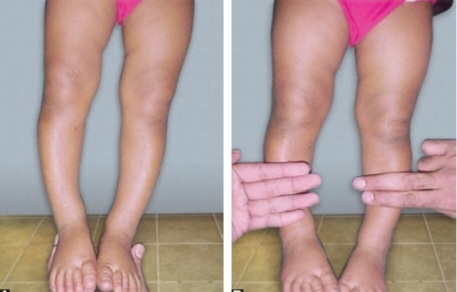
🔍 Key features of the Cover-Up Test:
- ✓ Lateral knee radiograph – with knee extended
- ✓ Assesses femoral-tibial relationship
- ✓ Positive cover-up test – distal femur overlaps the tibia
- ✓ Indicates tibial torsion or Blount disease
- ✓ Helps differentiate Blount from physiologic bowing
📋 Clinical scenario (examiner prompt)
A 2‑year‑old child is brought to the clinic because of bowlegs (genu varum) that have been progressive over the past 6 months. The child is obese (BMI >95th percentile) and began walking early. On examination, there is lateral thrust on walking and a varus deformity of both knees. A lateral radiograph of the knee shows a "cover-up" sign – the distal femoral condyle overlaps the proximal tibia (see image). The metaphyseal-diaphyseal angle (MDA) is 16°.
🧑⚕️ Examiner tasks · TOACS
1. Identify the diagnosis from the clinical image and context.
2. Describe the clinical features (progressive genu varum, obesity, lateral thrust, metaphyseal-diaphyseal angle >11°).
3. Explain the cover-up test (lateral radiograph, femoral overlap of tibia, indicates Blount disease).
4. Discuss management (bracing vs surgery – guided growth or osteotomy).
🎯 Expected answers (for examiners)
- • Diagnosis: Infantile Blount disease (tibia vara)
- • Clinical features: Progressive genu varum in a child >2 years; obesity; early walking; lateral thrust on gait; internal tibial torsion; metaphyseal-diaphyseal angle (MDA) >11° (normal <9°)
- • Cover-up test (Langenskiöld): Lateral knee radiograph with knee extended. Positive if the distal femoral condyle overlaps the tibial metaphysis (due to tibial torsion). Negative in physiologic genu varum (no overlap).
- • Classification (Langenskiöld): Stages I-VI based on radiographic severity (metaphyseal changes, physeal irregularity, beaking, fragmentation).
- • Management: Stage I/II in children <3 years → bracing (KAFO) with medial upright. Stage III+ or >3 years → surgery (guided growth – tension band plate, or high tibial osteotomy).
• Purpose: Differentiate Blount disease from physiologic bowing
• Technique: Lateral knee radiograph, knee extended
• Positive: Distal femur overlaps the tibia → Blount disease
• Negative: No overlap → physiologic genu varum
• Associated: Tibial torsion, varus, lateral thrust
• Treatment: Bracing (KAFO) vs guided growth/osteotomy
⚡ Quick FCPS‑style MCQ
A 2.5-year-old obese child with progressive genu varum has a positive cover-up test on lateral knee radiograph. The most likely diagnosis is:
A. Physiologic genu varum B. Blount disease (tibia vara) C. Rickets D. Genu valgum📌 Topic summary · Cover-Up Test for Blount Disease
Blount disease (tibia vara)
Progressive genu varum, obesity
Femoral overlap of tibia
>11° indicates Blount
KAFO bracing
Guided growth or osteotomy
| Feature | Blount Disease | Physiologic Genu Varum |
|---|---|---|
| Age of onset | Usually >2 years | Infancy (0-2 years) |
| Progression | Progressive | Resolves with growth |
| Obesity | Common | Not typical |
| Lateral thrust | Present | Absent |
| Cover-up test | Positive (femoral overlap) | Negative |
| MDA (metaphyseal-diaphyseal angle) | >11° | <9° |
| Treatment | Bracing or surgery | Observation |