🧬 TOACS FCPS Station · Facial Angiofibromas in Tuberous Sclerosis
📷 Clinical Photograph – Facial Angiofibromas
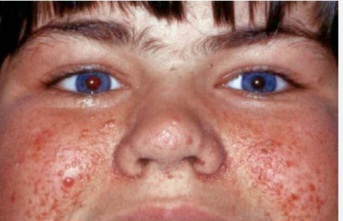
🔍 Key clinical features:
- ✓ Multiple erythematous papules/nodules – on cheeks, nose, chin
- ✓ Butterfly distribution – bilateral, symmetrical
- ✓ Major diagnostic criterion – ≥3 facial angiofibromas or forehead plaque
- ✓ Associated with TSC – TSC1/TSC2, mTOR overactivation
- ✓ Typically appear in childhood – may increase in number/size with age
📋 Clinical scenario (examiner prompt)
A 10‑year‑old child is brought to the dermatology clinic with reddish bumps on the face that have been increasing in number over the past 2 years. The lesions are on the cheeks and nose in a butterfly distribution. The child has a history of seizures since infancy and developmental delay. On examination, there are multiple erythematous papules and small nodules on the cheeks, nasolabial folds, and chin. There are also hypopigmented ash‑leaf macules on the trunk and a shagreen patch on the lower back.
🧑⚕️ Examiner tasks · TOACS
1. Identify the diagnosis from the clinical image and context.
2. Describe the clinical features (facial angiofibromas, butterfly distribution, associated with seizures, ash-leaf macules, shagreen patch).
3. Explain the underlying condition (tuberous sclerosis complex, TSC1/TSC2, mTOR pathway).
4. Discuss diagnostic criteria and management (major/minor criteria, topical rapamycin, everolimus, surveillance).
🎯 Expected answers (for examiners)
- • Diagnosis: Tuberous sclerosis complex (TSC) – facial angiofibromas
- • Clinical features: Multiple erythematous papules/nodules in butterfly distribution (cheeks, nose, chin); associated with seizures, developmental delay, ash-leaf macules, shagreen patch, ungual fibromas
- • Genetics: TSC1 (9q34, hamartin) or TSC2 (16p13, tuberin) – mTOR overactivation; autosomal dominant, 2/3 de novo
- • Diagnostic criteria (major): ≥3 facial angiofibromas or forehead plaque; hypomelanotic macules (≥3, ≥5mm); shagreen patch; ungual fibromas (≥2); cortical tubers; subependymal nodules; SEGA; cardiac rhabdomyoma; renal angiomyolipoma; LAM
- • Treatment: Topical sirolimus 0.1-1% cream (first-line for facial angiofibromas); laser (pulsed dye, CO2) for refractory; oral everolimus for SEGA, renal AML, refractory seizures
- • Surveillance: MRI brain every 1-3y (SEGA); renal US every 1-3y; echocardiogram until rhabdomyoma regresses; annual ophthalmology
• Appearance: Erythematous papules/nodules, butterfly distribution
• Major criterion for TSC (≥3 lesions or forehead plaque)
• Pathogenesis: mTOR overactivation (TSC1/TSC2 loss)
• First-line treatment: Topical sirolimus (rapamycin) 0.1-1% cream
• Alternative: Laser therapy (pulsed dye, CO2)
• Systemic therapy: Everolimus for associated manifestations
⚡ Quick FCPS‑style MCQ
A child with a history of seizures and developmental delay presents with multiple erythematous papules on the cheeks and nose in a butterfly distribution. The most likely diagnosis and first-line treatment are:
A. Acne vulgaris – topical benzoyl peroxide B. Tuberous sclerosis – topical sirolimus (rapamycin) C. Neurofibromatosis – surgical excision D. Angiofibroma – oral everolimus📌 Topic summary · Facial Angiofibromas in Tuberous Sclerosis
Tuberous sclerosis complex
Facial angiofibromas (butterfly distribution)
TSC1 (hamartin) or TSC2 (tuberin)
mTOR overactivation
≥3 angiofibromas or forehead plaque
Topical sirolimus, laser, everolimus
| Feature | Tuberous Sclerosis – Facial Angiofibromas |
|---|---|
| Genetics | TSC1 (hamartin, 9q34) or TSC2 (tuberin, 16p13) – loss of function → mTOR overactivation |
| Inheritance | Autosomal dominant, 2/3 de novo, high penetrance |
| Facial angiofibromas | Multiple erythematous papules/nodules in butterfly distribution (cheeks, nose, chin); major diagnostic criterion (≥3) |
| Other major features | Hypomelanotic macules (≥3), shagreen patch, ungual fibromas, cortical tubers, subependymal nodules, SEGA, cardiac rhabdomyoma, renal AML, LAM |
| Treatment – Facial angiofibromas | Topical sirolimus (rapamycin) 0.1-1% cream (first-line); pulsed dye laser/CO2 laser for refractory |
| Systemic therapy | Everolimus (mTOR inhibitor) for SEGA, renal AML, refractory seizures |
| Surveillance | MRI brain every 1-3y (SEGA); renal US every 1-3y; ophthalmology annually; echocardiogram (until rhabdomyoma regresses) |