🦷 TOACS FCPS Station · Pegged Teeth in Hypohidrotic Ectodermal Dysplasia
📷 Clinical Photograph – Pegged Teeth (HED)
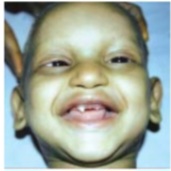
🔍 Key clinical features:
- ✓ Pegged (conical) teeth – small, pointed incisors
- ✓ Hypodontia – missing teeth (partial or complete)
- ✓ Sparse, fine hair – hypotrichosis
- ✓ Anhidrosis – inability to sweat → heat intolerance
- ✓ Characteristic facies – frontal bossing, saddle nose, everted lips
📋 Clinical scenario (examiner prompt)
A 3‑year‑old boy is referred for evaluation of unusual teeth and sparse hair. The mother reports that the child has few teeth and the ones present are small and pointed. He has a history of recurrent fevers without obvious infection, especially in warm weather. On examination, the child has conical (pegged) incisors, thin, sparse scalp hair, frontal bossing, a saddle nose, and thick everted lips. The skin is dry and there is periorbital hyperpigmentation.
🧑⚕️ Examiner tasks · TOACS
1. Identify the diagnosis from the clinical image and context.
2. Describe the clinical features (pegged teeth, sparse hair, anhidrosis, characteristic facies).
3. Explain the underlying condition (hypohidrotic ectodermal dysplasia, EDA/EDAR/EDARADD).
4. Discuss diagnosis and management (dental prostheses, cooling measures, genetic counseling).
🎯 Expected answers (for examiners)
- • Diagnosis: Hypohidrotic ectodermal dysplasia (HED, Christ-Siemens-Touraine syndrome)
- • Clinical features: Triad – hypodontia (conical/pegged teeth, delayed eruption), hypotrichosis (sparse, fine, pale hair), anhidrosis (reduced sweating → heat intolerance, hyperthermia); facial features: frontal bossing, saddle nose, thick everted lips, periorbital hyperpigmentation, dry skin, nail dystrophy
- • Genetics: X-linked recessive (EDA gene, 70%), autosomal dominant (EDAR), autosomal recessive (EDARADD); EDA-ID if with immunodeficiency (NEMO/IKBKG)
- • Diagnosis: Clinical; scalp biopsy (absent/reduced eccrine sweat glands); genetic testing (EDA, EDAR, EDARADD); sweat test
- • Management: Dental prostheses (early by age 2-3 years) for nutrition, speech, self-esteem; cooling measures (avoid heat, air conditioning, cooling vests); emollients for dry skin; artificial tears for dry eyes; treat eczema; genetic counseling
• Appearance: Small, pointed (conical) incisors
• Part of triad: Hypodontia + hypotrichosis + anhidrosis
• Gene: EDA (XLR), EDAR (AD), EDARADD (AR)
• Management: Dental prostheses (early)
• Heat intolerance: Life-threatening → cooling measures
• Genetic counseling: X-linked, AD, AR forms
⚡ Quick FCPS‑style MCQ
A 3-year-old boy with conical (pegged) teeth, sparse hair, and recurrent fevers in warm weather. The most likely diagnosis and first-line management are:
A. Clouston syndrome – nail care B. Hypohidrotic ectodermal dysplasia – dental prostheses and cooling measures C. EEC syndrome – cleft repair D. Witkop syndrome – dental implants📌 Topic summary · Pegged Teeth in Hypohidrotic Ectodermal Dysplasia
Hypohidrotic ED (HED)
Hypodontia, hypotrichosis, anhidrosis
Conical (pegged), missing
EDA (70%)
Dental prostheses, cooling
XLR, AD, AR
| Feature | Hypohidrotic Ectodermal Dysplasia |
|---|---|
| Triad | Hypodontia (conical/pegged teeth), hypotrichosis (sparse hair), anhidrosis (inability to sweat) |
| Facial features | Frontal bossing, saddle nose, thick everted lips, periorbital hyperpigmentation |
| Genetics | X-linked recessive (EDA, 70%), autosomal dominant (EDAR), autosomal recessive (EDARADD) |
| Pathophysiology | Defective NF-κB signaling; impaired development of ectodermal structures |
| Complications | Hyperthermia (heat stroke), feeding difficulties, speech problems, dental caries, dry skin, eczema, recurrent eye infections (lack of tears) |
| Diagnosis | Clinical; scalp biopsy (absent/reduced eccrine glands); genetic testing; sweat test |
| Management – Dental | Early dental prostheses (by age 2-3 years) for nutrition, speech, self-esteem |
| Management – Thermoregulation | Avoid heat, air conditioning, cooling vests, misting fans; educate daycare/school |
| Management – Other | Emollients for dry skin, artificial tears, treat eczema, genetic counseling |
| Differential diagnosis | Hidrotic ED (Clouston – normal sweating), EEC, AEC, Witkop, EDA-ID (with immunodeficiency) |